Blog

What Cancel Culture Has In Common With Medieval Outlawry

Cancel culture is slippery in the taxonomist’s hands, but I think something like columnist Ross Douthat’s definition is about right: “Cancellation, properly understood, refers to an attack on someone’s employment and reputation by a determined collective of critics, based on an opinion or an action that is alleged to be disgraceful and disqualifying.”

This description highlights the differences of function between medieval outlawry and cancel culture today: Outlawry was a formal, legal punishment backed by the threat of violence and usually intended to punish people accused of felony crimes like murder, arson, or conspiracy. Cancel culture has no such legal force. It’s a movement of social censure, and in its quintessential cases—e.g., Justine Sacco or, more recently, David Shor or the woman from The Washington Post Halloween party story—there’s no criminal allegation or, many times, even a lean outside the Overton Window. (The “Central Park Karen,” somewhat unusually among high-profile cancellation stories, is being prosecuted.)

Beyond these distinctions, however, outlawry and cancel culture have much in common: They grow out of the same human impulse of ostracism, the desire to exclude offenders from “respectable” society. They give the broader community permission to attack their targets, whether with physical violence (as in outlawry) or via verbal abuse, doxxing, or threats (as in cancel culture). They oust offenders from their social class (today, typically the professional-managerial class) and deprive them of their normal means of livelihood.
Keep reading

Arizona GOP chair had Twitter account ‘temporarily limited’ for spreading COVID misinformation: report

The medical doctor who runs the Arizona Republican Party had her Twitter account “temporarily limited” for spreading misinformation during the coronavirus pandemic.

“Twitter has ‘temporarily limited’ the account features of Arizona Republican Party Chairwoman Kelli Ward after determining she violated its policy on spreading misleading and ‘potentially harmful’ information about the COVID-19 pandemic,” the Arizona Republic reported Tuesday. “Ward, a physician, has downplayed the severity of the virus’s spread in Arizona, even as caseloads skyrocketed and the state spiraled into a national hot spot.

Keep reading

10 Things To Know About Gary Webb, The Reporter Who Linked The CIA To Crack Cocaine

In August 1996, the San Jose Mercury News published a groundbreaking investigation, a year in the making, written by journalist Gary Webb entitled “Dark Alliance: The Story Behind the Crack Explosion.”

The series examined the origins of crack cocaine in Los Angeles that devastated vulnerable African American neighborhoods. Webb claimed the Contra rebels in Nicaragua were shipping cocaine into the U.S. Crack was then flooding Compton and South-Central Los Angeles in the mid-80s after being turned into crack. Relatively new at the time, crack was a highly addictive substance sold in rocks that could be smoked.

Webb reported that the anti-communist Contra rebels in Nicaragua had played a major role in creating the U.S. cocaine trade. The profits supported their fight against Nicaragua’s revolutionary Sandinista government in the 1980s.

The Contras were right-wing rebel groups backed and funded by the U.S. and active from 1979 to the early ’90s. They opposed the socialist Sandinista government in Nicaragua.

Webb suggested that the Central Intelligence Agency (CIA) knew about the Contras and protected their cocaine trade. The series findings enraged readers, particularly in the Los Angeles African-American community, and led to four major investigations.

The secret flow of drugs and money, Webb reported, had a direct link to the crack epidemic that devastated California’s most vulnerable African American neighborhoods.

Here are 10 things to know about Gary Webb and his report that linked the CIA to crack cocaine.

Keep reading

Democrats Wimp Out on Federal Marijuana Legalization. Thanks, Joe Biden!

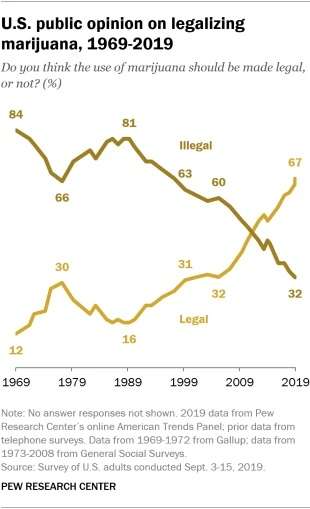
It’s 2020 and the leadership of the Democratic Party still cannot get it together on marijuana legalization, which two-thirds of Americans support.

Pew

According to Pew polling data, support for full legalization crossed the 50 percent threshold back in 2010 and has been growing ever since. Much like support for gay marriage recognition, this seems to be a permanent cultural shift in attitudes.

But unlike the Democratic Party’s embrace of gay marriage, its leadership cannot seem to line up behind marijuana legalization, even as the Black Lives Matter and criminal justice reform movements highlight precisely how the drug war has led to the overpolicing and harassment of black communities.

Marijuana Moment reports that on Monday the Democratic National Committee rejected an amendment to put a plank supporting marijuana legalization into the party’s platform. The final vote against, 50-106, is almost a perfect inversion of the two-thirds of the public who want legalization.

Keep reading

Why the Soviets Sponsored a Doomed Expedition to a Hollow Earth Kingdom

IN DECEMBER OF 1923, TWO unlikely travelers arrived in Darjeeling, India intent on finding what could not possibly exist: Shambhala, a kingdom located inside a hollow earth. Along them trailed Soviet spies, Western occultists and Mongolian rebels, all serving their own agendas. Even with so many eyes on them, their expedition still managed to disappear from the face of the earth for months; when they finally emerged, they had a fascinating story to tell and even more secrets to hide.

The travelers were Nicholas and Helena Roerich, two Russian expatriates traveling under a U.S, flag, which they had hoisted upon a Mongolian spear. As they informed the local authorities in Darjeeling, they were leading a scientific-archaeological expedition aimed at cataloguing the art and culture of Central Asia for the first time. Their eccentric behavior quickly raised some eyebrows: Nicholas Roerich, a famed painter and archaeologist, walked around Darjeeling in the robes of a Dalai Lama, held conspiratorial meetings with Tibetan lamas and introduced himself as an American, even though his accent betrayed his Russian heritage.

Still, the couple’s reputation as paragons of the Western art world as well as their American sponsors persuaded the authorities to let them pass through the city, and into the forbidden Tibetan plateau. However, nobody was aware of the couple’s true destination: the city of Shambhala, a place not to be found in any map.

Shambhala is a fabled city-kingdom of the Himalayas, believed by Buddhists, Hindus and local shamans to exist simultaneously on the physical and the spiritual plane. For millennia, the legend of the underground kingdom played an important role in every Tibetan tradition and eventually, rumors of its existence reached the West.

It so happened that Helena Roerich, a writer and philosopher, had translated in Russian The Secret Doctrine, Madame Blavatsky’s influential esoteric work which first presented Shambhala as a shortcut to enlightenment. The Roerichs came to believe deeply in the Shambhala myth and at some point, while living in New York, Helena received telepathic instructions from “Master Morya”, an otherworldly entity, encouraging the couple to leave the U.S. and seek the city for themselves.

Keep reading

Dr. Anthony Fauci isn’t ‘particularly concerned’ about the safety of Moderna coronavirus vaccine

White House coronavirus advisor Dr. Anthony Fauci said Monday he is “not particularly concerned” about the safety risk of a potential coronavirus vaccine by Moderna, despite the fact that it uses new technology to fight the virus. 

The vaccine, which entered a large phase-three human trial Monday, uses messenger ribonucleic acid, or mRNA molecules, to provoke an immune response to fight the virus. Scientists hope mRNA, which relays genetic instructions from DNA, can be used to train the immune system to recognize and destroy the virus. While early studies show promise, mRNA technology has never been used to make a successful vaccine before.

“It’s a novel technology. We are certainly aware of the fact that there’s not as much experience with this type of platform as there are with other standards,” Fauci, director of the National Institute of Allergy and Infectious Diseases, told reporters on a conference call alongside National Institutes of Health Director Dr. Francis Collins.

Keep reading