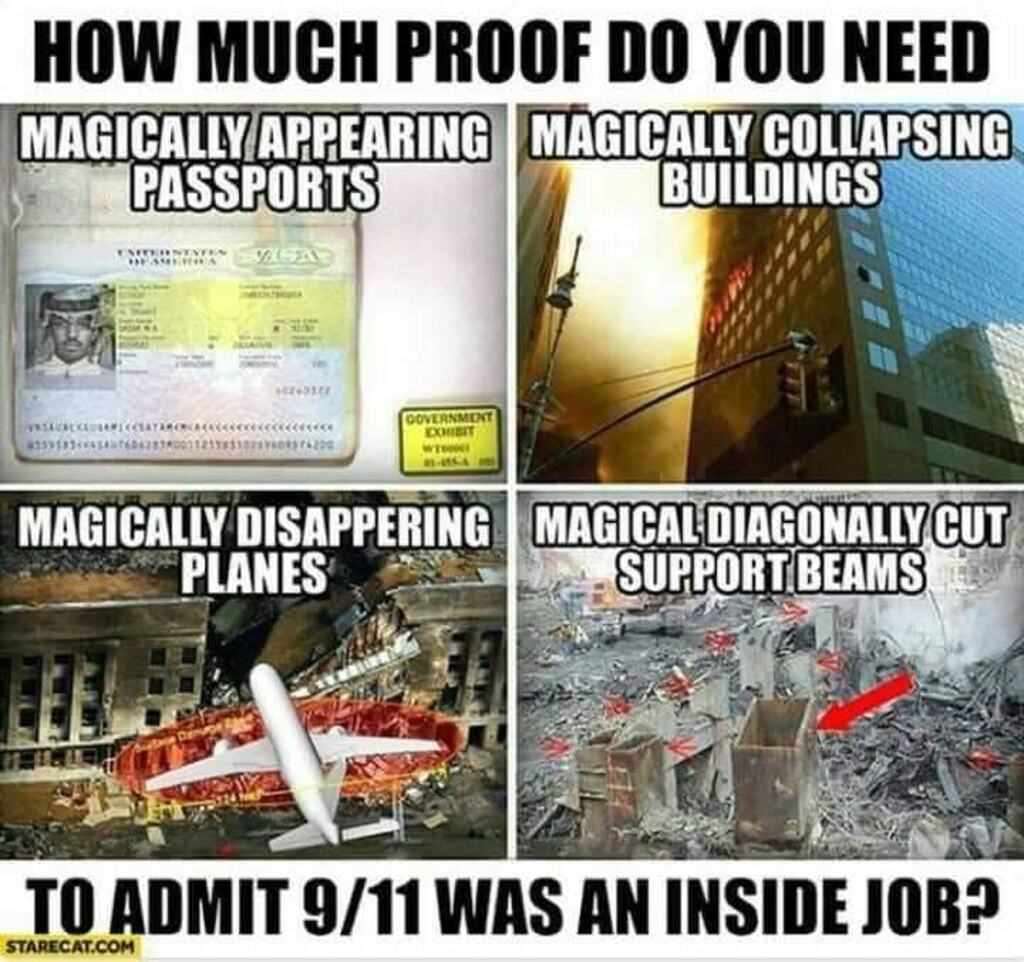
What will it take?


In the clip, Fisher seems confused by questions raised by Rudyk regarding how COVID-19 patients are counted. After Fisher explains this process, Rudyk asserts that the hospitals should become “scary” in their messaging about COVID-19, inflate their total number of COVID-19 patients by counting those who have recovered, and suggest that people will die without taking one of the controversial COVID-19 vaccines.
The video was obtained from an internal source at Novant Health, and was recorded earlier this week. The clip features three speakers: Rudyk, Fisher, and Shelbourn Stevens, president of who promises to speak with MacDonald about inflating the count of COVID-19 patients “offline.”
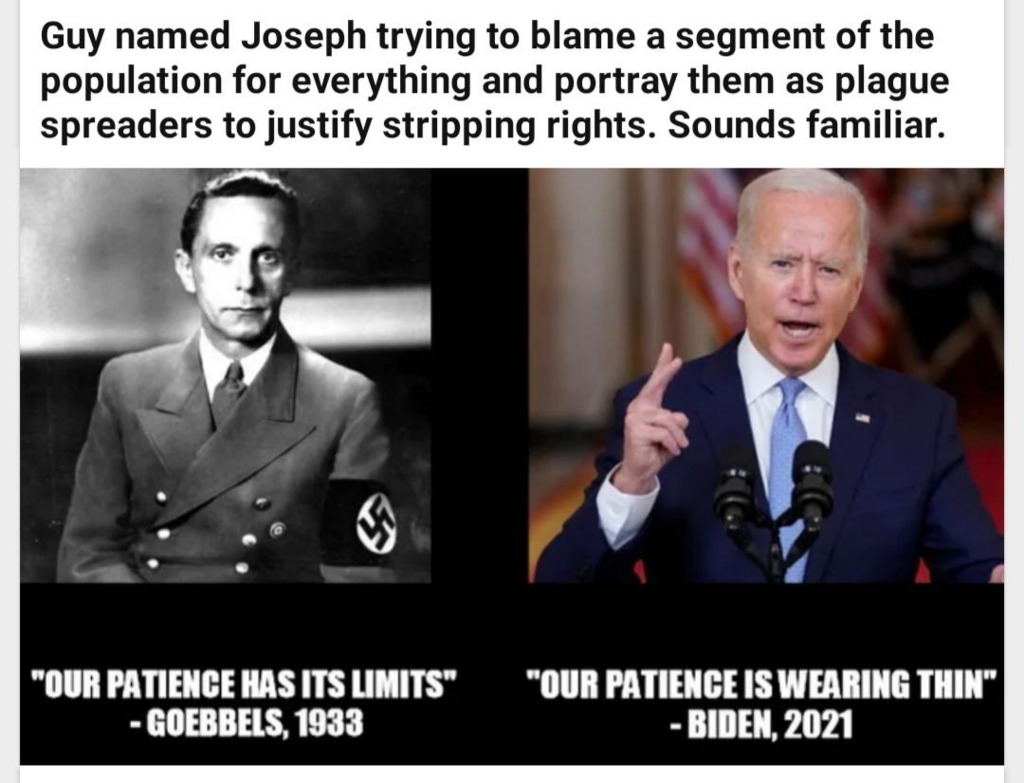
On Thursday evening, President Joe Biden unveiled two executive orders that could mandate COVID vaccinations for millions of working Americans in both the public and private spheres. But absent from these mandates are similar requirements for members of Congress, federal judges, or their staffers.
Biden’s executive orders would unilaterally require vaccination for federal employees, the military, and government contractors. The president also asked Occupational Safety and Health Administration (OSHA) to require that firms with over 100 employees either mandate vaccination or weekly CCP virus tests. In total, these mandates could affect over 100 million American workers, making it one of the widest-reaching vaccine mandates in world history.
Biden wrote, “It is the policy of my Administration to halt the spread of coronavirus disease 2019 (COVID-19), including the B.1.617.2 (Delta) variant, by relying on the best available data and science-based public health measures.”
The order continued, “The Centers for Disease Control and Prevention (CDC) within the Department of Health and Human Services has determined that the best way to slow the spread of COVID-19 and to prevent infection by the Delta variant or other variants is to be vaccinated.”
In the second section, Biden lays out this rigorous policy, requiring all executive agencies to “implement, to the extent consistent with applicable law, a program to require COVID-19 vaccination for all of its Federal employees, with exceptions only as required by law.” Such exemptions are few and strictly defined.
The order would cover civilian employees of executive offices like the State Department and Department of Defense, and would also require all military personnel to receive the vaccine. In total, this no-excuses order would affect millions of civilian and non-civilian federal employees.
The president went beyond this, however, laying out a framework that would require private-sector employers to mandate vaccines or weekly testing for their employees. To achieve this, Biden turned to the Occupational Safety and Health Administration (OSHA), a federal agency tasked with ensuring that companies protect the safety of their employees.


The mass media are churning out articles and news segments commemorating the 20th anniversary of the September 11 attacks, many of them featuring adoring retrospectives of their celebrity president’s actions as a US senator that day. Biden’s ceremonial PR tour to New York City, Pennsylvania and the Pentagon can be expected to receive a great deal of coverage as outrage swells over the president’s controversial new nationwide vaccine mandate.
And it’s all just so very, very stupid. This nation which has spent twenty years weeping about its victimization with Bambi-eyed innocence reacted to 9/11 with wars which killed millions and displaced tens of millions and ushered in an unprecedented new era of military expansionism which has funneled trillions of dollars to some of the worst people in the world.
Compared to the horrors the United States unleashed upon the world under the justification of 9/11, 9/11 itself was a family trip to Disneyland. The death and destruction visited upon Iraq alone dwarfs the 2,977 people killed on 9/11 by orders of magnitude; hell, this was true of the death and destruction the US had been inflicting on Iraq even before 9/11.
In a saner, more emotionally intelligent world, it is those deaths that Americans would be focused on this September the 11th.
Even the respected and dauntless filmmaker Spike Lee could not overcome the awesome wrath of the mainstream media that comes down upon any person of influence who dares challenge the official story of 9/11.
In a span of three days, from August 23rd to 26th, Lee went from staunchly defending his decision to include so-called “9/11 conspiracy theorists” in his eight-hour HBO docuseries, NYC Epicenters 9/11 → 2021½, to removing the entire 30 minutes he had devoted to questioning how the Twin Towers and Building 7 fell. The half-hour was part of the final two-hour episode set to air on the night of the 20th anniversary of 9/11.
Unbeknownst to most people — because only members of the media got to view the episode and declare it unfit for the public to see — the 30 minutes of excised material included far more than just interviews with so-called “fringe architects.” (Actually, there were upwards of 10 architects and engineers, ranging from a San Francisco high-rise architect to a fellow of the Society of Fire Protection Engineers.) There were also interviews with 9/11 family members who believe they have not been told the truth about the murder of their loved ones and with first responders and survivors who witnessed explosions. Along with all those interviews was a wealth of archival footage and radio dispatches from that morning, in which rescuer after rescuer can be heard reporting explosions. (Full disclosure: I was also interviewed for the film.)
Instead of painting a full and accurate picture of the now-excised section, the media seized upon the inclusion of “conspiracy group” Architects & Engineers for 9/11 Truth and our founder Richard Gage — who, in the words of Slate editor Jeremy Stahl, “is responsible for peddling some of the most pernicious and long-running lies about the 9/11 attacks.”
Stahl’s choice of words was clearly intended to imply, falsely, that Gage does not actually believe the view he is presenting but is, rather, knowingly perpetuating a lie for some nefarious purpose. Any person practicing real journalism who has interviewed Gage “multiple times” could not plausibly claim that Gage is lying. What Stahl was practicing was propaganda, the express goal of which was to stop millions of viewers from seeing the half-hour of documentary film that Lee made.
The death blow to Lee’s attempt to shine a light on the Twin Towers’ and Building 7’s controlled demolition appears to have been Stahl’s reporting of statements that Gage made in the past year in which he called the coronavirus pandemic a “hoax” and aired other related views about vaccines and Bill Gates. Stahl also loosely accused Gage of being anti-Semitic — or of condoning anti-Semitism — for having tolerated suggestions, made by an audience member in 2012 and by a podcast host more recently, that Israel’s Mossad was involved in the 9/11 attacks.
Less than 24 hours after Stahl’s Slate article was published, news broke that Lee was “back in the editing room” reexamining the final chapter of the series. One day later, HBO announced that the entire half-hour had been cut.
If Lee had any say in the decision, I suspect he did what he did because he felt he could not defend keeping Gage, nor did he care to, and he didn’t have time for the massive edit that would have been required to remove Gage, who was central to the section. It may be that all of the other attacks did not faze him at all. However, the current narrative is that Lee capitulated to the totality of the media’s condemnation over featuring so-called “conspiracy theorists.”
At the height of the controversy and since, countless articles have been published referring to the controlled demolition theory as “debunked.” These articles either have no links to any sources, or they have links to Popular Mechanics articles from 10 years ago or more, or they have links to the very reports and FAQs issued by the National Institute of Standards and Technology that are disputed by thousands of architects, engineers, and scientists. (By the way, Lee and others make the point that fire isn’t hot enough to melt steel because there was molten metal at Ground Zero, not because the steel needed to melt for the buildings to collapse. This fact, as with all of the evidence of controlled demolition, has not been debunked.)
Okay, okay, let’s all cool our jets here for a minute. I know we’re all worked up about the twentieth anniversary of the 9/11 attacks, and that’s all well and good. But let’s not let our emotions cloud our vision and let today’s commemorations cause us to forget the real horror we must all remain focused on: the Capitol riot this past January.
It is true that losing nearly 3,000 American lives to weaponized passenger jets was pretty bad, but I think we can all agree that this pales in comparison to the earth-shattering terror we all experienced when watching footage of wingnuts wander aimlessly around the Capitol Building for a few hours.
Serious experts agree.
In a July appearance on MSNBC’s ReidOut with Joy Reid, former Bush strategist Matthew Dowd said he felt the Capitol riot was “much worse” than 9/11 and that this is the “most perilous point in time” since the beginning of the American Civil War.
“To me, though there was less loss of life on January 6, January 6 was worse than 9/11, because it’s continued to rip our country apart and get permission for people to pursue autocratic means, and so I think we’re in a much worse place than we’ve been,” Dowd said. “I think we’re in the most perilous point in time since 1861 in the advent of the Civil War.”
“I do too,” Reid replied.


You must be logged in to post a comment.