‘We Already Fought This Battle’: After Public Outcry, Pennsylvania Health Department Will Rethink Plan to Expand Powers

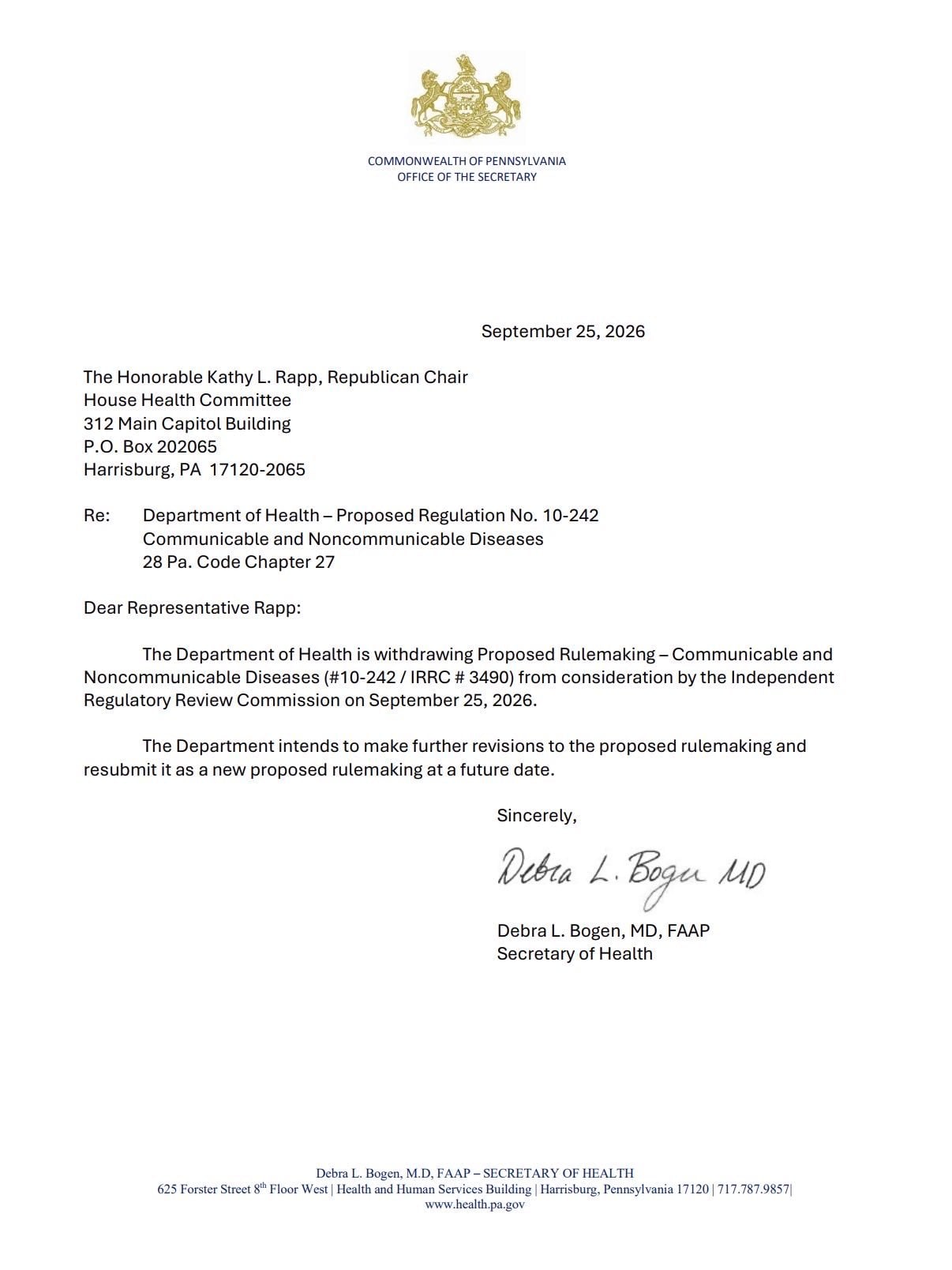
Following a wave of public opposition — including over 10,000 public comments — the Pennsylvania Department of Health has withdrawn its controversial proposal to grant itself substantially expanded powers during disease outbreaks.

The department had sought sweeping changes to Pennsylvania’s disease control regulations that would have allowed state health officials to impose stringent public health measures during outbreaks — including mandating masks, increasing vaccine surveillance and giving health officials access to students without their parents’ consent.

Commenting on the public response, state Sen. Doug Mastriano said in a statement:

“That is an extraordinary response, and a victory for the people of Pennsylvania. The citizens read what the government was proposing, remembered what happened during COVID-19 and spoke out, because we already fought this battle.”

Rather than proposing a bill and debating it in the General Assembly, the health department sought expanded powers by rewriting its regulations, typically a bureaucratic function.

But after the department submitted the proposal to the Independent Regulatory Review Commission and opened it for public comment, more than 10,000 people and organizations submitted comments, the majority opposing the changes, according to Mastriano.

Among those who opposed the changes was a group of state senators who fired off a 40-page letter detailing their objections.

Late last week, the department said it would rewrite and resubmit the proposed changes at a future date.

Keep reading

House Oversight Democrat in Sexual Relationship with Leftist YouTuber Tied to Influencer Program That is Under Investigation by Her Committee: Report

A House Democrat is reportedly in a sexual relationship with a liberal YouTuber at the same time her committee is investigating one of his projects.

Sources Say News’ Juliegrace Brufke, a veteran Capitol Hill reporter previously employed by Axios and The Daily Beast, reported on Thursday that 34-year-old Rep. Yassamin Ansari (D-AZ) has been seeing 24-year-old Jack Cocchiarella while the House Oversight Committee is looking into Chorus’s influencer program.

The Chorus Creator Incubator Program is a leftist nonprofit initiative that pays online influencers like Cocchiarella up to $8,000 per month to spread Democratic propaganda.

Cocchiarella sits on the creative council of Chorus and is listed as a co-founder.

According to Brufke, Ansari and Cocchiarella have been together on several occasions, including at the young leftist’s 24th birthday party last Friday.

More from Brufke:

Ansari was at Cocchiarella’s residence for his 24th birthday party on Friday, according to sources in attendance, with one source describing them as having a flirtatious dynamic with the congresswoman and helping set up ahead of the gathering kicking off.

It was not a one-off, according to other sources.

The pair appeared affectionate at the MS NOW party during White House Correspondents’ Dinner weekend, according to screenshots of text messages from multiple confirmed MS NOW party attendees describing what they had witnessed. Two others confirmed they saw the pair together at the party. One source said Cocchiarella confirmed to them directly that he was involved with “a Democratic congresswoman.”

Both Ansari and Cocchiarella turned up at a MoveOn “Won’t Back Down” event in Phoenix in August. Cocchiarella has also had Ansari on his YouTube show as recently as July.

In some cases, the personal relationships of public officials are no one’s business. But when a member of Congress is DATING a person whose program is under investigation by the legislative body, this should be national news.

Keep reading

Trump Says Inflation Will Pay Off The $40 Trillion Debt “Very Rapidly”

President Trump thinks ‘certain levels’ of inflation could take care of the $40 trillion national debt. 

“You know, inflation. Certain levels of inflation will also pay off that debt very rapidly. Very rapidly,” he told TIME in an interview published Thursday, after the outlet pointed out has grown by about $11 trillion over his five years in office. In response, Trump first blamed Joe Biden, then the Fed, then hinted at a plan he wouldn’t share.

“I know I’m the best in the world,” Trump said. “The best – I don’t want to tell you what those means are, but you can pay off the debt through other means. But the one thing that you can do is pay it off through growth, and we’ve never had growth like this.”

Later he circled back, saying “the growth is going to pay off the debt” and that the Fed’s hikes were “hurting our country more than inflation is hurting our country.”

He didn’t say what level of inflation he had in mind, or whether he wants the Fed to tolerate more of it. Earlier in the same interview, though, he blamed Biden for “the biggest inflation in history” and said he “inherited the greatest inflation in history,” adding that “the only thing I have to get down now is the gas.”

Headline CPI rose 3.4% in the 12 months through August, with core at 2.4%, according to the BLS. On Sept. 16 the Fed raised rates for the first time since July 2023 – a unanimous quarter-point hike to 3.75%-4% that included Trump’s own pick for chair, Kevin Warsh – and penciled in another before year-end. Trump told TIME he “probably would have voted against the board” if he were Warsh, and has called for rates of 1% “or less.”

On Thursday, the day TIME published the interview, the 10-year Treasury yield touched 5.34%, its highest since 2002. It closed at 5.24%.

He’s Floated This Before

None of this is new for the self-described “king of debt.” In May 2016 he told CNBC the US could buy back its own bonds at a discount if rates went up. That was widely read as a default threat, so a few days later he went on CNN to walk it back. “You never have to default because you print the money, I hate to tell you, OK?” he said.

A month before that, he told the Washington Post he could wipe out what was then a $19 trillion debt “over a period of eight years” – a debt that has since more than doubled.

Buybacks are back, too. After the debt crossed $40 trillion and long-dated yields kept climbing, Treasury Secretary Scott Bessent tripled the cap on the first expanded buyback to $6 billion. As we noted at the time, yields surged anyway, since $6 billion barely registers against more than $2 trillion in gross issuance a year.

Bessent, for his part, prefers to talk about growth. In June 2025 he told CBS’s Margaret Brennan that “everything has been alarmist” on inflation and that the US would never default. And the day after Treasury reported the $40 trillion milestone, he went on CNBC to say there was “nothing magic” about the number and “we can grow our way out of that.”

The Part He Left Out

Last year we ran a piece arguing Bessent was effectively putting the national debt on an adjustable-rate mortgage by leaning on floating-rate financing, which also projected the debt would top $40 trillion by the end of fiscal 2026 – it got there in mid-August, about six weeks ahead of schedule.

Back in April 2025, Bloomberg’s Simon White made the case that higher inflation and a weaker dollar – where US policy seemed to be headed – were consistent with a falling debt burden. But he warned that unlike Britain’s post-WWII “beautiful deleveraging,” erratic policymaking could wreck trust in the dollar system, spark capital flight and end up adding to the debt.

Nick Giambruno spelled out the mechanics in July: financial repression, where the government keeps interest rates below inflation and the difference quietly moves wealth from savers to the Treasury. With 9% inflation and 4% rates, he noted, that’s a 5% transfer every year, and it compounds.

It has worked before. A 2011 BIS paper estimated negative real rates wiped out debt worth 2-3% of GDP a year in the US and UK between the late 1940s and the 1970s. But that was under Bretton Woods, with interest-rate caps, captive domestic buyers and capital controls – and the paper found financial repression works best “when accompanied by a steady dose of inflation.”

The catch is that it only works if the Treasury can borrow below the inflation rate. Right now it can’t: the 10-year yields nearly two points more than headline CPI, interest on the debt already runs over $1 trillion a year, and everything that matures gets rolled at today’s rates.

Keep reading

Clinton-Era Laws Passed 30 Years Ago Enabled Trump’s Anti-Immigrant Agenda. Here’s How We Turn the Page.

The more the American public sees of President Donald Trump’s hardline, anti-immigrant policies in action — the deaths, military-style invasions of neighborhoods, and mass detention and deportations — the more his approval on the issue drops.

If this trend sounds familiar, it’s because a similar wave of disapproval played out in Trump’s first term. Despite that backlash, Trump returned to office embracing even more extreme measures.

We must finally confront and uproot the core of the U.S.’s anti-immigrant underbelly, which is largely reflected in the racially motivated notion of criminalization.

Trump was not the first politician to exploit the concept of criminality, and he certainly won’t be the last. Criminalizing narratives are deeply planted in the American psyche, and they have commonly acted as the vessel through which white supremacist rhetoric and policy are ingrained into our culture and laws.

In the late 1980’s, criminalization went mainstream in the form of racist dog whistles, particularly those hinging on vile anti-Blackness deployed by politicians seeking to activate white voters. In the decades since, conservative and liberal leaders alike more purposefully extended this criminality framework to immigration — so much so that it’s now perhaps the primary driver of the public immigration debate.

Consider how Americans of all political stripes are often presented with the binary choice of supporting the “right” type of immigrant. In this oversimplification, immigrants fall into categories like “good” or “bad,” “legal” or “illegal,” “deserving” or “undeserving.”

Trump did not invent these narratives. They’ve underpinned both major parties’ politics of immigration for several decades, despite their basis in fiction and fear-mongering rather than evidence and compassion, or the fact these narratives are weaponized against non-white immigrants who for centuries have disproportionately faced restrictive and punitive policies for the act of seeking relief in this country.

But Trump’s partisan opposition, despite its massive opportunities in the face of unpopular, hardline policies, has repeatedly failed to capture the public’s long-term support on immigration. Too often, Democrats repackage the same old criminalizing narratives — often in softer terms, but always in line with the oversimplified good-or-bad thinking. This lack of imagination is reflected in the nearly annual bipartisan votes to increase funding for federal enforcement agencies like Immigration and Customs Enforcement (ICE) and Customs and Border Protection, as well as Democratic leaders’ messaging and policies.

Take, for example, former President Barack Obama’s push to deport “felons, not families”; Joe Biden squandering his mandate to reverse the cruelty of Trump’s first term by continuing many Trump policies, like Title 42 and the backing of for-profit immigrant detention; or Kamala Harris, in her presidential bid, focusing much of her immigration rhetoric on “securing” the border.

It’s a toxic cycle: The public rightfully disapproves of the atrocities of anti-immigrant policies; in response, liberals roll out unimaginative plans hinged on outdated narratives; and finally, in the vacuum created by the lack of any tangible, pro-immigrant vision, the right recaptures the public’s attention with fear mongering and a sensationalist focus on crime and the border.

Keep reading

Trump Orders EPA Framework to ‘Release Into the Environment’ Modified, Bacteria-Based Mosquito and Tick Technologies Without Informed Consent

President Donald Trump ordered the Environmental Protection Agency (EPA) to create a regulatory framework for the “planned development and release into the environment” of mosquito- and tick-control technologies, according to a September 29 executive order published by the White House.

The executive order says that framework must consider “sterilization techniques, safe genetic modification, and use of safe, beneficial bacteria.”

  • Where is the informed consent?
  • What exactly will be released?
  • What has been modified?
  • Which bacteria will be used?
  • What else will the resulting products contain or carry?
  • How far can they travel?
  • Who monitors unintended exposure?
  • Who is liable if something goes wrong?
  • And how does an American who does not consent keep a released organism off their body and off their property?

The executive order does not say.

I do not consent.

You can contact the White House here.

Keep reading

Putin: Ready To Use ‘All Weapons’ Including Nuclear, If Kaliningrad Attacked

Now it’s no longer just high-ranking Kremlin officials saying it, but Russian President Vladimir Putin has now directly weighed in amid the ongoing nuclear threat tit-for-tat involving European officials.

Speaking at the Valdai Discussion Club in Moscow on Thursday, he warned the Western allies to cease their escalation in Ukraine, stressing he’s willing to use “all weapons” in the Russian arsenal in the scenario that Russia’s exclave of Kaliningrad comes under attack.

“The drills in the Baltic Sea, following one another… Then the attempts to arrest our ships and vessels. All this is an escalation. And then we began to hear statements regarding the Kaliningrad region,” Putin said.

“If it comes to direct attack against the Russian Federation, in this case on Kaliningrad and possibly some other territories, of course the issue of using all weapons in our country’s arsenal will inevitably and unavoidably emerge on the agenda. This is unavoidable,” he asserted in a warning that includes nuclear weapons.

NATO held recent military drills near Kaliningrad which were broadly described as deterrence operations, which Putin referenced in the remarks.

Rhetoric has been running particularly hot over the exclave which is sandwiched between NATO members Poland and Lithuania all week, as Associated Press earlier described:

The warning sent to NATO echoed statements issued by several Russian embassies in Europe this week which said that Moscow has “information that NATO is preparing (an) air and naval blockade of Kaliningrad and Kaliningrad region.”

The embassies in the U.K. and Ireland posted their statements on their Telegram channels, and the embassy in Belgium released it to the Tass news agency.

The ratcheting accusations from the European side have also centered on charges of a Russian sabotage campaign targeting the Baltics as well as Germany.

Moscow at the start of the week took the rare step of submitting a formal letter to NATO leadership in Brussels.

The letter accused NATO of an “unprecedented escalation of the military-political situation around Russia’s region of Kaliningrad accompanied by highly provocative public statements by NATO Allies’ officials.”

“This dangerous and reckless course entails high risk of the outbreak of a direct armed conflict with the possibility of Russian strikes against decision-making centers of the alliance’s member states right from the outset of the conflict,” the letter said.

NATO was especially incensed and alarmed at this key line of Moscow’s letter:

“Russia will be ready to use the entire arsenal of forces and capabilities at its disposal, including nuclear weapons, in order to defend its territory, should NATO countries undertake any attempt aimed at isolating the Kaliningrad region from the rest of the country.”

Apparently this most recent tense back-and-forth over Kaliningrad was initially triggered by a television show which recently aired in the UK this month.

Preview of the provocative UK series The WarGame which started airing this month. The Kremlin has vehemently condemned it, and sees in it some clear messaging and an ominous threat:

Keep reading

Federal Judge Blocks Border Wall Construction in Big Bend Region in Texas

A federal judge on Friday blocked border wall construction in the Big Bend region in Texas.

US District Judge Kathleen Cardone, a George W. Bush appointee, issued a preliminary injunction blocking border wall construction in Texas’s Big Bend region and Big Bend National Park.

The scope of Judge Cardone’s order includes patrol roads, border barriers or related infrastructure.

Environmental advocacy group Center for Biological Diversity filed the lawsuit in April and argued that the border wall construction lacked approval from Congress.

Judge Cardone sided with the plaintiffs on Friday and stopped the bulldozing and road-clearing by contractors while the lawsuit makes its way through the courts.

The Texas Tribune reported:

A judge on Friday blocked further border barrier construction in the Big Bend region, approving an environmental group’s motion for a preliminary injunction.

At the end of Friday’s hearing, U.S. District Judge Kathleen Cardone asked the courtroom to remain calm while she read her order aloud from the bench.

She ruled that the plaintiffs’ constitutional claims to halt the construction were likely to succeed and her preliminary injunction against “ground-distrurbing activities” would remain in effect while the suit continued to play out in court.

The legal team at the Center for Biological Diversity, an environmental advocacy group, filed the lawsuit against the Department of Homeland Security and its secretary in April on behalf of the Friends of the Ruidosa Church, a nonprofit dedicated to preserving a historic church in Presidio County, and Danny William Miller, a Rio Grande river guide and landowner who stands to lose his property in Redford to the wall.

The lawsuit argues that the five contracted border wall projects in the region are unconstitutional for a range of reasons, including violating the constitutional separation of powers and depriving citizens of their land.

Keep reading

Sen. Bill Hagerty Asks Tennessee to DISBAR Jack Smith Over Secret Subpoena for Republican Senators’ Phone Records

Sen. Bill Hagerty (R-TN) has asked the Tennessee bar to strip former Special Counsel Jack Smith of his law license, accusing the Biden-era prosecutor of hiding critical facts from a federal judge so he could secretly seize the call logs of sitting U.S. senators, including Hagerty’s own.

On September 30, 2026, one day after Smith testified before the Senate Judiciary Committee, Hagerty sent a four-page formal complaint to R. Culver Schmid, chairman of the Board of Professional Responsibility of the Supreme Court of Tennessee.

Smith’s Tennessee bar number is 034063. Hagerty is demanding the harshest penalty on the books: disbarment.

“I filed a bar complaint against Jack Smith this morning,” Hagerty wrote on X. “He’s a blatantly partisan actor and his prosecutorial misconduct damaged our constitutional order. He should never be able to practice law again.” He closed with a warning: “Next up, @Verizon.”

According to the complaint, Smith, while serving as special counsel in the Biden Justice Department, sent a grand jury subpoena to Verizon for non-content telephone records of sitting senators. Those logs show who called whom, the date, and how long the call lasted. They do not include the words spoken. The records, Hagerty says, “pertained to our duties as legislators.”

Attached to that subpoena was a secret nondisclosure order signed by D.C. Chief Judge James Boasberg. The order barred Verizon from telling anyone, senators included, that the government had come for the data.

Keep reading

Florida Attorney General files lawsuit against Pfizer for deceptive practices relating to its covid “vaccine”

Florida Attorney General James Uthmeier announced a lawsuit against Pfizer and CEO Albert Bourla, accusing the company of deceptive practices involving the marketing and safety claims surrounding its mRNA covid-19 vaccine.

Uthmeier said Pfizer presented mass vaccination as necessary to stop the spread of covid-19 while assuring the public that there were no significant safety concerns.  “Pfizer told Florida families that mass vaccination with their mRNA covid vaccine was necessary to stop the spread, and that there were no material safety risks,” Uthmeier said.

He specifically pointed to comments from Bourla that, according to Uthmeier, pressured people to take the vaccine by suggesting they would otherwise endanger those closest to them.  “CEO Albert Bourla said, ‘If you didn’t take it, you were putting the people you love the most at risk. He called people who asked questions criminals,” Uthmeier said.

The attorney general also criticised Pfizer’s public statements about potential safety concerns following the widespread distribution of the vaccine. “In January 2023, after billions of doses, he said Pfizer had not seen a single safety signal,” Uthmeier said.

Uthmeier argued that Pfizer had enormous financial incentives surrounding the vaccine and spent heavily on advertising while generating tens of billions of dollars from sales.  “They spent 10 billion dollars on advertising. They brought in more than 80 billion from the vaccine alone,” Uthmeier said.

At the centre of Florida’s allegations is Uthmeier’s claim that the company failed to adequately disclose information about potential risks.  “What they didn’t say was that they knew about myocarditis in teenagers and young adults,” Uthmeier said.

He further claimed that Pfizer had received thousands of reports involving adverse events.  “They had reports of 1,000s of adverse events, including stroke and death, and they had reason to know the shot posed risks to pregnant women and unborn babies in the first trimester,” Uthmeier said.

Uthmeier also referenced information he said was recently revealed by Senators Rand Paul and Ron Johnson involving Dr. Anthony Fauci and concerns about pregnancy.  “Recently, Senators Paul and Johnson revealed that Dr. Anthony Fauci texted that the second dose theoretically could be associated with miscarriage in the first trimester,” Uthmeier said.

According to Uthmeier, other federal health officials were aware of the discussion while pregnant women continued to be told that vaccination was safe.  “The CDC director and the Surgeon General agreed, but pregnant women, nevertheless, were told it was safe,” Uthmeier said.

The Florida attorney general also alleged that Pfizer had not established whether the vaccine prevented transmission before making claims about the broader public-health benefits of vaccination.  “Pfizer hadn’t even tested whether the vaccine stopped transmission,” Uthmeier said.

He said those allegations form the basis of the state’s lawsuit against Pfizer and Borla.  “That’s why we filed a lawsuit today against Pfizer and Albert Borla for their deceptive practices; what they did was wrong,” Uthmeier said.

Uthmeier framed the legal action as an effort to challenge what he described as a failure to provide Florida families with complete information about the vaccine.  “They assumed Florida families could not be trusted with the truth. Well, we disagree,” Uthmeier said.

He concluded by promising that his office would pursue accountability through the lawsuit.  “My office will hold them accountable. Thank you.”

Keep reading

40 Percent Error Rate Found In Afghan Refugee Vetting Samples, Inspector General Finds

A Department of Homeland Security (DHS) Office of Inspector General review has found errors in 40 percent of sampled asylum files for Afghan nationals who entered the United States under a Biden-era refugee program.

The report analyzed data from Operation Allies Welcome, which was initiated in the aftermath of the U.S. withdrawal from Afghanistan in 2021 and aimed to resettle roughly 97,000 Afghan nationals in the United States.

The DHS Office of Inspector General (OIG) analyzed a sample of 678 applications from 13,682 adjudicated applications filed by Afghan nationals resettled in the United States under the program.

The analysis identified a 40 percent error rate in adjudicating asylum files, including 303 missed aliases, 45 unresolved records, 23 missing security checks, and 115 other documentation issues, the OIG said in a Sept. 23 report.

“Most errors resulted from missed aliases or incomplete documentation, including two cases related to potential inadmissibility on terrorism-related grounds,” the report states.

One of the terrorism-related errors involved an asylum officer failing to include an applicant’s Terrorism-Related Inadmissibility Grounds worksheet in the case file. The second error involved officials failing to indicate whether they approved or disapproved an asylum officer’s analysis of an applicant subject to Terrorism-Related Inadmissibility Grounds.

In a Sept. 29 statement, DHS said that Operation Allies Welcome led to many criminal immigrants being released into the United States, including those accused of sexual battery, kidnapping, drug possession, hit-and-runs, and lewd or lascivious acts with a minor.

For instance, in November 2025, DHS assisted the FBI in arresting an Afghan national who was charged with threatening to kill Americans. He was in the United States as part of Operation Allies Welcome.

In December 2025, a member of the ISIS terrorist group’s Afghanistan affiliate who entered the United States under the operation was arrested. And in March this year, an Afghan national allowed into the country under the program who previously was convicted of indecent exposure to a minor was arrested.

In a June 2022 statement, U.S. Citizenship and Immigration Services (USCIS), under the Biden administration, had announced that Afghans who have supported and worked with the United States in Afghanistan and have undergone rigorous vetting could qualify for protection and other immigration benefits.

Then-DHS Secretary Alejandro N. Mayorkas said in the statement that this would “allow eligible individuals who pose no national security or public safety risk to receive asylum, refugee status, or other legal immigration status, demonstrating the United States’ continued commitment to our Afghan allies and their family members.”

Keep reading