
Get yours, HERE!

Get yours, HERE!
Among the many woke winners of this year’s prestigious National Book Awards is a black Columbia University professor whose screed attacks “white paint” as racist.
Professor Wendy Walters’ new book, “A Dead White: An Argument Against White Paint,” claims that white paint is not the “neutral” architectural design element that it initially appears to be.
Instead, she “interrogates all that we have taken for granted about the substance that colors, or fails to color, the structures and objects that surround us—and what the collective impulse toward white paint can tell us about culture, politics, and individual desire,” the publisher’s description states, in part.
The idea for the book originated with the Ivy League professor’s “genuine and visceral dislike of white paint – a feeling that is at times overwhelming,” she explained in a 2021 video for Creative Capital Foundation on YouTube.
But Walters pushed back on the idea that her emotional response is “possibly irrational.”
“As I tried to understand why my response to white paint was so strong, I discovered numerous examples of the way that it figured into systems of erasure, exclusion, violence, and the masking of power in the social and natural world,” she said in the video.
Most of the examples she gave linked white paint to racism.
In one, white supremacists splattered white paint outside the Rothko Chapel in Houston, Texas in 2018, and, in another, white paint was used to vandalize a 100th anniversary memorial gallery to the Tulsa race massacre in 2021.
She also mentioned a rainbow crosswalk for “LGBTQIA+ persons” in New Brunswick, Canada being painted over with white paint in an “act of intolerance.”
“I hope to encourage the reader to think about how practices of decoration and adornment might allude to hidden narratives of power, whether or not they recognize them as being so,” she said in the video.
The publisher’s description of her work does not mention racism or white supremacy, and the book isn’t scheduled for release until October.
However, in the 2021 video, Walters linked the book to her past writings about racism. According to her university bio, she “writes regularly about visual culture, political geographies, climate, and race and identity.”
“A Dead White” is not the first to link white paint to racism, though.
Three years ago, Norway’s University of Bergen received a $1.2 million government grant to explore how white paint has contributed to white supremacy around the world, The College Fix reported at the time.
The “NorWhite” study focuses on whether the Norwegian-developed paint pigment titanium dioxide white helped advance white “as a superior color,” Fox News reported.
Why such projects are deemed worthy of awards has a lot to do with the left’s capture of the arts and academia. As New York Times columnist Bret Stephens wrote on Tuesday: “Bluntly, the National Book Award has become a D.E.I. checklist: Only authors with preferred identities, preferred topics and preferred politics stand any realistic chance of winning.”
Stephens mentioned Walters’ book as one example. Other winners, announced last week, include books about “queer” parenting and “Islamophobia in America.”
The problem is not that moderates or right-leaning authors are no good. The problem is that they are being shut out and a broad range of topics and ideas are being ignored.
Maybe Walters is a good writer. Maybe not. Her book isn’t available to the public yet. But this “everything is racist” bent is getting old and boring. Frankly, it’s lazy, too.
Pick something, anything: clean pantries, clowns, Mozart, capitalism, mathematics, milk, Taylor Swift (these are already taken, by the way). Then, argue that it’s racist, smatter in a few “lived experiences” and – voila! – book deals and major prizes. Repeat. Again, and again, and again.
And they wonder why so many Americans have developed a distaste for academia.
A growing collection of wars and military flashpoints involving several nuclear powers is raising concerns that miscalculation or escalation in one region could pull major powers into a far wider conflict.
Russia’s war against Ukraine has entered a “dangerous new phase” in which the threat of regional spillover is growing, U.N. Under-Secretary-General Rosemary DiCarlo warned Wednesday, according to the United Nations. The Middle East is simultaneously confronting the continuing U.S.-Iran conflict and renewed fighting in Yemen, while tensions involving China and Taiwan and nuclear-armed India and Pakistan remain potential avenues for another major confrontation, according to the Council on Foreign Relations (CFR).
“It’s possible to consider that World War III has begun,” defense policy analyst and retired Marine Dan Grazier told the Daily Caller News Foundation. “The big problem before World War II was there were all these separate conflicts that were going on at the same time, and it was only a matter of time before they all got linked together.”
The number of armed conflicts worldwide has reached its highest level since the end of World War II, according to the CFR. Roughly 620 American government officials, foreign policy specialists and academics responded to CFR’s 2026 Preventive Priorities Survey, which identified a Taiwan Strait crisis and clashes between Russia and NATO as scenarios with potentially severe consequences for the United States.
“I would characterize the current environment as extremely dangerous, in part because key players greatly underestimate the potential for disaster,” the director of grand strategy at the Quincy Institute, George Beebe, told the DCNF. “The biggest problem is that many leaders in the West believe the key to avoiding war is to demonstrate our resolve to escalate the use of force against our adversaries. They believe that diplomatic compromise constitutes ‘appeasement’ that endangers us.”
The nuclear danger extends beyond the sheer size of the world’s arsenals.
Of an estimated 12,187 nuclear warheads worldwide at the beginning of 2026, roughly 9,745 remained in military stockpiles available for potential use, 4,012 were deployed with operational forces and as many as 2,200 were kept on high operational alert aboard ballistic missiles, according to the Stockholm International Peace Research Institute. All nine nuclear-armed states also continued modernizing and enhancing their arsenals during 2025, with most deploying new nuclear-armed or nuclear-capable weapons systems.
A senior at a New York high school can no longer attend class as of today, after a federal judge declined to extend a medical exemption from the school’s vaccine mandates for the current school year.
Last year, U.S. District Judge Gary Brown of the Eastern District of New York ordered a New York school district to allow Sarah Doe, who had obtained a medical exemption, to attend high school during the 2025-2026 school year.
But in a ruling issued late Wednesday in Jane Doe v. Oceanside Union Free School District, Brown denied the renewed medical exemption request for the 2026-2027 school year.
Last year, Brown granted an emergency preliminary injunction allowing Sarah to attend 11th grade without receiving the third dose of the hepatitis B (Hep B) vaccine — the only recommended shot she hadn’t taken at the time — because her severe reactions to previous doses had left her sick and disabled.
When the lawsuit was filed, at least six treating physicians certified to the school district that Sarah could be harmed by taking the shot, according to court documents. The district nonetheless repeatedly denied her exemption requests. Since then, more doctors have affirmed that assessment.
Brown said last year’s decision rested in part on a physician’s report that Sarah experienced an anaphylactic reaction to an earlier dose, and evidence she had received the first two doses and had some immunity.
Brown also based his previous decision on an appeals court precedent stating that there had never been definitive proof that hepatitis B could be transmitted through “non-parenteral” routes like saliva — meaning passed in ways not transmitted through blood or broken skin.
After attending school last year under the court order, Sarah applied for a medical exemption from the Hep B vaccine and also the second meningococcal vaccine required for this school year.
The school district again denied her request. Sarah’s lawyers responded by filing an emergency motion seeking a new court order allowing her to return to school this year.
Explaining his latest decision, Brown said this year’s circumstances were “substantially different.” This year, Sarah would be attending school without two of the mandated vaccines, instead of one. And, he said, there was insufficient medical evidence showing that she could not receive the meningococcal vaccine.
“At the end of the day, Sarah is a child who just wants to go to school,” her attorney, Sujata Gibson, told The Defender.
“At one time it was believed and generally understood that after we had once had the disease we were for ever secure against it, but it is now proved that a second and even a third attack is by no means uncommon among persons of a peculiar habit of body, and whose lives are spent in opposition to all sanitary laws. This error led to that blind infatuation of being inoculated for the Small-pox which became so fashionable in the last century, and which, after much controversy, was adopted by the London College of Physicians, who considered it ‘highly beneficial to mankind’.”—William Job Collins, MD, twenty-five years public vaccinator, London, England, 1869[1]
“Millions of vaccinations are made every year, and nobody knows what they are made with. The whole process is a haphazard game with chance. Vaccination was accepted on the simple dictum of Jenner that it would stamp out smallpox. The medical profession of today buys its vaccinal virus of those who make merchandise of it on their simple dictum that it is the right thing to use … I compiled a list of upwards of a thousand instances of persons who had suffered permanent injury, or death [from vaccination] … Of these, nine have been personally known to me.”—George William Winterburn, PhD, MD, author of The Value of Vaccination: A Non-partisan Review of Its History and Results, 1886[2]
“Cow-pox was exceedingly virulent and fatal disease coming to fag end of its career in Jenner’s time. He found it difficult to get lymph from the cow, and therefore he resorted to the heels of horses; and the original lymph we use from the Royal Vaccine Institute has never been vaccine lymph at all; from the day it was introduced into London to the present time – it was derived from the arm of Jane King, who was inoculated from a horse with greasy heels.”—John Le Gay Brereton, Esq., MD, MRCS, LAC, 1881[3]
“This madness – first filtered through the brain of Jenner by the superstitious old women of Berkeley and its neighbourhood, who had long secretly practised vaccination upon children – was, after some few years of hard fighting, transmitted to Sir Gilbert Blane and a few of his class; and as these were the great ‘medicine men,’ whose wisdom excelled all others, the delusion was soon shared by the King. From the King it passed to the Court, from the Court to the Government, from the Government to the profession, and from the profession to all who readily move by example in high places. In this way, not England alone, but every part of the civilised world, more or less, went mad; and humanity is now reaping its reward – not in the extirpation of small-pox, as promised by these fanatics, but in the increase of diseases more frightful in their character, and in their general results more fatal.”— Dr. Skelton, Licentiate in Medicine and Surgery, London and Edinburgh[4]
In 1796, Edward Jenner tested a popular belief: that cowpox protected against smallpox. He obtained cowpox material from a milkmaid and used it to inoculate an eight-year-old boy named James Phipps, whom he then deliberately exposed to smallpox. Because the boy did not fall ill, Jenner concluded that the procedure – cowpoxing, later given the more scientific-sounding and mysterious name vaccination (from vacca, Latin for cow) – was effective and conferred lifelong protection. On 17 March 1802, he informed the House of Commons that vaccination was entirely safe, granted lifelong immunity and would rid the world of smallpox.[5]
From the outset, however, many regarded this new notion – built on eighty years of smallpox inoculation – as anything but safe or effective. Yet the idea took hold almost immediately. As Dr. William Rowley, MD, observed in 1805 – less than a decade since vaccination had started – “Whoever had not taken the oaths of supremacy and allegiance to vaccination, or who dared to doubt the infallibility of Cow-pox inoculation even in its infancy, even before any judgment could be formed, were ignominiously treated as traitors to the royal vaccinating state, as rebellious subjects to the Jennerian despotic power.”[6] Decades later, Dr. Charles Creighton likewise noted how firmly this idea had taken root: by 1801, he wrote, professors and others of his class “on the Continent as well as in England were already deeply committed“ and that “anyone who undertakes to answer for Jenner and his theories, must shatter his own reputation for scientific and historical knowledge.”[7]
What follows is not a history of vaccination’s triumphs but a record of its failures – drawn almost entirely from the testimony of physicians who witnessed them firsthand. The timeline that unfolds across the following decades chronicles smallpox vaccination’s inability to shield against the very disease it promised to conquer, together with the injuries and deaths that followed in its trail. The quotations assembled here, spanning 1799 to 1910, call into question the triumphant narrative so widely accepted about this medical intervention.
Sweden started ringing the alarm bell more than 20 years ago, calling for a ban on the weedkilling chemical paraquat in 2004. One by one, dozens of other countries did the same as evidence of paraquat risks to human health mounted. Even the Chinese government, which owns the longtime paraquat maker Syngenta, halted domestic use of the pesticide a decade ago after conducting its own studies on paraquat safety and finding troubling results.
In the US, two states – Vermont and California – have recently also banned paraquat, citing risks that include an association between paraquat and Parkinson’s disease shown in years of scientific research. And California regulators announced in August that paraquat makers voluntarily agreed to stop selling the chemical after the state identified health concerns in connection with its use in new research. Several federal lawmakers have pushed for a nationwide ban.
Yet amid the global cloud of concern, the US Environmental Protection Agency (EPA) continues to greenlight paraquat use on millions of acres, and has downplayed scientific findings linking paraquat to Parkinson’s, an incurable brain disease. The agency said in June it would hold a round table over the summer to re-examine the “safety challenges” associated with paraquat. But no such event has yet been held or scheduled.
Now, clues to how and why the US remains one of the world’s last large markets for widespread paraquat use are coming to light through troves of internal Syngenta records recently revealed through litigation.
The records show that as paraquat markets around the world started crumbling over concerns for public health, Syngenta, a Swiss-headquartered multinational, fought to keep a tight hold on the US market, where use of paraquat nearly tripled between 2000 and 2018, a time period when dozens of other countries were banning paraquat.
Internal corporate records, depositions and other records show that before and during this time frame, Syngenta did not share certain internal data and other information with the EPA regarding paraquat health effects and risks despite federal legal requirements for companies to report information about “unreasonable adverse effects” of their products.
Among the data not shared by Syngenta were analyses of how quickly the chemical could permeate untreated clothing; how fast it could absorb into an applicator’s skin and bloodstream. The company also did not share some information about how mixing paraquat with surfactants increases the chemical’s absorption. Surfactants are additives commonly used by farm workers to help herbicides overcome the waxy, water-repellent surface of their leaves. Certain information demonstrating dire risks to the brain from exposure was also not shared with the EPA.
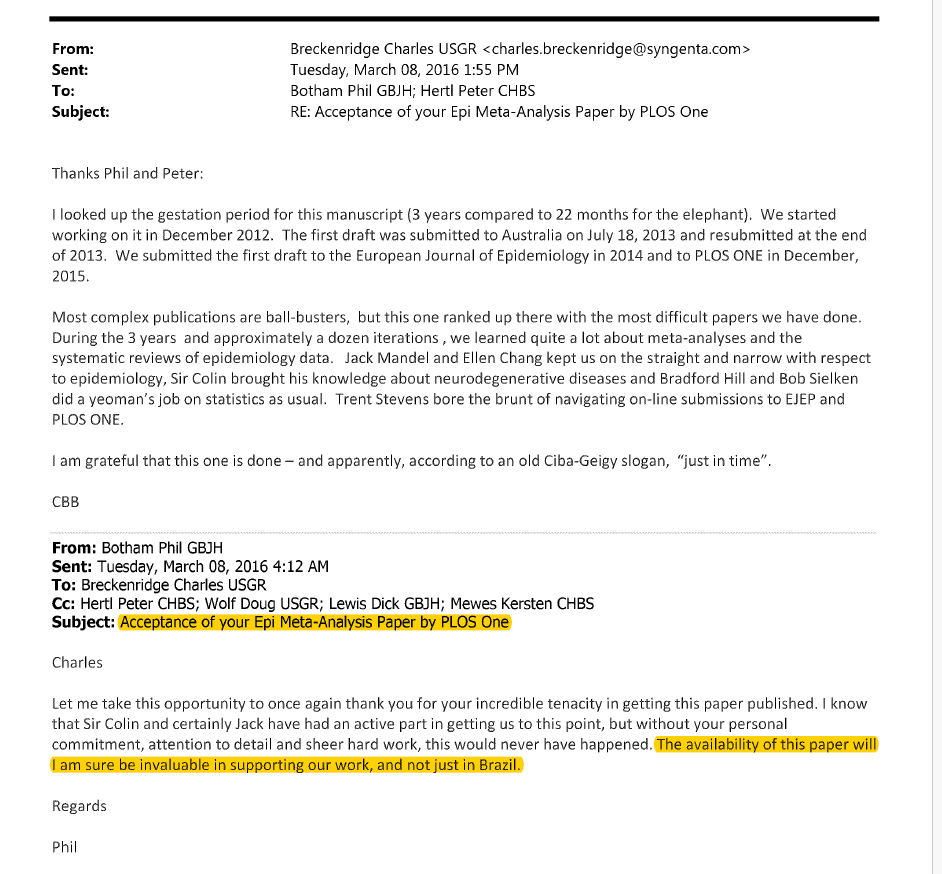
In contrast, the company focused on developing and promoting science showing paraquat safety that it could share with regulators, including one published in 2016 that company insiders noted would be “invaluable in supporting our work”.
Major social media companies including Meta, YouTube, X, and TikTok are reportedly refusing to accept paid advertisements for Alex Gibney’s upcoming documentary about Elon Musk, raising concerns that the Masters of the Universe are closing ranks to protect one of their own.
The Hollywood Reporter reports that Bleecker Street, the distributor of Alex Gibney’s four-hour documentary Musk, is facing an unprecedented challenge in promoting the film’s October 9 theatrical release. YouTube, TikTok, Meta’s platforms Instagram and Facebook, and Elon Musk’s own X platform have all declined to run paid advertisements featuring the documentary’s trailer, according to sources familiar with the situation.
The rejections have caught Bleecker Street by surprise, prompting the distributor to scramble internally to understand the reasoning behind the decisions. A person familiar with the company’s processes, who is not authorized to speak publicly, confirmed that the studio is working to address the situation through appeals.
Perhaps most notably, X, the social media platform owned by Musk himself since 2022, has refused to engage with Bleecker Street representatives about the film or even accept advertising for any other films on the distributor’s upcoming slate. Musk has described himself as a “free speech absolutist” since buying Twitter and renaming the platform.
All three companies that provided explanations cited concerns related to “political content” as their reason for rejection. TikTok and Meta maintain policies prohibiting campaign or other political advertisements. Meta’s policy stems largely from fallout following the Cambridge Analytica scandal during the 2016 election cycle. However, the Musk trailer, which was released on Thursday, does not appear to constitute the type of campaign advertising these policies were designed to prevent. The trailer contains only a shot of a political rally from 2024 and a reference to the 2024 election at its conclusion, elements commonly found in documentaries without constituting political advocacy.
YouTube’s rejection presents an even more puzzling case, as the platform does permit campaign advertisements, requiring only “paid for” disclosures from verified candidates.
Earlier this year, the Small Business Administration (SBA) referred more than $200 billion in suspected COVID loan fraud to the IRS.
The tax agency then compared the information that the borrowers submitted to the SBA when applying for the loans with the information they declared to the IRS.
Analysis identified discrepancies associated with approximately $100 billion in loans, the SBA said in a Sept. 23 statement.
The IRS will determine whether additional taxes and penalties apply, including penalties for committing fraud, according to the SBA.
The suspected fraud pertains to the Paycheck Protection Program (PPP) and COVID Economic Injury Disaster Loan (EIDL) initiatives.
PPP was aimed at helping businesses keep their workforce during the pandemic, while EIDL provided loans and advances to help businesses recover from the economic impacts of the crisis.
In 2023, the SBA judged that 20 percent of the $1.2 trillion pandemic relief program could have been obtained by fraud.
SBA Administrator Kelly Loeffler said:
“The IRS’s identification of approximately $100 billion in suspected tax fraud sends a clear message: fraudsters who stole from SBA’s COVID-relief programs will … face accountability at the SBA.
“If they inflated payroll, fabricated employee counts, falsified business records, or otherwise lied to obtain taxpayer-funded loans, they will also face scrutiny from the IRS.“
The federal government is estimated to lose $233 billion to $521 billion annually to fraud, the Government Accountability Office said in an April 2024 report.
German youth do not feel like going to war for their Globalist overlords.
We have been reporting here on TGP about how the lust for rearmament has befallen Europe in the wake of the war in Ukraine.
As is usually the case, Germany is one of the most engaged countries in this process.
In order to have sufficient manpower to make the Bundeswehr a formidable fighting force, Berlin is floating the idea of reinstating the compulsory military service.
But before such decisions are even implemented, students and teachers across the country are going on strike to protest against the possible reintroduction of the draft.
BBC reported:
“One of the organizers of the strike, Bela Breitner, from School Strike Against Compulsory Military Service said the federal government was ‘serious about gradually reintroducing compulsory military service’.
At one protest in Hamburg, demonstrators waved flags and held up banners emblazoned with the words ‘We won’t take part in your wars’.”
A New Jersey AI infrastructure project has been slapped with a $1.07 million environmental penalty after state officials determined that dozens of large natural-gas generators had been running without the necessary air permits, according to The Guardian.
The fine against DataOne is the biggest New Jersey regulators have imposed on a data center. The generators were being used at the company’s Vineland complex, a large computing facility about 40 miles from Philadelphia that is expected to support Microsoft’s growing demand for AI capacity through its $17 billion arrangement with infrastructure provider Nebius.
The Guardian writes that the equipment apparently wasn’t present when environmental officials inspected the property in December. By July, however, regulators found the generators at the site. Independent reporting later used thermal-drone footage to show that 45 of the facility’s 62 generators appeared to be operating.
That raised a significant permitting issue because the state had not authorized the generators under its air-quality program. The units produce emissions that can contribute to harmful air pollution, particularly when large numbers are operated simultaneously.
DataOne has now been given 45 days to bring the equipment into compliance by applying for the appropriate permits. If it fails to do so, the company could be forced to stop using the generators. For now, New Jersey is permitting them to continue operating while that process plays out.
The decision has frustrated some environmental advocates, who argue that the financial penalty is relatively small compared with the scale of the project.
They have also questioned why operations were allowed to continue after regulators determined the required approvals were missing.
The controversy adds to earlier friction surrounding the Vineland development, including complaints from nearby residents about noise and disputes over construction and zoning.
DataOne says the generators were only intended as an interim source of electricity and disputes the state’s interpretation of the permitting requirements. Nevertheless, the company says it will submit the necessary applications while moving ahead with plans to replace the generators with quieter, lower-emission fuel cells.
The company has not indicated whether it will contest the $1.07 million penalty.


You must be logged in to post a comment.