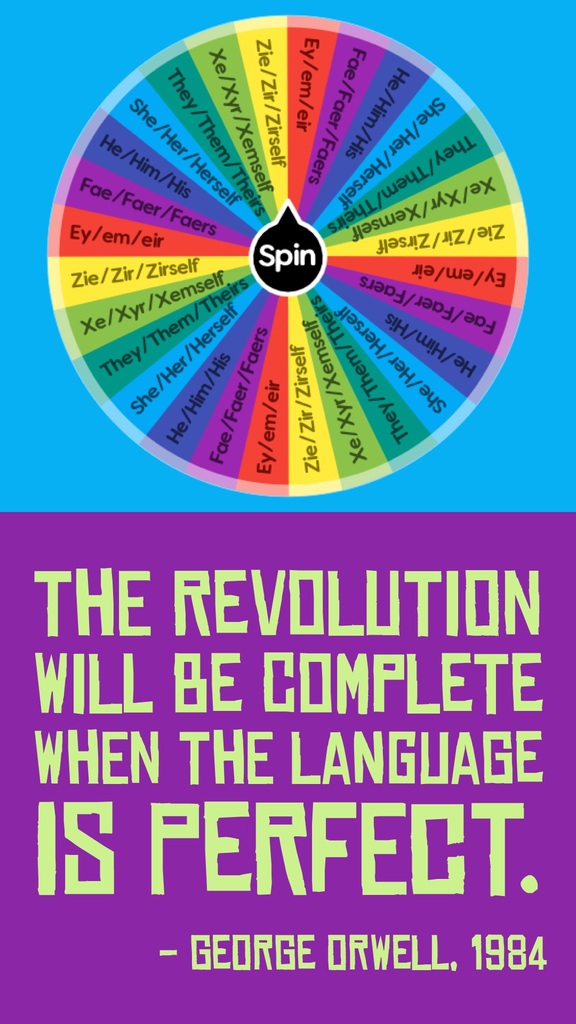
George Orwell on language…

As part of its ongoing efforts to feature language that is more inclusive and reflective of modern-day society, Dictionary.com will no longer include the word “slave” as a noun identifying a person, instead using the adjective “enslaved” or referencing the institution of slavery. The change is one of 7,600 updates the online resource has announced, which also include the addition of terms relevant to race, social justice and identity, such as “BIPOC” (Black, Indigenous and People of Color) and “Critical Race Theory.”
The latest updates — which also include capitalizing “Indigenous” when referring to people, and adding entries for “racialization,” “disenfranchisement” and “overpolice” — follow those announced last September. That round of revisions saw the capitalization of the word Black in reference to people, and the addition of terms relevant to mental health (specifically, suicide and addiction) and LGBTQ identity. John Kelly, managing editor of Dictionary.com, tells Yahoo Life that the changes are an important part of respecting the power of language and its ability to offer representation and dignity.
George Orwell famously wrote this quote regarding how totalitarian states destroy societies and keep people living under ignorant and fearful tyranny:
“Every record has been destroyed or falsified, every book rewritten, every picture has been repainted, every statue and street building has been renamed, every date has been altered. And the process is continuing day by day and minute by minute. History has stopped. Nothing exists except an endless present in which the Party is always right.”
Now, Orwell’s fiction is becoming America’s truth.
After changing the definition of ‘racism,’ ‘sexual preference,’ ‘assault rifle,’ and other words to suit the globalist agenda recently, Webster has completely silently changed the definition of vaccine entirely to accommodate experimental biological agents that may alter a human’s genetics.

In a book titled “Labor-Based Grading Contracts: Building Equity and Inclusion in the Compassionate Writing Classroom,” professor Asao Inoue encourages teachers to ditch grading for a “labor-based” grading system wherein students earn grades based on their effort. The quality of a student’s writing would not help or hinder their course grade.
“This book focuses on one kind of grading contract, one that calculates final course grades purely by the labor students complete, not by any judgments of the quality of their writing,” Inoue writes. “While the qualities of student writing is still at the center of the classroom and feedback, it has no bearing on the course grade.”
Near the beginning of the document, the author admits that the theory of “labor-based” grading is rooted in critical race theory. Critical race theory is the idea that America is rooted in racism as are the systems of modern American society.
Critical race theory contributed to Inoue’s idea that ranking things is a system rooted in racism. Because grading is a form of ranking, grading must also be a racist idea. In his book, Inoue dubbed grading and the education system writ large “racist” for their connections to ranking.
Opponents of our new social justice dispensation often find themselves at a rhetorical disadvantage. Social justice advocates desire to replace oppressive “cultural, structural, and personal norms” with a new, more “welcoming culture.” Anyone who opposes this transformation is, by definition, unwelcoming. Who wants to be defined as unwelcoming? The rhetorical disadvantage of dissidents is only compounded by the development of new code words for social justice (like diversity or inclusion). Social justice warriors win battles simply through deploying certain terms, since this language cows and confuses their opponents.
Americans, after all, value diversity, inclusion, and equity. Diversity of faculties and talents produces inequalities—and protecting such diversity was, as Madison writes in Federalist 10, “the first purpose of government.” Inclusion reflects the universality of the rights of man, though certain people would enjoy them sooner and others later as enlightenment spread. Equity is a characteristic of impartial laws, derived from English common law, that protects and recognizes all equally before them; it provides predictable rules and doctrines for settling disputes. Diversity, inclusion, and equity produce inequalities that serve the public good: they reward productivity, expand opportunities for individuals, and provide a basis for stable common life under equal laws.
Our regnant social justice ideology redefines these words, taking advantage of their sweet sounding civic bent. This co-option represents a thoroughly new civic education. Social justice advocates have won no small ground in American political debate by seeming to adhere to the words and ideas of the old civic education, while importing a new, pernicious vision. We must re-train our ears to hear what social justice ideology peddles.
Opponents of this movement can best grasp social justice newspeak through an analysis of its public documents. What follows is based on my analysis of the state of Washington’s 2020 Office of Equity Task Force’s Final Proposal. The same word salad is served everywhere critical race theory is taught—in university task forces (like Boise State’s), in corporate trainings, even in K-12 curriculum.

For Earyn McGee, terminology matters.
McGee, a herpetologist, studies the habitat and behavior of Yarrow’s spiny lizard, a reptile native to the southwestern United States. The University of Arizona graduate student and her colleagues regularly pack their things—boots, pens, notebooks, trail mix—and set off into the nearby Chiricahua Mountains. At their field site, they start an activity with a name that evokes a racist past: noosing.
“Noosing” is a long-standing term used by herpetologists for catching lizards. But for McGee, a Black scientist, the term is unnerving, calling to mind horrific lynchings of Black people by white people in the United States in the 19th and 20th centuries. “Being the only Black person out in the middle of nowhere with a bunch of white people talking about noosing things is unsettling,” she says. McGee has urged her colleagues to change the parlance to “lassoing,” which she says also more accurately describes how herpetologists catch lizards with lengths of thread.
McGee isn’t alone in reconsidering scientific language. Researchers are pushing to rid science of words and names they see as offensive or glorifying people who held racist views.
 Hellbound and Down
You must be logged in to post a comment.