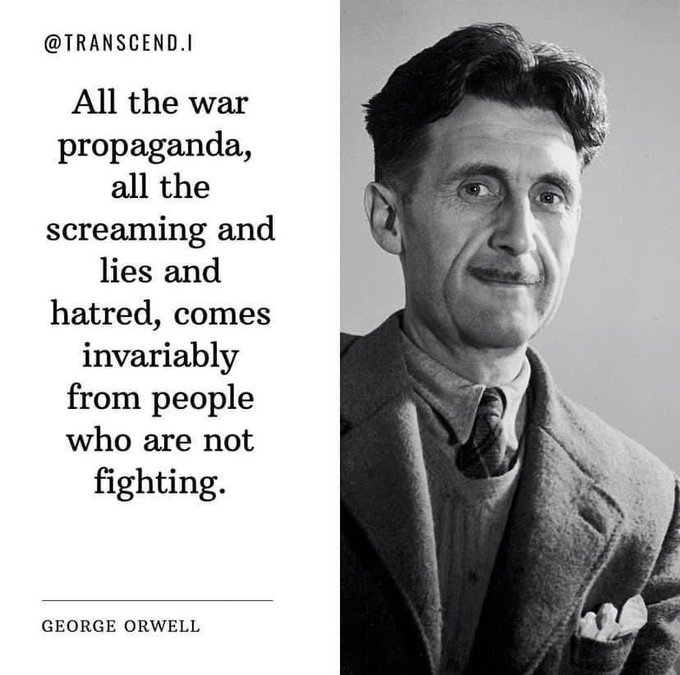
George Orwell’s Warning to Britain

Great Britain, where I live, once prided itself on eccentricity, irreverence, and the right to say unpopular things. Today, people living in my country have been arrested over social media posts and other digital communications. Some have been imprisoned. Online censorship has become more sophisticated, surveillance technology continues to advance, and cancel culture has taught millions of people that expressing the wrong opinion can carry severe consequences. As a result, people are self-censoring out of fear of reprisals.

Books have a particular role to play here. They give people permission to explore ideas away from the noise and intimidation of social media. A reader can encounter something privately, consider it, question it, disagree with it, return to it, and perhaps find the confidence to openly express an opinion they had previously been afraid to voice.

This is why my publishing house, Free Speech Press, is launching with a reprint of George Orwell’s 1984.

For this special edition, I asked the British writer and broadcaster Neil Oliver to write a new prologue. Neil travelled back, intellectually and geographically, to the circumstances in which Orwell created his final novel.

What follows is an extract from that prologue:


George Orwell was dying when he wrote 1984. Like the setting sun, he had travelled into the west: to Jura, the Deer Island in the Inner Hebrides off Scotland’s west coast. George Orwell was his nom de plume – Eric Arthur Blair is on the stone over his clay in the churchyard of All Saints’ Church in Sutton Courtenay, in Oxfordshire – and 1984 would be his swan song. As well as dying (he did not know it then) he was grieving the loss of his wife. It was with his sister Avril then, that he arrived at the lonely farmhouse of Barnhill in the north of the island in May of 1946. Eileen Orwell had died the year before, during a hysterectomy, and the couple’s son Richard joined father and aunt, along with housekeeper Susan Watson later that summer.

Barnhill was remote and on the point of being reclaimed by the elements, until the infusion of life, lives saddened, and from an unlikely source. Jura can be hard to love. Sparsely populated then as now, a place of blanket bog and bare rock. Getting to Barnhill was a matter of two ferries – first to Islay, second to Jura – then 20 miles by motor vehicle until the road dwindled and the last four had to be covered on foot. Food, fuel and the rest had to be carried along with everything else required. “Extremely un-get-atable” is how Orwell described their billet, and he loved it. He was middle-class – a literary type, obviously – and while he had written about the travails of the workers – including the degraded and degrading lives of coal miners and their families in Lancashire and Yorkshire in The Road to Wigan Pier (1937) – and had put in time in self-inflicted poverty as a Down and Out in Paris and London (1933) – by 1946 he still hankered after the hardship of other men’s lives, and the possibilities of a life lived far from the madding crowd.

If it sounds as though I am being unkind, it is not my intention. 1984 was a book I was given to read at school and along with many I have had reasons to think about George Orwell over and over in the years since. Most recently, when it has seemed for all the world as though his last novel is received and used less as dire warning of totalitarianism and more a must have How To handbook for would-be dictators everywhere, I have learned to see the author as nothing less than a seer.

That he was drawn to the Deer Island for the writing of it says to me that his last months and years were ordained for a vision, or a dreary dream the telling of which was nothing less than a calling, or perhaps a penance. It is Highland tradition that deer, the Red Deer, are portents of death. When the deer come down out of the hills and walk the streets of human habitations, their fleur-de-lis hooves clipping through the quiet dark, it is deep sadness they are foretelling. Dying of Tuberculosis still undiagnosed, though it had him coughing red blood while he wrote and wrote within the white walls of Barnhill, he and the world around him were also grieving all that had been lost in the World War just past. It was a shell-shocked world, and Orwell no stranger to its ways. Homage to Catalonia (1938) had been the product of his time fighting Fascism in the Spanish Civil War, and there he had been shot through the throat by a sniper, the wounding leaving him with a voice rendered faint. 

Made gaunt anyway by war’s privations, broken hearted, during that harsh cradling on Jura he saw the future as clear as any Highlander gifted or cursed with the Second Sight. The future he saw was populated by citizens denied hope, made hopeless. Everything shaped to grind souls to lifeless matter. Tasteless food, ill-made and ill-fitting clothes. War everywhere and forever, pointlessly consuming whatever the proles made in soul-sapping factories. No privacy. Big Brother watching over all. The world of 1984 is as familiar to my generation as a half-remembered dream and yet for so many of us the last handful of years have had us sense its version of reality not as a dream but as an inevitability. Big Brother is made real in the apparatus of panopticon surveillance and those we are expected to call leaders foment war after war. 
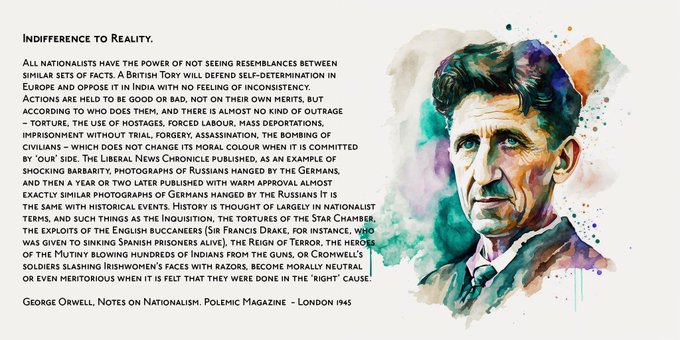
Keep reading

Britain Goes Full ‘Airstrip One’

In George Orwell’s 1984, Great Britain was just a province of Oceania named “Airstrip One” as a none-too-subtle nod to the U.K.’s role as host to the heavy bombers of U.S. Eighth Air Force during World War II.

Four decades past the real 1984, and there’s still no Oceania. But Britain looks more and more like Airstrip One as Parliament considers a bill opening up everyone’s smartphone to government supervision — and jail time for tech execs who don’t submit.

You had to figure this was probably coming, right?

Right.

Reclaim the Net reports that “Ministers are reportedly drafting a law that would force Apple, Google, and the rest to make it impossible for a child to send, receive, view, or share a single nude image, with the executives who refuse facing up to five years in prison.”

That might sound all well and good, but as usual, For the Children™ is little more than the government’s justification for total surveillance.

“You cannot block every naked picture someone might stumble across without inspecting every picture, every message, every video call, every streamed film, on every device, all the time,” Reclaim noted, with nudity serving as “the excuse and the unbroken view into your phone is the actual prize.”

The industry term is “client-side scanning,” which sounds much nicer than “a government mandated app that looks at everything on your phone all the time.”

And even that sounds better than “Big Brother is Watching You,” which is exactly what it is.

As already required by Britain’s Online Safety Act, Apple and Google forcibly install age verification on every iPhone and Android device in the UK via app store updates.

No, it can’t be uninstalled.

Keep reading

Too On Brand: School Purges 1984, Animal Farm, Lord of the Flies, and Others to Promote ‘Diversity’

You really can’t make things like this up. 

Seriously. Liberals may want to purge libraries of “wrongthink,” but you would expect that anybody with an IQ above room temperature could have figured out that tossing out more than half your books in a school library, including 1984 and Animal Farm, would be a bad look. 

But no. Not in Canada, apparently. And certainly not at the Thames Valley School District in London, Ontario. Out of a High School library of 18,000 books, 10,000 were “deselected” and tossed into the trash because they didn’t fit the vision of having an “inclusive” library. Presumably, that explains why they tossed out books by J.K. Rowling, which I assume were quite popular with the kids; she engages in wrongthink about gender, and needs to be purged. 

A London, Ontario, secondary school binned more than 10,000 library books between January and March this year under the Thames Valley District School Board’s “inclusive libraries revitalization project,” eliminating more than half of the school’s 18,000-book collection.

H.B. Beal’s library once held one of the largest collections in the board. Today, fewer than 8,300 books remain. The estimated value of the discarded materials exceeds $180,000.

Education Minister Paul Calandra moved quickly to halt further library culls while the ministry investigates the Beal revitalization project. A spokesperson for the ministry confirmed last week that “the minister has directed that all current and future library collection reviews be paused, pending further evaluation.”

According to board documentation, the project aims “to revitalize the collections of Thames Valley schools to ensure they are culturally responsive, reflect our diverse student population, and contain accurate and up-to-date information.” The project adds that it will focus on “deselecting texts with harmful images, messaging, slurs, and racial epithets to facilitate the safety and well-being of all students.”

Some of the books “deselected” blow your mind, not because it would surprise you that radical leftists would want to hide them, but because it makes their goals of purging the library of any ideological diversity so blatant. They literally purged books about…book banning. 

Keep reading

Has Orwell’s 1984 Become Reality?

To some readers it may seem like a rhetorical question to ask whether the narrative of George Orwell’s dystopian novel, Nineteen Eighty-Four (or 1984), first published in Britain in 1949, has somehow left its pages and settled, like an ominous miasma, over the contours of social reality. Yet, closer inspection – which means avoiding compromised mainstream news outlets – discloses a disquieting state of affairs. 

Everywhere we look in Western countries, from the United Kingdom, through Europe to America (and even India, whose ‘Orwellian digital ID system’ was lavishly praised by British prime minister Keir Starmer recently), what meets the eye is a set of social conditions exhibiting varying stages of precisely the no-longer-fictional totalitarian state depicted by Orwell in 1984. Needless to stress, this constitutes a warning against totalitarianism with its unapologetic manipulation of information and mass surveillance. 

I am by no means the first person to perceive the ominous contours of Orwell’s nightmarish vision taking shape before our very eyes. Back in 2023 Jack Watson did, too, when he wrote (among other things):

Thoughtcrime is another of Orwell’s conjectures that has come true. When I first read 1984, I would never have thought that this made up word would be taken seriously; nobody should have the right to ask what you are thinking. Obviously, nobody can read your mind and surely you could not be arrested simply for thinking? However, I was dead wrong. A woman was arrested recently for silently praying in her head and, extraordinarily, prosecutors were asked to provide evidence of her ‘thoughtcrime.’ Needless to say, they did not have any. But knowing that we can now be accused of, essentially, thinking the wrong thoughts is a worrying development. Freedom of speech is already under threat, but this goes beyond free speech. This is about free thought. Everybody should have a right to think what they want, and they should not feel obliged or forced to express certain beliefs or only think certain thoughts. 

Most people would know that totalitarianism is not a desirable social or political set of circumstances. Even the word sounds ominous, but that is probably only to those who already know what it denotes. I have written on it before, in different contexts, but it is now more relevant than ever. We should remind ourselves what Orwell wrote in that uncannily premonitory novel. 

Keep reading

BEYOND PARODY: Anniversary Edition of George Orwell’s ‘1984’ Includes ‘Trigger Warning’ by American Professor

A new anniversary edition of George Orwell’s classic dystopian novel ‘1984’ has been released and it includes a ‘trigger warning’ in the introduction that was written by an American professor.

Apparently, progressives in higher education don’t understand the concept of irony.

Trigger warnings are one of the progressive concepts that sprang out of liberal academia in recent years and assumes that the reader is so mentally fragile that they need a warning for material that could somehow traumatize them.

The College Fix reports:

75th anniversary edition of ‘1984’ contains trigger warning by American U. professor

Courtesy of Dolen Perkins-Valdez, who according to her website has “established herself as a pre-eminent chronicler of American historical life” and teaches literature at American University, the intro makes note that “there are no Black characters at all” in the novel.

For a “contemporary reader” such as herself, Perkins-Valdez (pictured) says this gives her “pause.” She also says a “sliver of connection” is difficult with a book that “does not speak much to race and ethnicity.”

On the June 2 edition of the show “America This Week, Live,” host Walter Kirn had co-host Matt Taibbi in stitches pointing out the paradox of such an introduction in a book whose themes include the use of language and freedom of thought…

“So, this version of ‘1984’ has a trigger warning […] here it goes: Dolen Perkins-Valdez [says] ‘I’m enjoying the novel on its own terms, not as a classic but as a good story. That is, until Winston [Smith] reveals himself to be a problematic character.’

“‘For example, we learn of him he dislikes nearly all women. And especially the young and pretty ones. Winston’s views on women are, at first, despicable for the contemporary reader. He is the kind of character that can make me put a book down.’”

Just unreal.

Keep reading

The Complex Legacy Of George Orwell

George Orwell, one of the most influential political writers of the 20th century, is widely recognized for his searing critiques of totalitarian regimes in his novels Animal Farm and 1984. Orwell’s portrayal of state control, propaganda, and the manipulation of truth has resonated with readers across the political spectrum. However, Orwell’s personal political ideology and his critiques of totalitarianism are far more complex than is often acknowledged. Rather than being a passive observer or simply an opponent of dictatorship, Orwell was deeply involved in the socialist movements of his time, aligning himself—whether accidentally or intentionally—with Trotskyist circles. Orwell was a powerful voice of the left, despite being a target in the war among socialist factions.

Orwell’s Political Ideology and Alignment with Trotskyism

While Orwell is best remembered for his criticism of authoritarianism and totalitarianism, it is essential to understand that he was, first and foremost, a committed socialist. Despite never formally joining a political party, Orwell was an active and vocal participant in the socialist movement. This may surprise those who associate Orwell solely with his critiques of state tyranny. Indeed, Orwell’s disdain for the left dictatorship did not extend to all forms of socialism, and his political writings often reflect an internal critique of socialist regimes rather than a wholesale rejection of socialist principles.

Orwell’s critique of Stalinist totalitarianism is best understood as part of a broader ideological struggle within the socialist movement itself. Specifically, Orwell’s critiques echo the views of Leon Trotsky, a key figure in early Soviet history and one of Stalin’s most prominent critics. Trotsky was a revolutionary Marxist who played a crucial role in the Russian Revolution of 1917 and the subsequent civil war. He was instrumental in founding the Red Army, which secured the Bolshevik victory over the anti-communist White Army during the Russian Civil War. However, Trotsky’s theory of “permanent revolution” set him at odds with Stalin, who favored the consolidation of socialism in one country—namely, the Soviet Union—before pursuing global revolution. Trotsky’s insistence that socialism must be spread worldwide made him a figure of suspicion within the Soviet hierarchy. In the early 1920s, Stalin consolidated power, leading to Trotsky’s exile in 1929. Despite this, Trotsky continued to oppose Stalin’s policies from abroad, particularly through his writings.

Trotsky’s critique of Stalinism included accusations that Stalin had betrayed the original goals of the Russian Revolution. According to Trotsky, Stalin had established a bureaucratic dictatorship rather than a dictatorship of the proletariat, as envisioned by Marxist theory. He argued that Stalin’s regime represented, not the rule of the working class, but the rise of a privileged bureaucratic elite, a “nomenklatura,” that dominated Soviet society. In addition, Trotsky accused Stalin of fostering a cult of personality, suppressing political opposition, and betraying the internationalist principles of socialism.

Keep reading

Was George Orwell defending the Left, the Right or was he simply defending freedom?

No writer’s legacy and approval is so fought over as George Orwell, whose final – and most celebrated – work Nineteen-Eighty-Four was published seventy five years ago this month.

The most influential piece of political fiction in history, such is the success of the dystopian novel that its themes have been recited to death by columnists, often by people I imagine he would have loathed (including me). 

Orwell’s nightmare became a particular focus of conservative commentators from the 1990s with the rise of ‘political correctness’, which might be seen as both a form of politeness and at the same time a way of policing opinions by changing the language. As Orwell’s Newspeak was described, it was to ensure that dissent cannot be voiced because ‘the necessary words were not available’. Newspeak, along with thought police and doublethink, has become a part of our political vocabulary, while even the proles have Big Brother to entertain them. No one can doubt that Orwell has won the final victory, and the struggle for the writer’s soul forms part ofDorian Lynskey’s entertaining and informative The Ministry of Truth, a biography of Nineteen-Eighty-Four which was published at the time of the last significant anniversary. 

Lynskey, a hugely gifted writer who specialises in the relationship between arts and politics, is very much on the Left and sees the modern parallels with the Trumpian disdain for truth, although the great man himself is now often more cited by the Right. Indeed the anniversary was recently celebrated by the free-market think-tank the Institute of Economic Affairs with a new edition and an introduction by my friend Christopher Snowdon.

Orwell was a paradoxical man, contradictory, sometimes hypocritical (aren’t we all?). In the preface to his book, publisher Victor Gollancz wrote that ‘The truth is that he is at one and the same time an extreme intellectual and a violent anti-intellectual. Similarly he is a frightful snob – still (he must forgive me for saying this), and a genuine hater of every form of snobbery.’

As Lynskey writes: ‘Until the end of his life, Orwell acknowledged that microbes of everything he criticised existed in himself. In fact, it was this awareness of his own flaws that inoculated him against utopian delusions of human perfectibility.’

Such awareness is surprisingly rare among intelligent journalists and commentators, especially when ideology takes a grip – and Orwell was introduced to this reality in quite brutal form.

Keep reading

On the 75th Anniversary of Orwell’s ‘1984’, Five Predictions From The Book That Came True

75 years ago, George Orwell’s novel ‘1984’ was published. In the book, writing became the ultimate act of subversion and we started to see that happening in real life during the pandemic. Fortunately, enough people fought back and a few places, such as Substack, remained where we could express our opinions.

Professor Jean Seaton, Director of The Orwell Foundation, said:

“In Nineteen Eighty-Four, Orwell posed the most terrifying of all questions: could people be brought to really believe (rather than merely pretend to believe) the lies they are told? Seventy-Five years later we are at the start of a roller-coaster experiment with our minds as we battle, rather feebly, to manage the information technologies that already do much to control us and our societies, alongside the resurgence of authoritarianism”.

The pandemic certainly showed us that people could be brought to really believe the lies that they were told.

Keep reading