Language warfare…

During the Dubai Design Week, a new alarm system was unveiled. The device sounds an alarm when it detects potentially “offensive” language.
The device is named after Themis, the Greek goddess of social order and justice. Themis is a lamp-sized device created for the purpose of moderating discussions in educational settings and “manifest political correctness.”
The device can also be used to police language at family gatherings and dinner parties. The designer of Themis, Zinah Issa, hopes it will help with “self-critique.”
Speaking to The Telegraph, Issa said: “Through the use of speech recognition and sound sensors we were able to program Themis to detect offensive terms – racial slurs, offensive jokes – through the microphone.
A writer with Slate has declared that the word ‘woke’ when used by a white person should be treated as a racial slur because it was “shoplifted” from the “black community”.
It’s the latest narrative in the debate over cancel culture.
It is no longer credible to declare that cancel culture doesn’t exist, and so the left has reverted to what it knows best, baseless accusations of racism and bigotry.
Along with a tacit threat, Slate hack Joel Anderson tweeted “If you’re not black and started using ‘woke’ pejoratively sometime post-2018 or so (or worse, don’t know anything about the earlier iteration of the term), I think it’s fair to consider it a racial slur.”
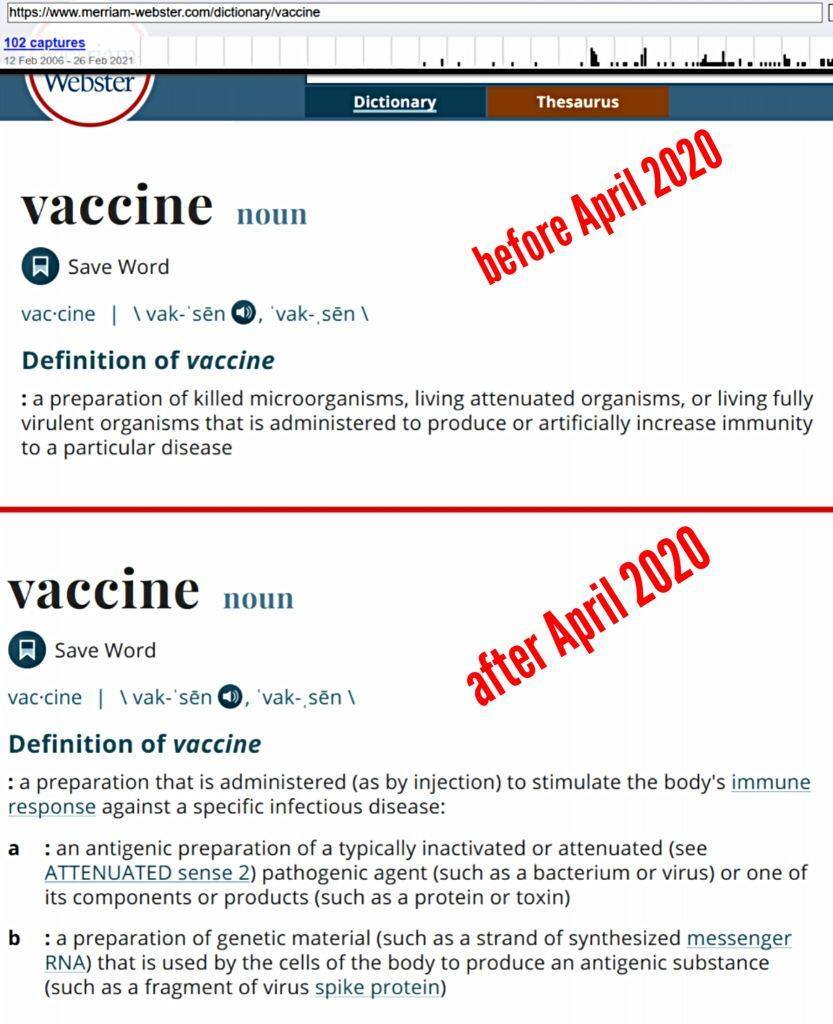
The Centers for Disease Control and Prevention (CDC) altered the definition of “vaccine” because of concern that its definition did not apply to COVID-19 vaccines, according to newly released internal emails.
The agency updated its definition on Sept. 1.
The definition was formerly, “a product that stimulates a person’s immune system to produce immunity to a specific disease, protecting the person from that disease.” It is now, “A preparation that is used to stimulate the body’s immune response against diseases.”
One CDC employee in August, shortly before the definition was changed, said that the definition was being used by “right-wing COVID-19 pandemic deniers … to argue that mRNA vaccines are not vaccines,” according to the newly published emails.
The Pfizer and Moderna COVID-19 vaccines utilize messenger RNA technology. All three COVID-19 vaccines authorized for use in the United States have plummeted in effectiveness against infection in recent months after initially being promoted as protecting against infection and severe disease.
The definition “was twisted to claim that the existing COVID-19 vaccines were not vaccines because they only prevented severe illness,” the CDC employee said.
Alycia Downs, listed on LinkedIn as the lead health communication specialist for the agency, messaged a colleague on Aug. 19, saying she needed to update the definition and others like it “since these definitions are outdated and being used by some to say COVID-19 vaccines are not vaccines per CDC’s own definition.”
Downs didn’t receive a response so she messaged again the following week, writing, “The definition of vaccine we have posted is problematic and people are using it to claim the COVID-19 vaccine is not a vaccine based on our own definition.”
Valerie Morelli, another CDC official, approved the change on Sept. 1, even though it seems to differ greatly from a definition she laid out in an earlier document (pdf).
“If this is for the general public, I am good with the change,” Morelli wrote.
The emails were obtained by lawyer Travis Miller through a Freedom of Information Act request. The CDC did not dispute their authenticity.
From the beginning of the alleged pandemic, the ruling class has been as dishonest as possible in their response to Covid. Much of their power over the hysterics has derived from the manipulation of language. At times it was counterintuitive, but fear overpowers reason in weak-minded people.
Stopping air travel from the epicenter was considered xenophobic. What is xenophobic about mitigating the spread of a supposedly terrible virus? No one asked. In the context of the Trump administration, xenophobia was merely a word loaded with pejorative meaning. Refusing the vaccine continues to be construed as selfish; don’t get it for you, get it for others, they say. What extra protection does my vaccination offer to others if it truly works and someone else already got it? Again, no one asks. In the context of vaccine status, the very concept of individuality is being erased in favor of the nebulous greater good.
Amazingly, even though the Biden administration has since allowed its lead scientists to admit on national television that cloth masks are wholly ineffective, that social distancing at six feet is completely arbitrary, that PCR tests need to be retired by the end of the year due to their worthless function as as a diagnostic tool, and that vaccines are not efficacious for anyone after just a few months, the majority of the herd – the brainwashed sheep – continue to chew unthinkingly on whatever government cud they can find.
Even when truth is acknowledged, it only becomes “the truth” when repeated ad nauseam on media and political outlets of a certain persuasion.
Now, it is not just that people have been brainwashed, though they have (the psychological term is mass formation). Society is increasingly full of people that not only don’t think for themselves but of people that can’t even if they want to. This is the result of controlling language. This is the Orwellian premise of thoughtcrime literally becoming impossible.
On September 1st, 2021 the United States Center for Disease Control (CDC) updated its website’s definition of the word “vaccination,” replacing the word “immunity” with “protection.”
“Vaccination: The act of introducing a vaccine into the body to produce immunity to a specific disease.”
Prior to September 1st, the orginial definiton of “vaccination” on the CDC’s website.
“Vaccination: The act of introducing a vaccine into the body to produce protection from a specific disease.”
As of Septembest 1st, the new definiton of “vaccination” on the CDC’s website.
The change in definition was noticed by Americans around the country with many posting screenshots of the definition before and after the change online.
One such post was shared on Instagram by conservative political commentator Kangmin Lee, known as @koreanchristianconservative on Instagram.
“We’re living in 1984.” Lee writes. “They keep shifting the goalpost, lying to us, and redefining terms. They did this with herd immunity, anti-vax, and now the definition of vaccination itself from immunity to “protection”, which is such a broad, vague term. And of course, this is all by design. Wake up America.”
“Stop trusting these public health bureaucrats,” Lee wrote in another comment on his post.
The post shows a screenshot of a Twitter post saying “The CDC changes the definition of v⍺ccination on September 1st. Replaces ‘immunity’ with ‘protection,’” and also shows screenshots to show evidence of the definition before and after the change, with dates included.
The Arts Council of Wales spent £51,000 on a report that found its own Welsh language policies “systemically racist.” By asking workers to know the language, the council upholds a “white supremacist ideology,” the report claimed.
The Arts Council of Wales tests its employees on their Welsh language skills every year, while National Museums Wales assesses whether Welsh language skills are “essential” for particular roles.
However, the arts council recently paid an outside organisation, the Welsh Arts Anti-Racist Union, £51,000 ($69,474) to investigate whether these language policies exclude black people and other non-white minorities.
Little wonder that here and there sanity nostalgia is gripping the Western world, at least those isolated portions of it that are not internalising the sinister “new normal.” But it is seemingly to no avail. All commanding positions are firmly in the hands of lunatics, who are determined to turn a once great and exemplary civilisation into an asylum.
As George Orwell has taught us, language manipulation is at the frontline (yes, I have just broken one of the cardinal rules of his “Politics and the English Language,” but not his final injunction to “break any of these rules sooner than say anything outright barbarous”) of politicised mind-bending. The sort of language we are permitted to use circumscribes the thinking that we shall be allowed to engage in. The assault on language is, therefore, an integral component of the unrelenting warfare being waged for the conquest and control of the mind. Word elimination and reassignment of meaning, as Orwell also presciently noted, are essential elements of the campaign to reformat the mind and eventually to subjugate it.
A breath-taking example of how this process works was recently unveiled by the thoroughly brain-washed students of the once prestigious Brandeis University who, this time without prompting from their faculty elders and betters, voted to ban from their campus such odious words and phrases as “picnic” and “you guys,” for being “oppressive”. “Picnic” is prohibited because it allegedly evokes the lynching of Blacks.
The precocious young intellectuals took pains to produce an entire list of objectionable words and phrases, shocking award-winning novelist Joyce Carol Oates who tweeted in bewilderment: “What sort of punishment is doled out for a faculty member who utters the word ‘picnic’ at Brandeis? Or the phrase [also proscribed – S.K.] ‘trigger warning’? Loss of tenure, public flogging, self-flagellation?”
Towson University recently hosted a virtual “Antiracist Pedagogy Symposium,” according to Campus Reform, which “criticized university writing curriculum and programs for being racist and perpetuating whiteness.”
The program, which featured an array of speakers, was sponsored by the school’s Office of the Provost, the College of Liberal Arts, the Faculty Academic Center of Excellence, Center for Student Diversity, the school’s department of English, and more.
In addition to educating attendees about first-year writing and graduate school writing, the forum also addressed “linguistic justice.”
“As the country begins its long-awaited reckoning with institutional racism, colleges and universities have been engaging deeply in the ethical dilemma of our time: How do our institutional structures and practices contribute to the problem of silencing, marginalizing, minoritizing, and otherwise harming black and indigenous students of color?” the event page reads. “What do we need to change to create not just a passively inclusive atmosphere for student, but an actively anti-racist one?”


You must be logged in to post a comment.