Canada’s Tariff Strategy Designed To Interfere With U.S. Midterm Elections

Late last month, Canadian Prime Minister Mark Carney walked away from a trade deal with the United States. According to Treasury Secretary Scott Bessent, Canada was “offered the best trade deal of any country on the globe,” but Carney abandoned the deal “at the last minute.”

According to the White House, “the U.S. offered Canada the most preferential market access of any country on Earth, with deep cuts on steel, aluminum, autos, lumber, and more. Instead of partnership, Canada chose unreasonable demands, walk-backs, and flat-out rejection.” Canada responded with retaliation rather than negotiation, becoming the only other country besides China to do so.

And the reason is that Canada is trying to influence the 2026 midterm elections in the United States.

After the trade negotiations failed, Canadian officials announced that tariffs of up to 50% will hit roughly 700 American products starting September 8, covering close to $20 billion in goods, about 7% of everything Canada imports from the United States. The rates range from 15% to 50%, and tariffs on American steel and aluminum will double from 25% to 50%. This was a targeted economic strike meant to hit key states before the midterm elections.

Ottawa has barely bothered to deny it. Canadian Industry Minister Mélanie Joly said the tariffs were built to apply political pressure on specific states, telling reporters: “We are also targeting products that can target specific states in the United States. We are being smart and strategic in order to apply political pressure, and I think it’s the right thing to do right now.”

Asked directly about the political intent by the Canadian Broadcasting Corp., Joly did not walk it back: “We are putting pressure clearly on different states and different people. We don’t want to do that. We don’t want this trade war. We didn’t start it.”

The target list reads like a midterm map. Cheese products from Wisconsin. Washers and dryers from Kentucky, where GE Appliances is a major employer. Steel, aluminum and auto parts from Michigan. The Wall Street Journal reported that Canadian officials designed the package to protect domestic industry and to “sting President Trump and his Republican Party” heading into November.

“The states that are most reliant on Canada as an export market are often the northern-tier states – Maine, Michigan, Minnesota, Wisconsin, New Hampshire,” Ed Gresser told the Wall Street Journal. He argued that Canada is “trying to show the Republican party that there’s a systemic cost to doing this sort of thing.”

Trade consultant Eric Miller, who heads the Washington-based Rideau Potomac Strategy Group, said Canada picked targets with available substitutes, either domestic production or imports from Mexico and China, items like air conditioners and appliances, while simultaneously hitting producers in swing states and reliably Republican territory.

Nowhere was the targeting clearer than Maine, and nowhere did it collapse faster. Ottawa’s original list carried a 25% tariff on American lobster, set to bite during the fall season when roughly half of Maine’s catch goes to Canadian processors. Sen. Susan Collins (R-ME), facing re-election in November, had already warned that the trade war would hurt her state. The Maine Lobstermen’s Association warned on Aug. 26 that the duty would land at the worst possible moment for an industry running on thin margins.

Keep reading

VoterGA: Declassified Intelligence Reveals Massive China Election Interference Cover-up

President Donald Trump delivered a primetime address from the White House on July 16, 2026, on the subject of US election security.

During the speech, Trump announced the declassification of intelligence documents and made a series of allegations involving China, the 2020 election, and a subsequent effort by intelligence officials to withhold information from him and from Congress.

As reported earlier by Patriot Perspective, one CIA report outlined China’s broader objective as leveraging domestic and foreign groups opposed to Trump to reduce his support, pressure him to resign, or stop him from winning another term.

Another report alleged that information collected from millions of TikTok users could be used to place authentic names, addresses, and identification numbers on the fraudulent licenses, making them more difficult to detect.

The release by the US government in July, via an earlier TGP report by Patriot Perspective, revealed China’s massive, multi-year US election interference campaigns.

The documents depict a foreign adversary determined to exploit America’s political divisions.

The most alarming material concerns the collection of Americans’ personal information.

Keep reading

US Meddling In Brazilian Elections, Preparing For Possible Military Intervention

The United States is interfering in the Brazilian presidential elections, pressuring the Brazilian electorate into voting for right-wing candidate Flavio Bolsonaro, the son of disgraced former president, Jair Bolsonaro. If that does not work and President Lula da Silva secures a fourth term in office, the groundwork is already being laid for a potential military intervention. From sanctions and economic warfare, to coaching influencers and journalists on how best to attack the left-wing government, the Trump administration is doing everything it can to overthrow Lula.

Meanwhile, the State Department’s recent decision to designate Brazilian gangs as “foreign terrorist organizations” just as it did with Venezuela’s Tren de Aragua, signals a willingness to intervene militarily.

Brazil is Trump’s next target, and builds upon recent U.S. and Israeli interference in May’s Colombian elections, where pro-Trump candidate Abelardo de la Espriella won a razor-thin victory.

MintPress examines the Trump administration’s attempts to undermine Brazilian democracy and install another Bolsonaro back into power.

A Thumb on The Scale

Brazil’s October elections are rapidly approaching, and while thirteen people are standing for president, two principal candidates have already emerged: current left-of-center president Lula da Silva, and far-right challenger, Flavio Bolsonaro. Flavio is the son of disgraced former president, Jair (sentenced to 27 years in prison for leading a January 6th-inspired coup attempt), and the brother of Eduardo (convicted in absentia for lobbying the United States to intervene in his father’s trial).

It is obvious which candidate Washington prefers. The Bolsonaro’s are politically, ideologically, and personally very close to the MAGA movement, and Flavio has already promised that, if elected, his country will become one of the U.S.’ closest allies.

Lula currently holds a double-digit lead on Bolsonaro (40% to 28%, with no other candidate holding more than 10% of the public’s voting intentions). But Brazilian politics can change very quickly; in 2018, Lula held a 20-point lead over Jair Bolsonaro when the Brazilian Supreme Court blocked him from running. He was imprisoned on bogus charges in a case orchestrated by the U.S. government, leaving the path clear for Bolsonaro’s victory.

Lula has sounded the alarm that Brazilian democracy is once again under threat from Washington. “As far as I’m concerned, [Trump] can continue liking Bolsonaro, the father, the son, the grandson… There is no problem with that. It’s his problem. There’s no accounting for taste,” he said. “Now, don’t meddle in the Brazilian elections, because the Brazilian elections are a Brazilian problem, just as American elections are their business, not mine,” he added: “All I want is the same respect for Brazil that I have for the United States. That’s it.”

Washington, however, has other ideas. On May 26, Flavio Bolsonaro traveled to Washington to meet with Trump, Vice President J.D. Vance, and Secretary of State Marco Rubio to sell them on the concept of military intervention in Brazil. Two days later, the U.S. State Department designated two Brazilian gangs, Comando Vermelho and Primeiro Comando da Capital, as “Specially Designated Global Terrorists” and “Foreign Terrorist Organizations, a decision that Brian Mier, an American journalist who moved to Brazil in 1991 and is now Brazil correspondent for TeleSur English, described as “a preemptive move to possibly invade if Lula wins reelection.”

In 2025, the State Department did the same with Venezuelan gang, Tren de Aragua. Just months later, the U.S. carried out an operation to kidnap President Nicolás Maduro, decapitating the Venezuelan government.

Keep reading

Fact Check: Premier Smith claims Russian interference is happening in the referendum campaign. Is it?

Speaking to Focus Punjabi on OMNI TV, Premier Danielle Smith said, “There are various shares of information online that appear to be amplified by different bot farms that may have a link to Russia.”

The whiffs of foreign interference in the referendum have yet to turn into a smoking gun of any sort. That’s why the premier was careful to use the terms “may” and “appear” in her statement. The foreign interference bogeyman has been an effective tool for federalists to discredit an independence movement which has existed far longer than the internet has.

The source of the latest allegations is Cipher AI, which is a tool that scans foreign media sites. Cipher’s recent snapshots (roughly 150 flagged items over two-week windows in July and August 2026, about 80% linked to Russian content farms) document amplification of anti-government or pro-separation talking points.

That volume is modest against the total volume of Canadian social media discussion on energy policy, federal-provincial relations, and the referendum. Russian bot farms also plug Temu items and porn sites. It doesn’t mean they are being guided by foreign governments or have an agenda at play.

Identifying “foreign interference” requires more than detecting non-Canadian IP addresses, Russian-language origins, or content farms. Cipher flags “dubious claims” from foreign media or proxies and tracks amplification. Human reviewers then decide whether material qualifies as disinformation or coordinated influence. This step is subjective.

Alberta Public Safety Minister Mike Ellis reported that the RCMP found “no credible information” suggesting the separatist movement itself has been subject to foreign interference. CSIS sent a form letter to NDP Leader Naheed Nenshi saying they are watching the situation, but monitoring a risk is not the same as confirming that risk has materialized into significant interference capable of steering results.

The U.S. element cited in reports is largely public and open. Presidential rhetoric about Canada as a potential “51st state,” meetings between independence advocates and alleged U.S. officials (with no commitments reported), and commentary from Trump-aligned media figures. There is no coordinated campaign, and there haven’t been efforts to interfere in Alberta from south of the border.

There has been no indication of significant overseas foreign interference in Alberta’s referendum campaign.

Past reports involved a group in the Netherlands making money for themselves by creating pro-independence YouTube channels and a noodle merchant from Indonesia who made $14 from Facebook by placing pro-independence postings.

Albertans are capable of distinguishing messaging and determining how to vote. The ground game in the referendum is what’s moving the needle in the independence movement through public meetings and door-knocking campaigns.

Foreign interference is an insignificant factor in the campaign despite how hard federalists are trying to amplify that narrative.

Keep reading

NSA Blocked Reports Of China Interference In US Elections From Reaching Trump: Declassified Docs

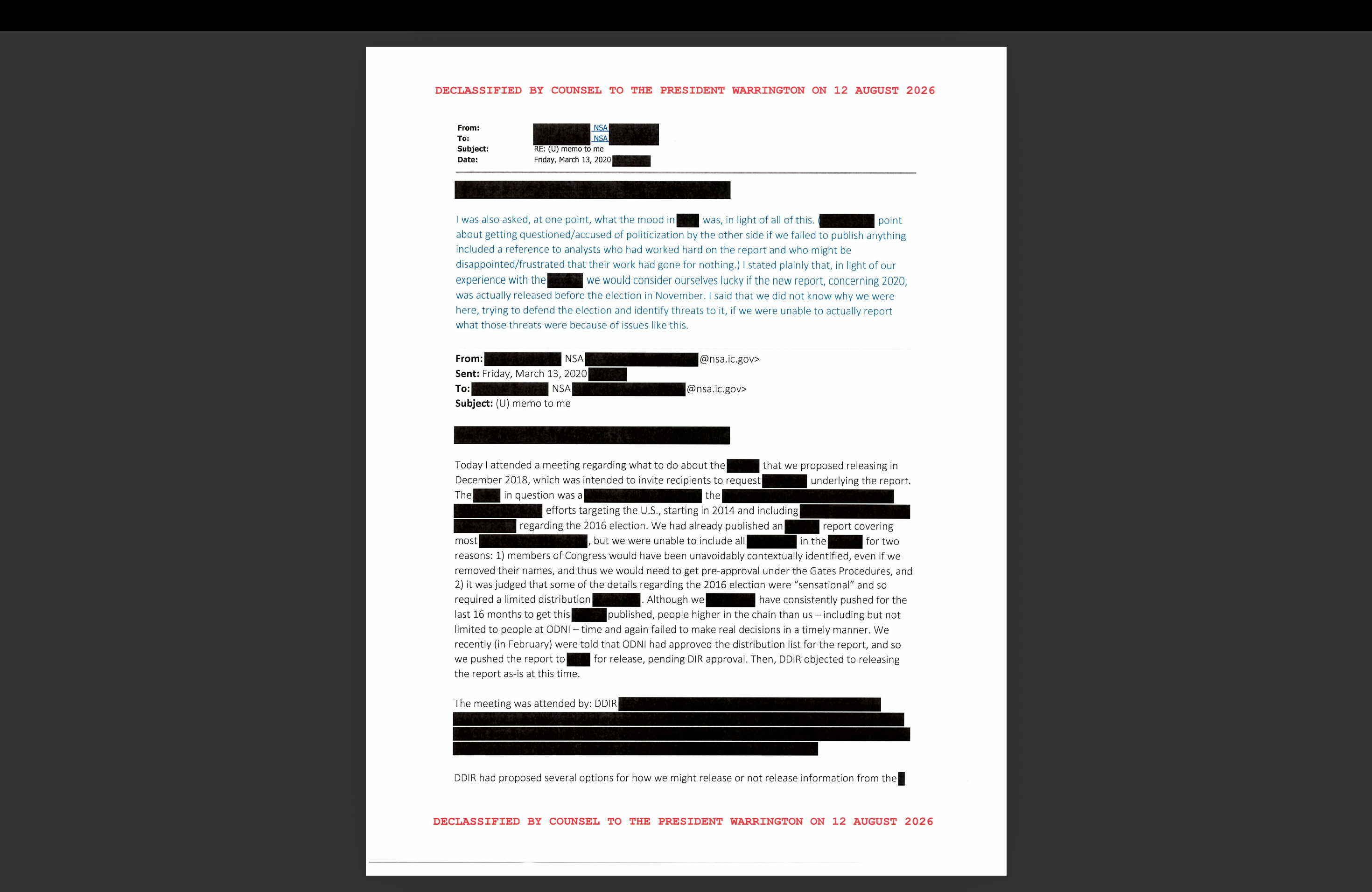
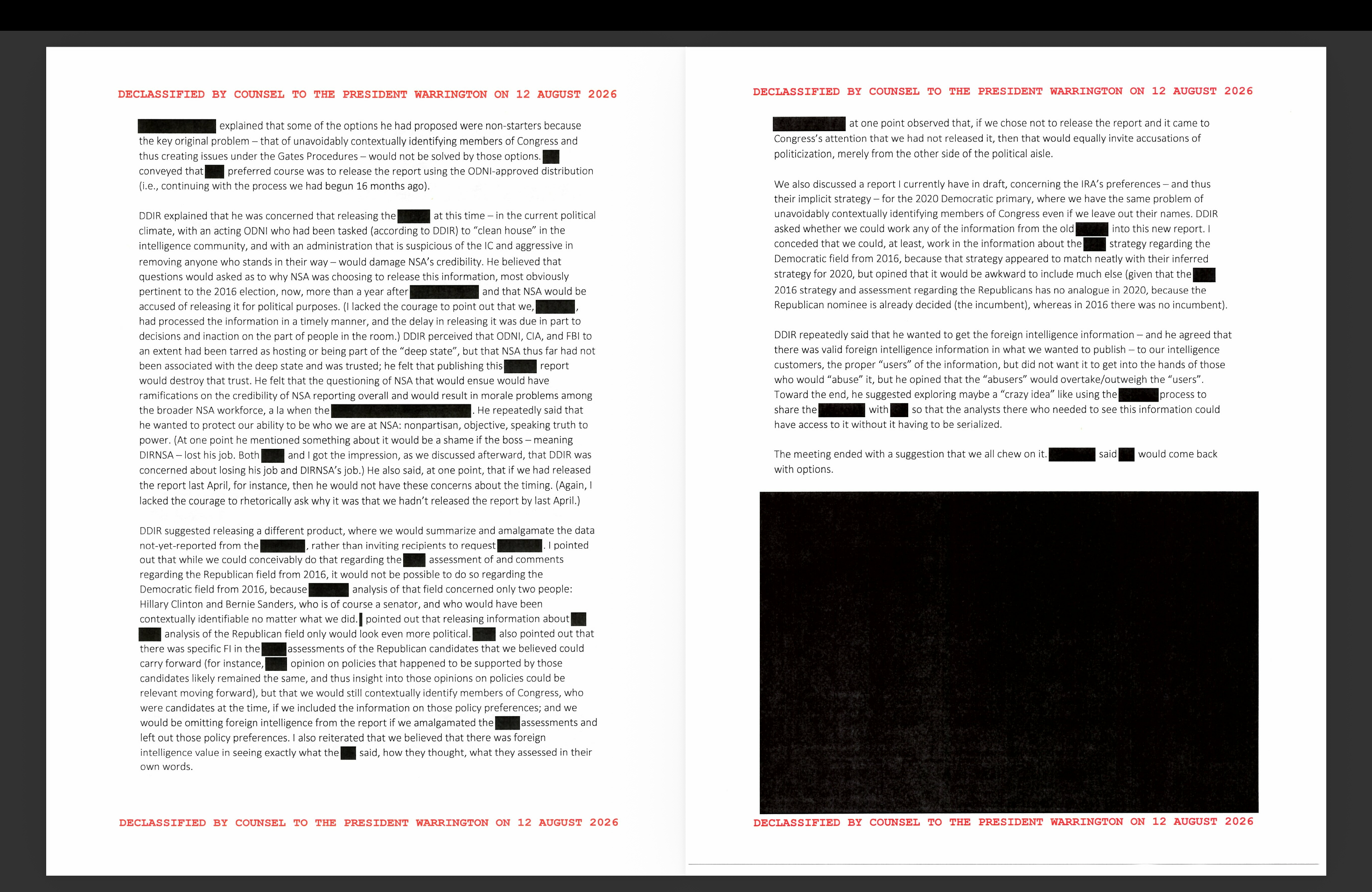
Newly declassified intelligence emails reveal that decisions were made by National Security Agency (NSA) leadership to block reports of Chinese influence in American elections from reaching President Donald Trump.

Four pages of emails, all dated March 13, 2020, were released on Aug. 18 by the White House Government Transparency Task Force.

According to one email—written by an unidentified NSA employee following a meeting about intelligence reporting foreign efforts to target the 2016 and 2020 presidential elections in the United States beginning in 2014—internal concerns were raised about the agency’s suppression of the reports.

“We did not know why we were here, trying to defend the election and identify threats to it, if we were unable to actually report what those threats were because of issues like this,” the NSA employee wrote.

According to another email, NSA analysts had proposed releasing the reports in 2018.

Task force officials are digging through files to determine why evidence of the Chinese Communist Party’s attempts to influence the elections was not passed on to the president, Congress, and some intelligence leaders, including then Director of National Intelligence John Ratcliffe, now CIA director.

Certain aspects of the reports on the Chinese election influence were censored because “it was judged that some of the details regarding the 2016 election were ‘sensational’ and so required a limited distribution [redacted],” an NSA analyst wrote, noting that colleagues tried for 16 months to get the information published.

“People higher in the chain than us—including but not limited to people at ODNI [Office of the Director of National Intelligence]—time and again failed to make real decisions in a timely manner,” they said.

Intelligence officers were told in February 2020 that the office approved the report, and analysts prioritized its delivery, but the NSA deputy director blocked its release, according to the documents.

George Barnes served as NSA deputy director from 2017 to 2023.

[The deputy director] explained that he was concerned that releasing the [redacted] at this time—in the current political climate, with an acting [director of national intelligence (DNI)] who had been tasked … to ‘clean house’ in the intelligence community, and with an administration that is suspicious of the [intelligence community] and aggressive in removing anyone who stand in their way—would damage NSA’s credibility,” the analyst wrote, referring to Trump appointee Richard Grenell, who became acting DNI on Feb. 20, 2020.

The analyst said the deputy director was concerned that releasing the information could be viewed as political in nature because of the two-year delay.

“I lacked the courage to point out that we, [redacted], had processed the information in a timely manner, and the delay in releasing it was due in part to decisions and inaction on the part of people in the room,” the analyst wrote.

According to the analyst, the deputy director also sought to keep the NSA’s reputation separate from the CIA, FBI, and ODNI—agencies he perceived “had been tarred as hosting or being part of the ‘deep state.’”

The analyst said the deputy director thought publishing the report would “destroy that trust.”

“He felt the questioning of NSA that would ensue would have ramifications on the credibility of NSA reporting overall and would result in morale problems among the broader NSA workforce, a la when the [redacted],” the analyst wrote.

Other elements of the gathered intelligence were excluded from reporting because it would have been impossible to conceal the identity of members of Congress, the analyst said. Such cases require special approval, as dictated by the “Gates Procedures,” established by Robert Gates, former director of Central Intelligence, in 1992.

Keep reading

US Intel Chiefs Back Trump’s Claim China Interfered In American Elections

A fact sheet released July 30 by the White House Government Transparency Task Force says China and its proxies bought, stole, or hacked voter data belonging to as many as 220 million Americans, including some information that was not publicly available.

The fact sheet pairs that finding with the intelligence community’s official definition of election interference, which includes a foreign power’s targeting of voter data.

It notes that, for a foreign country’s actions to amount to “election interference,” they do not have to change the actual results.

“That definition includes a foreign power’s targeting of voter registration infrastructure or data,” the task force states, citing declassified documents produced by the U.S. intelligence community.

The fact sheet was approved by the heads of the Office of the Director of National Intelligence (ODNI), the National Security Agency, the Central Intelligence Agency (CIA), and the Department of Homeland Security, according to the White House.

Representatives from those agencies—as well as the Federal Bureau of Investigation—also coordinated with the White House before Trump’s July 16 address and “approved the factual statements” drawn from intelligence documents used in the speech, the task force states.

Election Interference Defined

In his speech, Trump said China has long been meddling in U.S. elections, including that it was “working to influence” the results of the 2020 presidential election, in which President Joe Biden was ultimately declared the winner.

Trump did not explicitly claim that China managed to change the 2020 result, and neither did the heads of U.S. intelligence agencies.

The spy chiefs did say in the fact sheet that voter-registration data is itself part of election infrastructure and could be manipulated in ways that affect election results, for instance by preventing groups of voters from casting their ballots.

“Adversaries could alter data to potentially prevent individual voters or groups of voters from voting, causing delays on election day or forcing voters to use provisional ballots,” the task force states, citing intelligence community documents.

Keep reading

Democrats Don’t Want You to See This Video of Biden on Election Interference

Donald Trump delivered a speech Thursday night that set off an absolute partisan meltdown. Democrats didn’t wait for Trump to finish his remarks on foreign interference in U.S. elections to start attacking it. They didn’t even wait for him to start. They spent the hours before the speech aired trying to debunk whatever he was about to say, and once he actually said it, they rushed to microphones and social media to call him unhinged, dishonest, and dangerous.

It’s a funny thing about that panic. Democrats have spent a quarter-century questioning American election results whenever it suited them. They disputed the 2000 election for years. They disputed the 2004 election. They spent Trump’s entire first term insisting Russia hacked the 2016 election and that he colluded with Vladimir Putin to steal it from Hillary Clinton. Nobody called that an attack on democracy. Every election they have lost since 2000 has been questioned in some capacity.

So when Trump raises the possibility that foreign powers meddled in 2020, the outrage from the left isn’t really about protecting democracy; it’s about protecting a result Democrats can’t afford to have questioned.

Trump’s speech laid out a case that China had compromised voting machines, bribed American journalists, and run a fake ballot scheme designed to inflate Joe Biden’s vote total in 2020. It certainly puts that 81 million votes thing into perspective, doesn’t it? China and Iran had worked overtime to keep him out of the White House. Worse yet, Trump said the intelligence community had evidence that meddling was coming, then evidence that it happened, and buried it.

Despite documented irregularities in the battleground states in 2020, Democrats treat any Republican who questions that election as an enemy of democracy. They give themselves a pass for disputing Bush’s win in 2000 and Trump’s win in 2016 because they lost, so obviously the election was stolen.

In the end, if the elections they won were actually as secure as they claim, a few questions wouldn’t send them into hysterics.

Keep reading

Declassified Intelligence Records: China ‘Compromised’ at Least 18 State Voter Rolls

On Thursday evening, President Donald Trump’s White House published declassified documents related to election integrity and China’s encroachment into American elections.

One of those documents, a disclosure from the United States intelligence community via the White House Task Force on Government Transparency, suggests that at least 18 states have had their voter rolls “compromised” by China.

The document posted by the White House only names 15 of the 18 states, as well as the District of Columbia. Those named in the document are:

  • Alaska
  • Arkansas
  • Colorado
  • Connecticut
  • District of Columbia
  • Florida
  • Georgia
  • Iowa
  • Kansas
  • Maryland
  • Michigan
  • New York
  • North Carolina
  • Ohio
  • Oklahoma
  • Rhode Island

In addition, the document states that the U.S. intelligence community has found that more than 200 million voter records have been compromised by China.

Keep reading

Failing German Chancellor Merz ‘Warns’ Trump Administration To STAY OUT of European Elections

Whine as he may, MAGA will help restore Europe’s greatness.

Like so many other Euro-Globalist ‘leaders’, German Chancellor Friedrich Merz hops from summit to summit, splashing his face on the news cycle, as much is said and little gets done.

Back home, no joy awaits him, as polls show that Merz is now the most unpopular politician in Germany, with a personal rating that has sunk to a historic low of 13% favorability.

He even has to manage the efforts by his own party to replace him with a younger leader.

So, prodded by the MSM, he tries to find some solace by making repeated statements against the US Donald J. Trump administration – it’s a cheap way to score a few points with the leftists.

Today (15), he is issuing a warning – yes, you read it right – against Trump and the MAGA movement to stay out of European elections.

Merz is reportedly pushing back against a new, million-dollar funding scheme from the US to support ‘free speech and religious liberty’ in Europe.

The problem is that the warning is not going to fly, because this outreach to Europe is part of the deepest levels of foreign policy, as it can be read clearly in the 2025 National Security Strategy:

“We want to support our allies in preserving the freedom and security of Europe, while restoring Europe’s civilizational self-confidence and Western identity.”

There’s more:

“Protection of Core Rights and Liberties – The purpose of the American government is to secure the God-given natural rights of American citizens.

[…] In particular, the rights of free speech, freedom of religion and of conscience, and the right to choose and steer our common government are core rights that must never be infringed. Regarding countries that share, or say they share, these principles, the United States will advocate strongly that they be upheld in letter and spirit. We will oppose elite-driven, anti-democratic restrictions on core liberties in Europe, the Anglosphere, and the rest of the democratic world, especially among our allies.”

And finally: “We reject the disastrous “climate change” and “Net Zero” ideologies that have so greatly harmed Europe, threaten the United States, and subsidize our adversaries.”

Keep reading

Trump to Accuse China of Meddling in US Elections in Thursday Night’s Speech – Evidence Beijing Compromised US Voter Data – CIA Withheld Info: Report

President Trump to reveal China’s role meddling in US elections during Thursday’s speech, according to CBS News.

Trump will be delivering a speech on Thursday at 9 ET.

President Trump will be joined by CIA Director Ratcliffe, Acting DNI Bill Pulte, DHS Chief Markwayne Mullin and FBI Director Kash Patel.

The president will reportedly unveil evidence showing Beijing compromised US voter data and the CIA knew about it but didn’t share the information with him during his first term.

BREAKING via @CBSNews: Part of Trump’s speech Thursday night will touch on previously unreported Chinese meddling in U.S. elections, sources told me. Some evidence shows Beijing compromised U.S. voter data — and evidence the CIA knew about the action and didn’t share that…

— Jennifer Jacobs (@JenniferJJacobs) July 15, 2026

CBS News reported:

Part of President Trump’s speech Thursday night is expected to touch on previously unreported alleged Chinese meddling in U.S. elections, according to sources familiar with the matter.

One component: Allegations that Beijing compromised U.S. voter data and evidence the CIA knew about the action and didn’t share that information with Mr. Trump during his first term.

The audience for the primetime speech is expected to include members of the president’s cabinet. Among those invited are the heads of CIA, FBI, Office of the Director of National Intelligence and Department of Homeland Security, as well as other agencies and staff. Some cabinet members will not be there due to scheduling conflicts.

Asked for comment on the contents of the president’s address, White House press secretary Karoline Leavitt said: “As usual, anonymous sources are speculating about what President Trump will say during his speech on Thursday evening. The truth is, nobody knows yet what President Trump will ultimately say, which is why everyone should tune in.”

A White House task force will be releasing classified intelligence documents related to the 2020 election, according to a leak to MS NOW.

According to MS NOW, Trump will speak about the newly declassified intelligence.

Keep reading