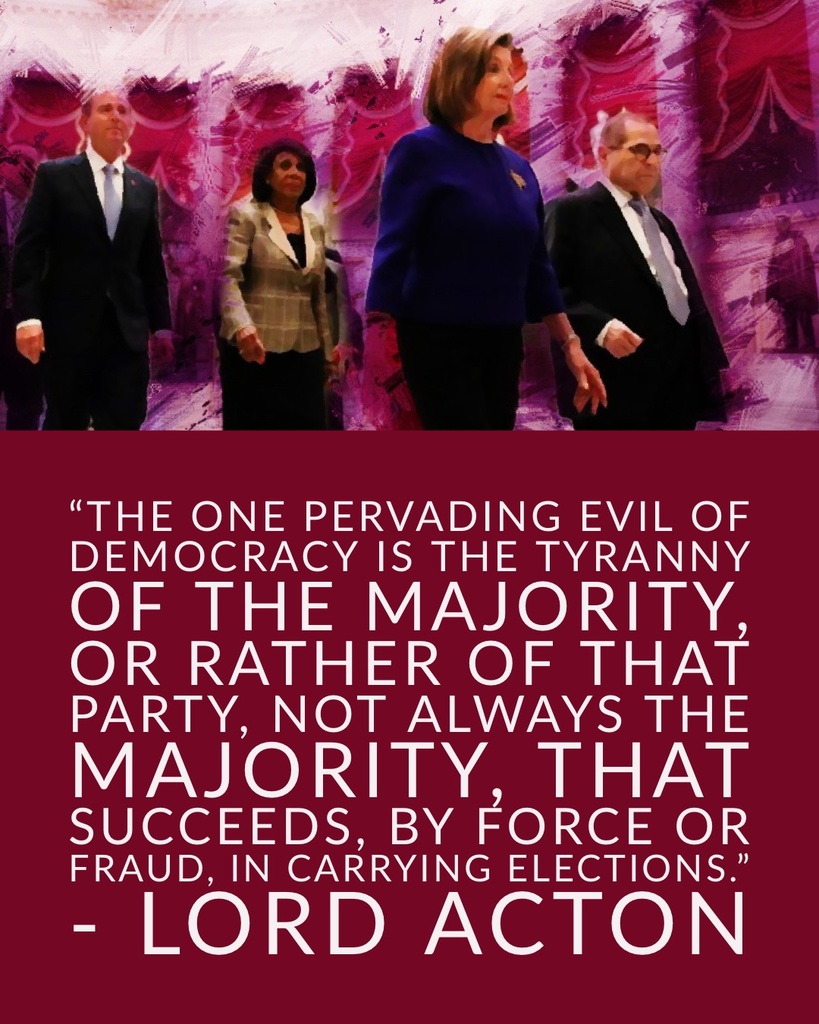
Lord Acton on democracy…

Jane Roberts of the Daily Memphian reports on the sudden death of a young orthopedic surgeon at the Baptist Memorial Hospital in Memphis, Tennessee. According to the report, Dr. J. Barton Williams (36) passed away not long after receiving the covid-19 vaccine. The previously healthy surgeon began to experience multi-system inflammatory syndrome (MIS) after vaccination. MIS is one of the twenty-six adverse events that the FDA initially warned about when the covid-19 vaccines were rushed through clinical trials and approved for emergency use. MIS is an autoimmune reaction that involves life-threatening inflammation of the heart, lungs, kidneys, brain, skin, eyes or gastrointestinal organs and can lead to death.
Instead of investigating the role that the vaccine caused in the doctor’s death, his former colleagues are trying to rule out any link to the vaccine. “We want to be sure there is no indication that there is any relationship to the vaccine at this point,” said Baptist infectious disease expert Dr. Stephen Threlkeld, in an official statement. Baptist physicians admitted they are working with the CDC to eliminate any notion that the man’s death was related to the vaccine.
The infectious disease experts are trying to blame the doctor’s immune system for the death and are making the absurd claim that a previous COVID infection was the culprit behind his death, despite the hospital never recovering the virus from him. The deceased Dr. Williams had never tested positive for covid-19 and was even vaccinated to ensure that the virus would never affect him. The hospital is trying to declare that the doctor’s death was the first case of someone who “died of a delayed immune response to COVID and had received the vaccine.”

Scientists have cloned the first U.S. endangered species, a black-footed ferret duplicated from the genes of an animal that died over 30 years ago.
The slinky predator named Elizabeth Ann, born Dec. 10 and announced Thursday, is cute as a button. But watch out — unlike the domestic ferret foster mom who carried her into the world, she’s wild at heart.
“You might have been handling a black-footed ferret kit and then they try to take your finger off the next day,” U.S. Fish and Wildlife Service black-footed ferret recovery coordinator Pete Gober said Thursday. “She’s holding her own.”
Elizabeth Ann was born and is being raised at a Fish and Wildlife Service black-footed ferret breeding facility in Fort Collins, Colorado. She’s a genetic copy of a ferret named Willa who died in 1988 and whose remains were frozen in the early days of DNA technology.
Join us at minds
A whistleblower leaked shocking images of Coca-Cola’s online training modules instructing employees to “try to be less white.”
Karlyn Borysenko, an anti-critical race theory activist, obtained the images from an internal whistleblower and posted them online:
“Confronting Racism: Understanding what it means to be white, challenging what it means to be racist”
“Try to be less white”


Far underneath the ice shelves of the Antarctic, there’s more life than expected, finds a recent study in the journal Frontiers in Marine Science.
During an exploratory survey, researchers drilled through 900 meters of ice in the Filchner-Ronne Ice Shelf, situated on the south eastern Weddell Sea. At a distance of 260km away from the open ocean, under complete darkness and with temperatures of -2.2°C, very few animals have ever been observed in these conditions.
But this study is the first to discover the existence of stationary animals—similar to sponges and potentially several previously unknown species—attached to a boulder on the sea floor.
“This discovery is one of those fortunate accidents that pushes ideas in a different direction and shows us that Antarctic marine life is incredibly special and amazingly adapted to a frozen world,” says biogeographer and lead author, Dr. Huw Griffiths of British Antarctic Survey.
 Hellbound and Down
You must be logged in to post a comment.