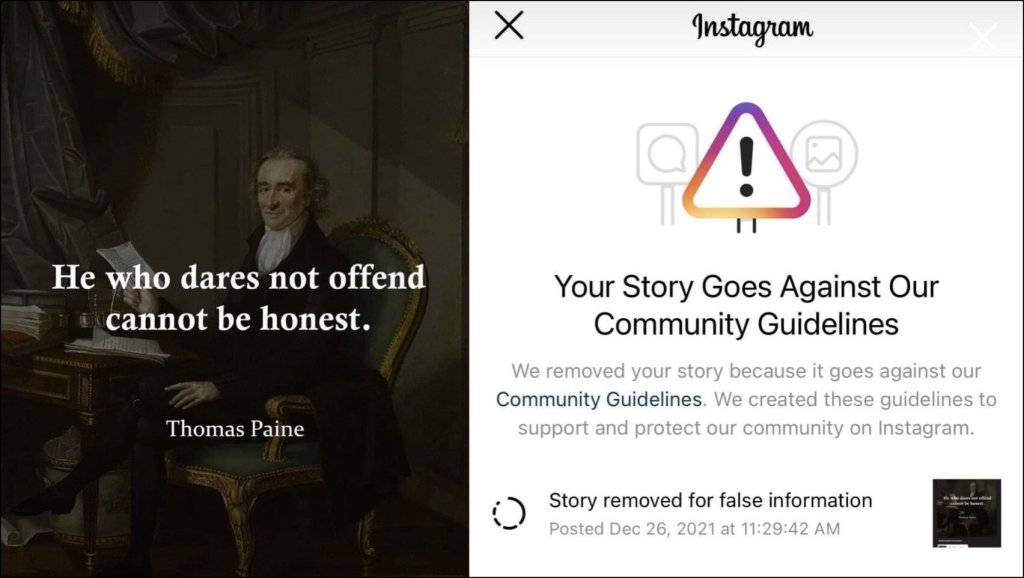
Who determines truth?

Former New York Times reporter and outspoken critic of the US response to the Covid pandemic Alex Berenson is suing Twitter for suspending his account, claiming the platform “acted on behalf of the federal government.
In the lawsuit, filed this week in the Northern District of California, Berenson accused Twitter of breach of contract and of violating his First Amendment rights.
The alleged breach of contract stems from the fact that Berenson claims a Twitter executive had repeatedly assured him that he would be free to express his views on the platform without fear of retaliation.
“Despite the controversy around his statements, a senior Twitter executive repeatedly assured Mr. Berenson that the company backed his right to free expression and that he would continue to enjoy access to the platform,” Berenson’s lawyers said in the suit.
The independent reporter and best-selling author was reportedly suspended from Twitter in August over a tweet questioning whether Covid vaccines could actually prevent infection and transmission of the virus, referring to them as “therapeutic” drugs. A Twitter spokesperson at the time said Berenson was permanently suspended for “repeated violations of our COVID-19 misinformation rules.”
In the tweet, Berenson wrote: “It doesn’t stop infection. Or transmission. Don’t think of it as a vaccine. Think of it – at best – as a therapeutic with a limited window of efficacy and terrible side effect profile that must be dosed IN ADVANCE OF ILLNESS.”
Berenson argues the platform acted on behalf of the Biden administration in censoring his posts, as the president himself had criticized “misinformation” about Covid spreading on social media only days before the author’s suspension.
He is also claiming in his lawsuit that a California law applying to “common carriers” applies to Twitter. The legislation, dating back to 1872, regulates companies that “offer to the public to carry persons, property, or messages.”
The Pentagon has updated its policy regarding extremism among military personnel.
The revised policy comes as the result of a Counter Extremist Activity Working Group established in the Spring by Defense Sec. Lloyd Austin.
Officials say the new policy does not seek to focus on any one ideology, thought, or political orientation, but to define more clearly what qualifies as prohibited extremist activity.
A report issued Dec. 20 provides a lengthy definition of “extremist activities” that range from advocating or engaging in political violence to knowingly displaying paraphernalia, words, or symbols in support of extremist activity.
This can include “liking” content on the internet, according to Pentagon press secretary John Kirby.
“The physical act of liking is, of course, advocating,” Kirby told reporters Monday. “And advocating for extremist groups—certainly groups that advocate violating the oath of the Constitution, overthrowing the government, terrorist activities. Liking is an advocation.”
According to the report, extremist activity can include posting, liking, sharing, re-tweeting, or otherwise distributing content—when such action is taken with the intent to promote or otherwise endorse extremist activities.
Silicon Valley Big Tech giants like Twitter and Facebook appear to have adopted an explicit policy to suppress conservative views and encourage the spread of leftist dogma, as several media reports have revealed.
In the early part of the year, anything related to the election was a major target for Big Tech censorship. Views that strayed from the accepted COVID-19 narrative fell squarely in Big Tech’s bullseye the whole year, as alternative treatments for the virus and questioning of mask mandates incurred a great deal of scrutiny from the heads of Silicon Valley. And the tech overlords did all they could to promote social wokeness, furiously attacking critiques of transgenderism as well as pro-life content.
Facebook bowed to its insufferably woke employees and decided to develop algorithms that allowed hatred for whites and conservatives while protecting favored left-wing groups from ridicule on the platform.
Former Twitter CEO Jack Dorsey resigned in November, clearing the way for anti-conservative radical Parag Agrawal to take the helm, a move that conservatives immediately criticized. Before banning former President Donald Trump following the Jan. 6 Capitol riot, Twitter had censored Trump and his campaign 625 times, without censoring Joe Biden at all. Twitter also censored New York Post stories in the lead-up to the 2020 election that focused on the alleged corrupt business dealings of President Joe Biden and his son Hunter in Ukraine.
“It just doesn’t sit right with me,” begins a TikTok by a user named Evelyn Juarez. It’s a breakdown of the tragedy at Astroworld, the Travis Scott concert in early November where eight people died and more than 300 were injured. But the video isn’t about what actually happened there. It’s about the supposed satanic symbolism of the set: “They tryna tell us something, we just keep ignoring all the signs,” reads its caption, followed by the hashtags #wakeup, #witchcraft, and #illuminati.
Juarez, a 25-year-old in Dallas, is a typical TikToker, albeit a quite popular one, with 1.4 million followers. Many of her videos reveal an interest in true crime and conspiracy theories — the Gabby Petito case, for instance, or Lil Nas X’s “devil shoes,” or the theory that multiple world governments are hiding information about Antarctica. One of her videos from November suggests that a survey sent to Texas residents about the use of electricity for critical health care could signify that “something is coming and [the state government] knows it.”
Her beliefs are reminiscent of many others on the internet, people who speak of “bad vibes,” demonic spirits, or a cosmic calamity looming just over the horizon, one that the government may be trying to keep secret. Juarez tells me she was raised Christian, although at age 19 she began to have a more personal relationship with God outside of organized religion.
Today, she identifies more as spiritual, as an increasing number of young people do, many of them working out their ideas in real time online. They may talk about manifesting their dreams and faceless sex traffickers waiting to install tracking devices on women’s parked cars. Some might act almost as prophets or shamans, spreading the good word and guiding prospective believers, while others might just lurk in the comments. They might believe all or only some of these ideas — part of the draw of internet spirituality is that it’s perfectly pick-and-choosable — but more than anything, they believe in the importance of keeping an open mind to whatever else might be out there.
I asked Joseph Russo, a professor of anthropology at Wesleyan University, if this loosely related web of beliefs could ever come together to form into its own kind of religion. “I think it already has,” he says.
The editor of The British Medical Journal (BMJ), one of the world’s oldest and most respected medical journals, has written a letter to Meta’s CEO Mark Zuckerberg to bring to his attention an “incorrect” fact-check on one of its reports.
The report was titled: “Covid-19: Researcher blows the whistle on data integrity issues in Pfizer’s vaccine trial.”
A former employee at Ventavia, a research company that helped with the trials of the Pfizer Covid vaccine, provided The BMJ with dozens of internal documents, photos, email, and recordings, that revealed “a host of poor clinical trial research practices occurring at Ventavia that could impact data integrity and patient safety,” according to the letter.
“We also discovered that, despite receiving a direct complaint about these problems over a year ago, the FDA did not inspect Ventavia’s trial sites,” the letter, written by BMJ editor Fiona Godlee, further claims.
The BMJ hired an investigative reporter to write the story, which was published on November 2. The article had been peer reviewed, legally reviewed, and subjected to The BMJ’s high editorial standards.
However, starting November 10, Facebook users started reporting problems when trying to share the article. Some said they were unable to share, others said their posts were flagged with a warning saying, “Missing context… Independent fact-checkers say this information could mislead people.” Others were warned about the consequences of repeatedly sharing “false information.”
The BMJ’s article was fact-checked by Lead Stories, a Facebook contractor. The BMJ described the fact-check performed by Lead Stories as “inaccurate, incompetent and irresponsible.”
The trial of Ghislaine Maxwell, former partner of Jeffrey Epstein, looks like it is being set up to fail. Prosecutors rested their case after nine days in which victims seemed barely prepared for cross-examination and co-conspirators were notable by their absence.
Even this threadbare reckoning was too much information for Twitter, which banned a popular account reporting daily from Manhattan Federal Court. The new Twitter CEO has previously said the company is not bound by the First Amendment, and blocked posts that were drawing 500,000 views.
The touchy revelation seems to have been that hard drives removed from Jeffrey Epstein’s townhouse in 2019 already had FBI tags on them, suggesting they’d previously been seized and returned to the predator.
The state-corporatist media, like the federal prosecutors, have ignored the clear implication of surveillance and even blackmail. The court case is limited to six counts relating to sex trafficking and Maxwell’s alleged involvement in Jeffrey Epstein’s sexual abuse of teen women.
Not only does it seem U.S. agencies may have been complicit in compromising individuals — Twitter tries to stop us from knowing. Kudos to The Free Press Report for its daily summary of the trial.
Liberals are three times more likely than conservatives to report people on social media to Big Tech companies for possible terms and regulations violations, a new poll suggests.
According to the Cato 2021 Speech and Social Media National Survey, of the 2,000 people polled, liberals, even moderate ones, were far more likely to encourage Big Tech-led censorship of their peers on apps such as Twitter, Facebook, and Instagram.
“This behavior is highly tied to political ideology,” the poll notes.
While 65 percent of strong liberals, 44 percent of moderate liberals, and 32 percent of moderates testified that they reported another user for “sharing offensive content or false information,” only 21 percent of moderate conservatives and 24 percent of strong conservatives said they did the same.
In addition to reporting people to Big Tech companies, 80 percent of strong liberals and 68 percent of moderate liberals said they have blocked or unfriended someone for their posts “about politics or science.” Only 48 percent of moderates, 44 percent of moderate conservatives, and 46 percent of strong conservatives reported doing the same.
The survey also found that “altogether, conservatives are more likely than liberals to have personal or near personal experience of being penalized by social media companies for the content they’ve posted to their accounts.”
The poll reinforces an alarming trend indicating a shrinking level of tolerance and a desire for censorship among the left. In a recent poll of 850 private and public college, university, and trade school students spread across the United States, Generation Lab and Axios found “Young Dems more likely to despise the other party.”
In private emails between Mark Zuckerberg and Anthony Fauci – obtained exclusively by The National Pulse – the Facebook founder and CEO offered to send “data reports” on users to “facilitate decisions” about COVID-19 lockdowns.
The revelation is a stark example of how Big Tech corporates and government can easily collude using user data to restrict the liberties of the general public.
In the exchange, Zuckerberg insists: “I want to make sure you have all the resources you need to expedite the development of a vaccine.”
Zuckerberg – whose personal foundation referenced in the email plowed hundreds of millions of dollars into securing a victory for then-candidate Joe Biden in 2020 – offered the assistance to the National Institute of Allergy and Infectious Diseases (NIAID) Director just one month after the pair had connected over emails that were redacted by the U.S. government.
Downloading “free” apps onto devices more often than not allows app providers to collect personal data on users. Of course, companies that manufacture and sell devices tend to collect personal data on users too (see 1, 2, 3, 4, 5). Having access to this data allows companies and providers to analyze users’ habits and preferences so they can market additional products and services to them. They can also sell users’ data to 3rd parties. This practice is sometimes referred to as “Surveillance Capitalism.” As more customers are becoming aware of this, more want to be able to “opt out” of privacy invasive data collection. Companies aren’t necessarily making this easy though. Recently Verizon was exposed for automatically enrolling its customers into a new program that scans users’ browser histories. Facebook, Google, and Snapchat are now also being exposed for continuing to collect data on without users’ knowledge or consent.
 Hellbound and Down
You must be logged in to post a comment.