
It takes a creeper…

Nearly 1,800 Americans directly affected by the Sept. 11, 2001, terrorist attacks are opposing President Joe Biden’s participation in any memorial events this year unless he upholds his pledge to declassify U.S. government evidence that they believe may show a link between Saudi Arabian leaders and the attacks.
The victims’ family members, first responders and survivors will release a statement Friday calling on Biden to skip 20th-anniversary events in New York and Shanksville, Pennsylvania, and at the Pentagon unless he releases the documents, which they believe implicate Saudi officials in supporting the acts of terrorism. The group says that as a candidate Biden pledged to be more transparent and release as much information as possible but that his administration has since then ignored their letters and requests.
When President Biden first unveiled his $2+ trillion proposal for an infrastructure spending package, he was widely ridiculed for stretching the meaning of the word “infrastructure” far past its breaking point. The legislation snuck in climate change policy, billions for woke diversity initiatives, massive funding for public schools, and much more under creatively deceptive guises such as “human infrastructure.” Thankfully, this package didn’t get far.
However, more feasible efforts continue from a bipartisan group of senators seeking to pass a $1 trillion infrastructure compromise package. This legislative effort does, in fairness, stay much closer to the traditionally understood definition of infrastructure with its funding for roads, bridges, and more. Yet even this supposedly moderate, reasonable bill is 2,702 pages in length, leaving ample room for lobbyists and individual politicians to slip in wasteful items and crony pet projects.
Here are nine examples of seemingly unrelated, wasteful, or otherwise dubious spending programs snuck into the thousands of pages of legislative text.
Joe Biden’s Secretary of State Tony Blinken, who headed a Biden project at the University of Pennsylvania that took millions of dollars in anonymous Chinese donations, recently stated: “As the President has repeatedly made clear, great nations such as ours do not hide from our shortcomings; they acknowledge them openly and strive to improve with transparency. It is in this context that the United States intends to issue a formal, standing invitation to all UN experts who report and advise on thematic human rights issues,” he continued. “As a first step, we have reached out to offer an official visit by the UN Special Rapporteur on contemporary forms of racism and the UN Special Rapporteur on minority issues.”
Nextdoor, a social media networking service that operates as a neighborhood hub for sharing information, has been criticized by Congressional Democrats in the US for its lack of action to address the skepticism regarding the COVID vaccination.
“We urge you to release specific and clear data demonstrating the resources you currently devote to protect non-English speakers from misinformation, disinformation, and illegal content on your platform,” said the letter to Nextdoor CEO Sarah Friar, according to Politico Pro.
“Congress has a moral duty to ensure that all social media users have the same access to truthful and trustworthy content regardless of the language they speak at home or use to communicate online.” The lawmakers demanded a response by Aug. 13.
Iraqi Prime Minister Mustafa al-Kadhimi and President Biden announced last week that Washington will end its combat mission in Iraq by the end of the year. However, these long-serving U.S. soldiers are not coming home: many of the 2,500 American service members are expected to remain in the country for “training and advisory” purposes.
The United States and Iraq had issued a joint statement in April that the U.S. combat mission would be ending, but the timeline remained unclear. The timing of the recent announcement appears intended to boost Kadhimi’s prospects in October’s parliamentary elections — he faces domestic demands to oust U.S. forces, yet remains dependent on American support to maintain some semblance of control.
Many of the militia groups he now struggles to control initially assembled to fight the so-called Islamic State, or Daesh, starting in 2014. The Popular Mobilization Forces, or al-Ḥashd ash-Shaʿbī, many of whose fighters are Iraqi Shi’a, were supported by both the U.S. and Iran to defeat the Islamic State. The mobilization of these militias would not have been necessary if Paul Bremer and the Pentagon had not made the foolish decision to disband Iraq’s military following the U.S. invasion in 2003, as Iraq would still have possessed a functional army.
DIANA MARQUEZ HAS spent the last 14 months going on long walks, hitting the treadmill, and cooking with her daughter. She’s gotten to know her grandson, a fourth grader, helping him with his math homework. She has also lived with a weight hanging over her head — and an ankle bracelet strapped to her leg.
Marquez is one of roughly 4,400 people who were released from federal prison to home confinement starting in April 2020 as part of a Department of Justice directive aimed at preventing the transmission of Covid-19 in prison. Normally, the federal government allows people convicted of nonviolent crimes to serve out the last 10 percent or the last six months — whichever is less — of their sentences from home. Their time at home requires strict state scrutiny, including ankle bracelets and daily call-ins. The Department of Justice memorandum, issued under the Coronavirus Aid, Relief and Economic Security Act, asked the Bureau of Prisons to relax the eligibility standards for home confinement so that people convicted of nonviolent crimes could leave prison despite having served less of their sentences.
The status of these people has been in limbo since December, when Justice Department officials from the outgoing Trump administration issued a memo stating that people whose sentences would outlast the Covid-19 emergency order would be returned to prison.
Last week, the New York Times reported that Biden administration lawyers had concluded that the Trump administration memo correctly interpreted the law — and that thousands of people in home confinement must be returned to prison after the yet-to-be-determined end of the “pandemic emergency period.” About 2,000 people stand to be impacted, with the rest having now completed enough of their sentences to qualify for early release under the standard guidance.
The Biden Justice Department’s position is especially shocking for people like Marquez who are doing time for marijuana-related offenses. President Joe Biden, after all, campaigned on loosening drug laws and said that people with marijuana records — who comprise a relatively small percentage of the federal prison population — should be freed.
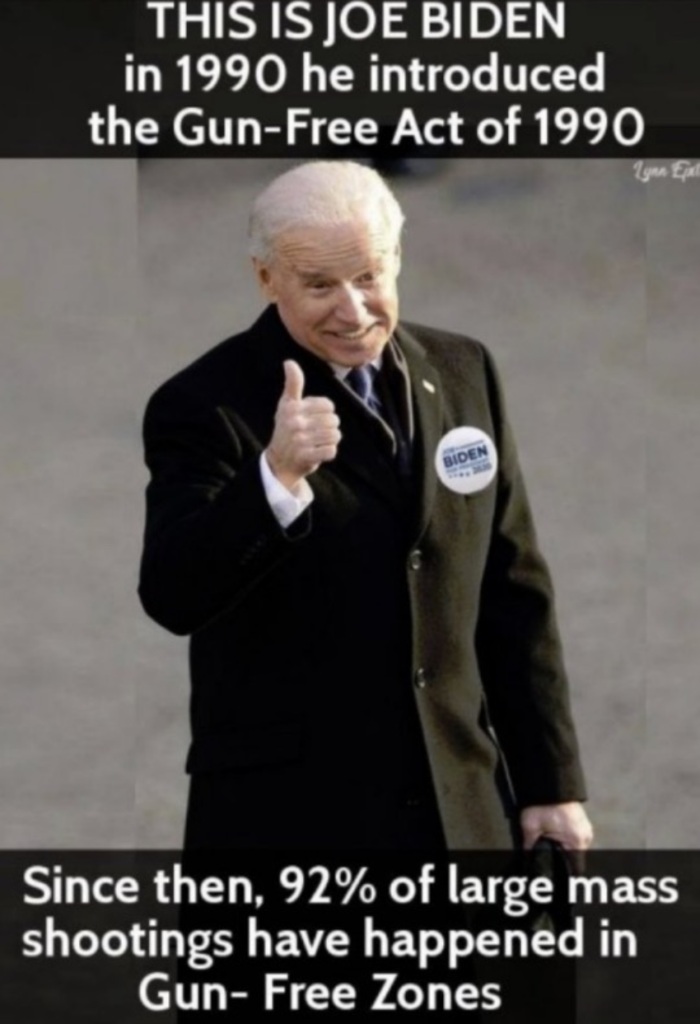
If there was any doubt that President Biden wants to ban the vast majority of guns in the United States, he again clarified his position last week. “The idea you need a weapon that can have the ability to fire 20, 30, 40, 50, 120 shots from that weapon — whether it’s a — whether it’s a 9-millimeter pistol or whether it’s a rifle — is ridiculous,” Biden said at a televised CNN townhall meeting. “I’m continuing to push to eliminate the sale of those things, but I’m not likely to get that done in the near term.”
The president’s gun control proposals will make guns so expensive and difficult to obtain that only the extremely wealthy will be able to afford to own one legally. While the news media assures Americans that Biden just wants “reasonable” regulations, Biden made the scope of his true ambitions clear during the campaign. At a high-dollar private fundraiser in Seattle in 2019 he said: “Why should we allow people to have military-style weapons, including pistols with 9-mm bullets and can hold 10 or more rounds?
When Republicans pointed out that this goal was tantamount to banning most modern handguns, liberal PolitiFact quickly came to Biden’s defense. The fact-checking site did so again last week. “The most popular handguns would face no restrictions under Biden’s policies,” wrote PolitiFact senior correspondent Jon Greenberg. The basis of this conclusion, Greenberg wrote, is that the popular Sig Sauer P365 cannot accommodate more than 10 or 15 rounds. This is untrue. Although that is how the pistol comes from the manufacturer, this gun and virtually all semiautomatics can use bullet magazines that extend well below the pistol grip. The model Greenberg referenced can actually use magazines that hold 20, 30, or even 50 rounds.
Presumably, PolitiFact believes that Biden’s proposed ban would only apply to guns based on their “standard magazine” size. But Biden himself wasn’t ambiguous. He talked about banning pistols based on their “ability to fire” or that “can hold” so many rounds. When he mentions “military-style weapons including pistols,” the president is talking about the gun themselves. He also wants to ban so-called “assault rifles” regardless of how many rounds their standard magazines hold, and he lumps those guns together with pistols. Over 85% of handguns in the U.S. are semiautomatics and would be banned if Biden has his way.


You must be logged in to post a comment.