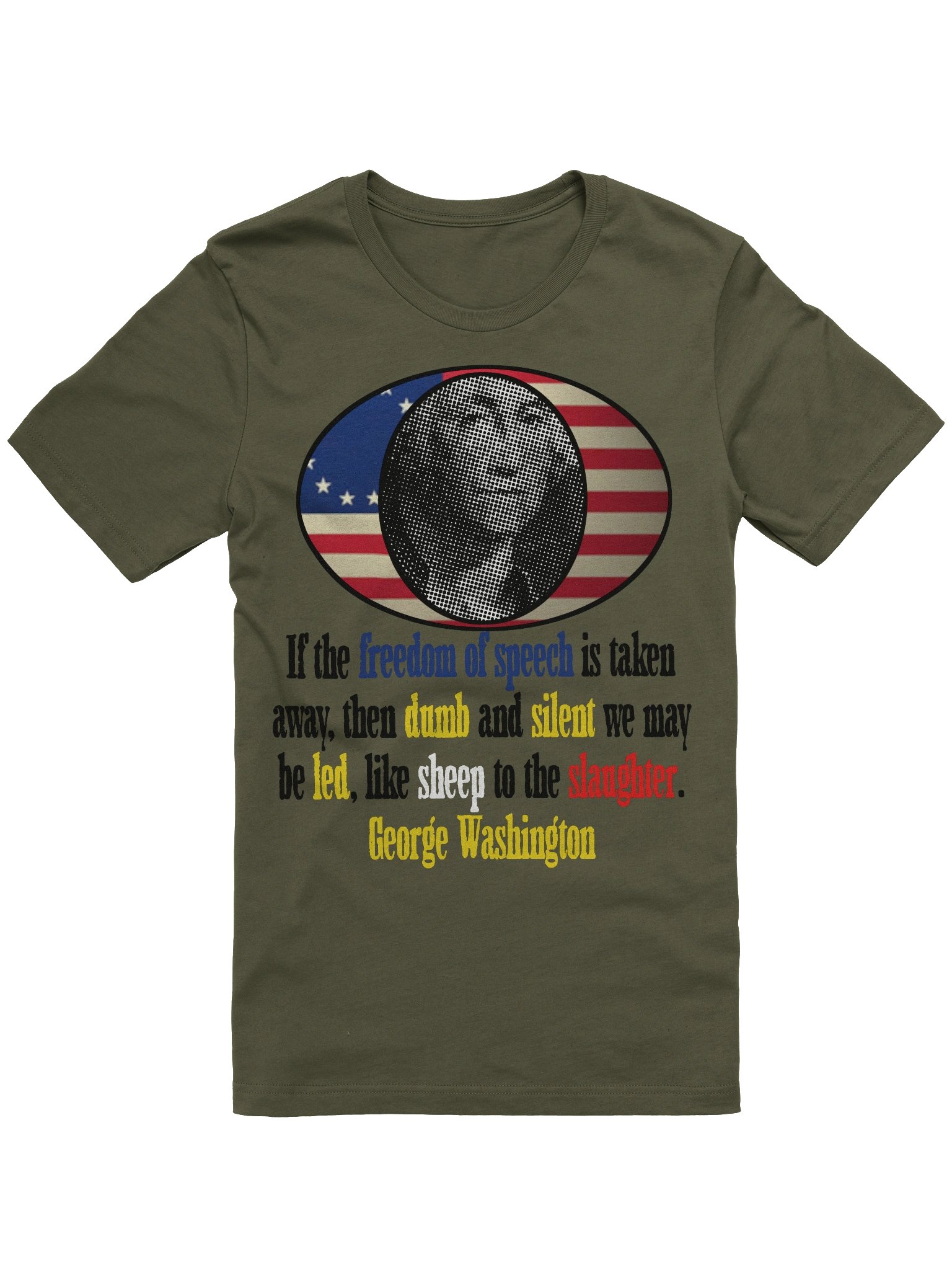
Wise words, indeed. Get yourself something nice, HERE, and help support this site!

Wise words, indeed. Get yourself something nice, HERE, and help support this site!
Hillary Clinton called half of Trump’s supporters a “basket of deplorables.” Joe Biden said, “Donald Trump and the MAGA Republicans represent an extremism that threatens the very foundations of our republic” – while his own Justice Department was trying to incarcerate Trump. Anderson Cooper asked Kamala Harris whether Trump was a fascist, and she answered, “Yes, I do. Yes, I do.”
The label was never just a label. Twitter banned Trump in January 2021 even though, as I discovered reporting on the Twitter Files, the company had concluded he did not violate its rules. Prosecutors then indicted him. A New York jury convicted him on 34 felony counts.
Meanwhile, AP [Associated Press] calls the socialist mayor of New York not “far left” but rather “the democratic socialist leader of America’s largest city.”
In the five months after Trump’s inauguration last year, the networks used “far right” and similar labels 1,222 times. They used “far left” 86 times. Another analysis of more than 30 million articles found that American and British media use right-wing extremism labels more than three times as often as left-wing ones.
If you think this ended with the 2024 election, look at what the same people are doing in Europe, because that is the playbook they intend to bring back here [to the USA].
A German court sentenced a journalist to seven months in prison for a satirical image of the interior minister. Prosecutors raided the home of a pensioner who called the vice chancellor an idiot in a meme. Police carried out 46 home searches in a single day for online speech.
Election officials strike opposition candidates from ballots. A Romanian court annulled a presidential election. French judges banned Marine Le Pen from office and a court ordered her to wear an ankle monitor. German bureaucrats kept a local political candidate off the ballot for his interpretation of “Lord of the Rings.”
What they do over there matters over here. The European Commission fined X [Twiter] €120 million after, in the words of the House Judiciary Committee, it “successfully pressured major social media platforms to change their global content moderation rules.” Global means you.
The creator of the campaign to raise British and English flags across the country to protest against illegal migrants being housed in hotels at taxpayer expense has been charged with 14 criminal offences, including using “threatening, abusive or insulting words”.
Thames Valley Police said on Sunday evening that Ryan Bridge, 45, of Blackwell has been charged with 14 offences relating to alleged incidents between January 31 and March 31 of this year in Oxfordshire.
According to GB News, Bridge was the founder of the Operation Raise the Colours campaign, which began last year in opposition to the government policy of taking alleged asylum seekers and placing them in hotels across the country at taxpayer expense.
The police force said that Bridge was charged with seven counts of using threatening words or behaviour to cause harassment, alarm or distress and three counts of using threatening, abusive or insulting words or behaviour with intent to cause fear of, or provoke, unlawful violence.
He was also charged with two counts of racially aggravated intentional harassment, alarm or distress, one count of racially aggravated fear of violence, and one count of common assault.
Thames Valley Police said that they had decided to submit the case to the Crown Prosecution Service following a review of the evidence, witness statements, and video footage.
It comes as the left-wing-run Birmingham city council that they plan on spending around £2.6 million to remove British and English flags from the streets of the UK’s second city.
According to the Daily Telegraph, around 20,000 flags were raised by members of the public on street infrastructure as a part of the Raise the Colours campaign.
The decision to spend millions removing the national flags comes despite the Birmingham currently being in around £3.5 billion in debt, the most of any local government in Britain.
Meanwhile, in Oxfordshire — where the campaign begun — secured an injunction in July to bar anyone from attaching flags to lampposts or to pain the flag on the road.
Those who breach the injunction against raising the flag face potential prison sentences, fines, or even having assets seized, the BBC reported.
The Liberal Democrat leader of the Oxfordshire City Council, Tim Bearder, said at the time: “This is a welcome judgement. We’re very pleased with the result… This sets a legal precedent and will hopefully deter people in not just Oxfordshire but around the country from partaking in this criminal activity.”
The Trump administration’s crusade to crush campus criticism took another wallop on Friday in a California courtroom. Federal judge Noël Wise ruled that the Trump administration’s “ideological-deportation policy” brazenly violated the US Constitution.
The Stanford Daily—one of the best-known college student newspapers in the nation—sued the Trump administration for changing its “immigration policy and pattern of enforcement, namely by arresting, detaining, and deporting students with F-1 visas when those students use their freedom of speech to express opinions that the government does not like.” It asserted that the Trump administration’s “actions have specifically impacted Stanford Daily by decreasing the quantity and diversity of opinion pieces The Stanford Daily is able to publish on the conflict between Israel and Palestine.” Foreign students who had written on the issue requested that their previous articles be deleted, and other foreign students were no longer willing to comment on hot issues.
The Trump administration claims unlimited discretion to silence foreign students by deporting those whose opinions it disapproves of. Judge Wise wrote, “The language of the [First] Amendment makes clear that it is not the government that gives freedom of speech to the people. Instead, that freedom is imbued in the people. . . . It is not the government’s to take.” This is a notion that conservatives instinctively understand when it comes to the Second Amendment and the right of self-defense. But many people fail to recognize the same right for freedom of speech. Conor Fitzpatrick—the chief supervising attorney at the Foundation for Individual Rights and Expression (FIRE)—which represented the student newspaper, declared, “Today’s ruling proves that free speech isn’t a privilege, but the inalienable right of every man, woman, and child.” FIRE president Greg Lukianoff clarified the scope of the ruling:
This ruling does NOT say the government must admit anyone, issue anyone a visa, or grant anyone citizenship. It says that once a person is lawfully here, the government cannot deport them because they engaged in protected speech. The government cannot tell a legal immigrant: An American is free to say this, but if you say it, you’re out.
George Porteous—Editor in Chief of Stanford Daily—hailed the decision: “The reporters in our newsroom shouldn’t have to fear that writing a story will result in their deportation. Today’s victory means they won’t have to.” But it remains to be seen whether this latest judicial rebuff slows the Trump censorship juggernaut.
Following the murder of conservative icon Charlie Kirk in 2025, The Gateway Pundit reported that more than 100 educators across the state of Texas faced investigations for their vile, hateful, and violent content celebrating his assassination.
Texas Governor Greg Abbott (R) announced that the Texas Education Agency (TEA) began the investigations into teachers who cheered Kirk’s murder and potentially incited additional violence online.
In a strongly worded letter to superintendents, TEA Commissioner Mike Morath condemned the educators’ despicable behavior, noting that such conduct may constitute violations of the Educators’ Code of Ethics.
Not wanting to be held accountable for their behavior, in January 2026, the Texas American Federation of Teachers (Texas AFT) filed a First Amendment lawsuit in federal court against the Texas Education Agency and Commissioner Morath, asking a judge to stop the state investigations so they can be as grotesque on social media as they want.
Texas AFT, along with the national AFT president, the far-left radical Randi Weingarten, and Texas president Zeph Capo, claimed Morath’s letter created a “vague, overbroad crackdown on off-duty political speech, chilled teachers, and led to leave, reprimands, doxxing, a temporary ‘do not hire’ flag,” and at least one firing.
The state, however, argued the letter was not a new policy and pointed to existing ethics rules. Districts, not TEA, made most employment decisions.
The Community College of Aurora closed its conduct case against student journalists this month, finding them “not responsible” due to unclear rules, after restricting the reporters from interviewing and publishing without prior approval and charging them for continuing those activities.
The student newspaper, FoxTalk, is led by CCA student Andrew Green, who told The College Fix via email that the decision, “is a big step forward.”
He added that he still doesn’t “know whether the restrictions on interviews, reporting and publishing have actually been lifted.”
“I want the earlier warning reconsidered, and a clear answer about whether we are free to interview students, report and publish. I would much rather spend my time building the newsroom than fighting the college,” he said.
He added that he believes the school and newspaper can have a “good relationship” moving forward, “while FoxTalk still does independent journalism.”
Green also said he is “working with the Student Press Law Center’s New Voices team to explore legislation around protections for college student journalists in Colorado,” he said.
“Even if FoxTalk and CCA resolve everything, I would like the next student journalist to have clearer rules than I did,” Green told The Fix.
A free speech group called the Foundation for Individual Rights and Expression continues to press the college.
Program Manager for FIRE’s Student Press Freedom Initiative Marie McMullan said the group is “assessing next steps” and that “until the ban on publication and student disciplinary measures are rescinded, our concerns remain.”
She also said that this “kind of blanket ban on student journalism can’t remain in place, and we continue pushing CCA to change its course.”
FIRE had sent a demand letter this month to CCA Vice President Reyna Anaya, calling on the school to “drop the charges against any student who chooses not to comply with such unconstitutional demands, and forego further censorial practices.”
The group alleges that CCA’s directives violated the First Amendment through prior restraint, prior review, compelled speech, and restrictions on associational freedom.
Reached for comment, CCA Executive Director of Communications and Special Initiatives Courtney Butler told The College Fix that the school is still reviewing the matter and is unable to provide additional comment.
FoxTalk was registered under the college on March 13th. In April, Green asked CCA administrators “to confirm whether FoxTalk could seek comment from CCA faculty and staff in their personal capacities without going through Butler’s office,” according to FIRE’s demand letter.
Dean of Student Success Julie LaRock then informed Green that the newspaper would need to “receive staff approval before identifying themselves as FoxTalk staff, accessing non-public spaces, beginning work on each month’s stories, and publishing any content whatsoever.”
LaRock further advised Green to hold off on additional work until structural coordination with the administration and faculty was established.
On June 3, Green questioned the order to stop FoxTalk from publishing, saying the group still planned to cover the June 30 primary election, including a debate at the University of Denver.
After an administrator said FoxTalk only had to follow regular student-organization rules, Green assumed they could publish again and wrote to confirm. The administrator replied that the ban was still in place until FoxTalk’s structure was fixed, and also criticized the activities of three members.
On July 14, Green was charged with interviewing students, posting on the FoxTalk website, contacting employees, and ignoring earlier orders. On July 23 he was charged again for not following a college official’s directives.
McMullan told The Fix that CCA’s rationale for restricting the students is not very common compared to what the group has seen in the past. However, several other schools have similarly tried to restrict student journalists.
“Repeatedly … universities and colleges subjecting student journalists to investigations, hearings, and punishments for basic newsgathering and publishing, or attempting to wholesale stop students from publishing,” she said.
Morgan State University, for example, implemented a policy that restricts student journalists’ ability to gather news directly, requiring media inquiries to go through the Office of Public Relations and Strategic Communications, The College Fix previously reported.
McMullan previously told The Fix this policy is a “blatantly” illegal “gag order.”
Texas Attorney General Ken Paxton, who is currently running for the US Senate, and pushing online digital ID age verification checks in the name of “online safety,” has announced a data center plan that, among other things, vows to “protect children” by making data center companies criminally liable if the centers they operate “empower AI chatbots that undermine children’s safety.”
Paxton is effectively promising to author legislation that would introduce a novel form of liability, aimed at data centers – the physical and hardware part of the internet’s infrastructure – for the content that is generated by software running on their servers.
This is a clear departure from the principle, enshrined in Section 230 of the Communications Decency Act (CDA), that internet infrastructure is not liable for third-party, user-generated content.
And, while Paxton’s plan speaks of chatbots that “undermine children’s safety” – a broad and vague term that can easily be abused to censor speech – the actual target could be any chatbot, and any speech.
And the liability would be criminal.
Paxton is quoted as saying in a post on X: “My Texas First Data Center Plan will protect our grid, our communities, and our children while ensuring America beats Communist China in the AI race,” he wrote.
In the heart of the Oxford Union, a supposed bastion of open debate, a single brown paper envelope triggered pure panic.
Commentator Laurence Fox stood to argue that the West is right to be suspicious of Islam. He held up the envelope and indicated it contained a cartoon of the prophet Muhammad. The chamber erupted in frantic attempts to stop him opening it. Rules were suddenly invoked. Relevance was questioned. Respect was demanded.
The Muslim president of the Union interjected that her very presence should have been enough to persuade Fox that Muslims believe in free speech.
“My wife asked me not to show this for fear of repercussions for my family,” Fox said. “But I told her that if I did not, I would have submitted to Islam.” He continued that the West should resist Islam “in the strongest terms on free-speech grounds alone.”
Fox opened the envelope and revealed a cartoon of Rees-Mogg. Laughter and applause followed. The fear that had gripped the room evaporated the instant it became clear the image did not depict Muhammad.
In that moment the argument was settled more effectively than any speech could manage.
The debate took place under the motion “This House believes the West is right to be suspicious of Islam.” Speaking for the motion were actor and free-speech campaigner Laurence Fox, Tommy Robinson, and writer Jonathan Sacerdoti. Against them stood Oxford Union president Arwa Elrayess, a 20-year-old Muslim of Palestinian heritage from Gaza, Rees-Mogg, and others. Outside, left-wing protesters tried to block entry. Inside, the atmosphere was already charged.
Fox made free speech the centrepiece of his case. He cited polling showing that 78 percent of British Muslims believe no publication should print pictures of Muhammad, rising higher among some groups. He noted that Britain had long abandoned its own blasphemy laws. Then he produced the envelope.
Jacob Rees-Mogg, speaking against the motion, reached for procedure, recalling that as a former Union librarian he believed props were against the rules. Others in the audience scrambled for any technicality that might prevent the image from appearing. The chair eventually ruled that props were permitted.
While no doubt there remains room for improvement Campus Reform is reporting that “A new study from the Foundation for Individual Rights and Expression (FIRE) has found that the number of schools maintaining restrictive policies on student expression has hit an all-time low.”
This is good news for those of us that still believe in free speech and for conservative organizations who wish to express their views.
“The organization’s annual Spotlight on Speech Codes report found that the number of overall schools with a “red light” rating fell to 13.2 percent, while just 9.8 percent of public schools earned the designation.”
This is surprising yet good news for the country and shows what having a President who believes in free speech can do.
These numbers while still not perfect are a far cry from the days the “group’s first study published in 2006, 68.6 percent of schools earned red light ratings.”
The original number was pathetic if unsurprising but the new numbers are shocking!
“Conversely, schools with a “green light” rating have policies that “do not seriously threaten protected expression.” This year’s report found that a total of 76 schools earned such a rating, the second time that they have outnumbered ones with a red light rating.”
Ann Widdecombe’s murder has reopened a question that surfaces from time to time: should politicians with ‘unfashionable’ views get extra protection? The investigation continues, so I won’t comment on that, but the fact that the question is even being asked in response to a 78 year-old woman being killed in her own home tells you something regardless of how the investigation concludes. We have been here before. Jo Cox in 2016. David Amess in 2021. A pattern is forming, whatever the final facts of this particular case turn out to be.
The debate this triggers is usually framed narrowly: what security do MPs need? I want to push it wider: what if politicians are not actually the group most exposed? They have protection officers, party machinery and a public profile that makes an attack on them a national story. I have none of that. Neither does anyone else who simply has an opinion and a job to protect.
I recently listened to Professor David Betz of King’s College London’s Department of War Studies, who argued that Britain may be entering a period of increasing internal conflict in which political violence becomes more likely.
Whether or not one accepts his analysis, it’s difficult to ignore the growing sense that our public discourse has become more hostile and less forgiving.
If expressing political disagreement increasingly carries the risk of intimidation or worse, the answer cannot simply be to provide more security for an ever-expanding list of public figures.
That treats the symptom rather than the disease.
I consider myself an ordinary person.
Thirty-plus years ago I would have considered myself slightly Left-leaning. I liked to think of myself as one of the good guys.
But somewhere in the last three decades the Overton window slid sideways, and views I’ve quietly held throughout – that mass immigration, legal and illegal, hasn’t obviously benefited the culture I grew up in, that free speech should mean everyone’s speech, including the people I disagree with – are now filed under ‘Right-wing’.
I don’t think I’m unusual. Look at the Brexit vote, which for many people was as much about sovereignty and control over immigration as it was about Brussels. Look at any poll on migration levels. There is a large, ordinary, non-extreme constituency that holds views broadly like mine. And a good number of them, I suspect, keep quiet for the same reason I’m staying anonymous here: weighing up whether speaking out is worth the risk. Silence can easily be mistaken for consensus, and I suspect that’s exactly what’s happening here.
Which raises a question I’ve had to sit with while writing this: am I a coward? Publishing anonymously, after all, is a way of having the argument without paying for it. But I don’t think cowardice is really what’s on display here. A coward stays silent. What I’m doing is closer to something else entirely: deciding that saying this at all matters more than saying it under my own name, while still not being willing to bet my livelihood on it. If that’s cowardice, then I suspect it’s shared by a very large, very quiet number of people who hold perfectly mainstream opinions and have simply done the same calculations that I have. That, in itself, might be the more troubling finding than anything else in this piece.
This is the part I think gets missed in the security debate. We talk about authoritarianism as something that happens to you: a knock on the door, a lost job, a police caution for a tweet. But before any of that, there’s the version that happens inside your own head. You draft the post and delete it. You bite your tongue at the dinner table. You calculate what a client, a neighbour, or a local WhatsApp group might do with an honest opinion, and you decide it isn’t worth finding out.
That calculation isn’t paranoid. The variables feeding it are laid out in article after article in the Daily Sceptic. Prevent’s own material cites “cultural nationalism”, defined as the belief that Western culture is under threat from mass migration and a lack of integration by specific ethnic and cultural groups, as a sub-category of extreme Right-wing ideology. Two-tier policing is underpinned by the College of Policing and National Police Chiefs’ Council (NPCC) Anti-Racism Commitment, which states that policing should not be “colour blind”, a principle many officers and members of the public have read as licence to treat people differently according to race. It is perhaps no coincidence that public trust in these institutions has been falling sharply. Gallup found that Britons’ confidence in the courts dropped 12 points in a single year to 57%, while confidence in local police fell 11 points to 64%, the largest year-on-year declines on record for either measure. When the referee looks like it’s picking sides, people stop trusting the game.
Campaigners have logged tens of thousands of ‘non-crime hate incidents’ a year, the great majority of them originating from something someone posted online. And after events like the Southport riots, an entire category of people were branded ‘far-Right thugs’ as a matter of editorial habit. None of this needs to end in a prosecution for it to work. Its function is to make you flinch before you speak, not after. And it’s working: a YouGov poll found that 57% of Britons admit to sometimes holding back their views for fear of a negative reaction, and research published earlier this year found the same pattern setting in even among teenagers, with around one in five saying they hide their political opinions at school to avoid being ‘cancelled’. Self-censorship of this kind isn’t a fringe habit. It’s now closer to a majority experience.
Nothing dramatic has happened to me. Nobody has knocked on my door. I have not been arrested, cautioned or sacked. I have simply chosen, before any of that could happen, to leave my name off this piece. That is precisely the point. Fear doesn’t need to become reality to change behaviour. The anticipation of it is enough.
That’s the self-censorship no one puts a number on, and I think it’s doing more to shrink public debate than any single policy or piece of legislation. Its success isn’t measured by how many people it punishes, but by how many quietly change their behaviour hoping never to be punished at all.


You must be logged in to post a comment.