Stop Mad King Donald’s Iran War: An Open Letter to Members of the US Congress

Dear Members of Congress,

In truly deranged remarks to world leaders at the UN, Donald Trump declared that “I have a big decision to make,” whether to negotiate a deal with Iran or instead to “annihilate the Islamic Republic” and drive Iran “into hell with no chance of survival.”

He posed it as his personal choice. The fact that the American people are dead set against Trump’s war means nothing. And as for the voters, he added that he gives “absolutely no credence” to the coming midterm elections in deciding on his actions and on Iran’s fate.

Nothing binds this President. He is not bound by law, the Constitution, the UN Charter, or public opinion at home and abroad. When asked at the start of the year whether he has any limits on his power, he said “Yeah, there is one thing. My own morality. My own mind. It’s the only thing that can stop me.”

Trump opened his speech with the 250th anniversary of the Declaration of Independence, hailing America’s freedom. The fact is that Trump’s authoritarianism far outdoes that of King George III, against whom the colonies rebelled. Among the founders’ indictments of Mad King George was that “He has affected to render the Military independent of and superior to the Civil power.” Yet our own mad king has decided that the survival of a whole civilization is in his hands alone.

Trump is emboldened in his contempt for Congress because the Republican members of Congress have abdicated their constitutional responsibilities, terrified of their own president, and forsaking their constituents for campaign lucre from AIPAC and the military-industrial complex.

The Constitution is unambiguous regarding Congress’s responsibility. Article I, Section 8 assigns Congress, not the President, the sole power to declare war. That is not a choice or an option. The Constitution doesn’t say that Congress can play dead and let the President declare war. The Framers made this choice deliberately, because they were explicitly rejecting the power of a king to take the nation to war.

In Federalist 69, Hamilton assured the public that the President’s war powers would be far less than the British monarch’s. Madison stated the principle plainly in a letter to Jefferson in 1798: “The constitution supposes, what the History of all Govts demonstrates, that the Ex. is the branch of power most interested in war, & most prone to it. It has accordingly with studied care vested the question of war in the Legislature.”

The founders’ careful design has been overturned because of the unconstitutional subservience of the Republican members of Congress to Trump and to the military-industrial-digital complex. And yes, under Democratic presidents, most Democratic members of Congress also looked the other way when those presidents chose to go to war.

The war with Iran is Trump’s folly but Congress’s disgrace for not stopping it. It is a war without a purpose that has created mass suffering in Iran, tens of billions of dollars of direct outlays, and staggering damage to American military bases in eight countries of the Middle East. The closure of the Strait of Hormuz has sent world and American prices soaring for oil, gas, fertilizers, and more. And the world has duly noted that Iran can hold its own against US aggression, albeit at great sacrifice to the people of Iran and the region.

America’s much vaunted AI battlefield has been exposed in the most horrifying way. On the first day of the war, an American missile struck the girls’ elementary school there, killing more than 150 people, most of them girls aged seven to twelve, and the military’s own inquiry reportedly found that over-reliance on artificial intelligence contributed to the targeting. Trump blamed “Iran or somebody else,” and seven months later the administration has offered no findings, no apology and no compensation to the families.

The President’s threat to annihilate a member state of the United Nations, delivered from the General Assembly podium, disgraced Trump in front of the world. It also violated Article 2(4) of the UN Charter, which prohibits even the threat of force against another state. Nearly all the world stands aghast.
Keep reading

Trump asked China’s president if he wants to buy US arms, ambassador says

The U.S. ambassador to China says President Donald Trump asked Chinese President Xi Jinping if he wanted to buy weapons from the United States.

WASHINGTON (AP) — President Donald Trump has justified the pending U.S. arms sale to Taiwan to Chinese President Xi Jinping by downplaying it as just one of many sales Washington makes around the world — even asking Xi if he’d be in the market for U.S. arms, Trump’s ambassador to China said on Sunday.

David Perdue said Trump raised the prospect of the arms sales from the U.S. to its ascendant geopolitical rival, an unlikely offer that if consummated would upend generations of U.S. policy toward China and Taiwan and potentially expose U.S. technology to a potential foe. Perdue, speaking to Shannon Bream on “Fox News Sunday” days after Trump hosted Xi for a state visit in Washington, didn’t specify when the offer was made.

Bream had cited concerns from Republican and Democratic lawmakers over delayed aid packages and weapons orders to Taiwan, the self-ruled democracy, to defend itself from China’s threat to invade the island. Bream asked if the U.S. is denying Taiwan to appease the Chinese president, who visited Trump last week.

Perdue pushed back on the suggestion, stating that Trump “is as strong on Taiwan as I’ve ever seen anybody” and has sold it plenty of weapons. Perdue also said Trump and Xi continue to talk about future U.S. weapons sales to Taiwan.

“But President Trump continues to say, ‘Hey, we sell arms to other people around the world,’” Perdue said. “He actually asked President Xi, would he like to buy some, at one point.”

The U.S. is bound by its own laws to provide Taiwan with the means to defend itself. While not recognizing Taiwan as a country, the U.S. is the island’s strongest informal backer and arms provider. But multiple U.S. leaders have left ambiguous whether they would commit military force to defend the U.S. ally should China invade.

China has pressed Washington to halt the arms sales, most prominently during a previous summit in May between Trump and Xi in Beijing. After that meeting, the United States paused the sale of a record-breaking $14 billion package — and Trump described arms sales to Taiwan as a “very good negotiating chip” with China.

In their private talks at the White House last week, Xi pressed Trump to oppose Taiwan independence, according to Chinese state media.

Keep reading

TikTok To Pay Alabama At Least $100 Million, Add Teen Limits Before First State Trial

TikTok and its creator ByteDance struck a deal Friday with Alabama that will pay the state at least $100 million and force changes in how teenagers use the app, days before what would have been the first state trial over claims the platform was built to addict minors.

The money is due within 45 days. It can climb to $300 million if certain conditions are met, Alabama Attorney General Steve Marshall’s office said. Alabama was set to select a jury on Monday.

“This is a great day for Alabama parents,” Marshall said. “Tonight, they can rest easier knowing real protections are in place to shield their children from the dangers of social media addiction. TikTok has agreed to give parents real control over what their kids see and how much time they spend on the app.”

The complaint had accused TikTok of designing addictive features, exposing young users to serious mental harms, and misleading the public about safety.

TikTok did not admit those claims in the papers released Friday.

The company did not immediately return a request for comment.

The deal requires teen accounts in Alabama to have a two-hour daily cap, which parents can further shorten. After 15, 60, and 90 minutes of continuous use, the app must interrupt the session, a feature the office called “productive pauses,” intended to break endless scrolling.

Teen accounts will be unavailable from midnight to 6 a.m. Messaging and push alerts face extra limits overnight and during school hours. In addition, cosmetic filters are banned for teen users.

The default feed for those accounts is to remain non-personalized, and teen accounts are to be harder for adults to find. Parents get notice of suspicious contacts. Parental controls are supposed to be easier to use.

Last month, a multi-state Meta deal was set to bring Alabama $117 million on similar youth-harm allegations. Earlier, Roblox paid the state $12.2 million and agreed to tighter age checks and chat rules.

The Alabama deal arrives as other fights progress.

On Sept. 10, a Travis County, Texas, judge ruled that TikTok violated the state’s consumer protection law by misleading users about tools meant to keep minors from harmful videos. Judge Cory Liu found Restricted Mode did not work as marketed.

Texas Attorney General Ken Paxton said the case now goes to trial next month to set penalties.

“TikTok sacrificed the safety and innocence of children for engagement and numbers, and now they are being held accountable,” Paxton said then.

Keep reading

Another Incredible Win Against the Covid Tyrants: New Jersey Jury Delivers Unanimous 8–0 Verdict for Christian Groundskeeper Fired Over a Religious Exemption — Awarded $671,000

A New Jersey jury just delivered a message that the Democrat machine in Essex County did not want to hear.

On Friday, an Essex County jury returned a unanimous 8–0 verdict for Theodore “Teddy” DeBlasio, a longtime groundskeeper at Essex County Hospital Center who was fired after the county denied his religious exemption from the COVID-19 vaccine mandate.

The panel awarded him more than $670,000 for economic and emotional harm. Attorneys’ fees are still to come. Punitive damages are next.

Attorney John D. Coyle of Coyle Law Group called it New Jersey’s first jury verdict in a COVID-19 religious exemption case.

DeBlasio, raised Catholic and now a Christian, objected to taking a shot tested or developed using aborted fetal cell lines. That is a sincerely held religious belief millions of Americans share. Essex County treated it like a punchline.

According to trial evidence cited by Coyle Law Group, in February 2022 the county denied every religious exemption request submitted by Christian and Catholic employees, and approved every request submitted by Muslim employees.

Coyle put it bluntly on X:

“It was revealed at trial that Essex County denied each and every request from a Christian employee and granted every Muslim exemption. That isn’t an exaggeration.”

“Catholic groundskeeper could not safely test and mask but a Muslim NURSE could test and mask.”

“Essex County determined that Teddy DeBlasio—with the crown of thorns tattooed on his wrist to remind him to think of Jesus with his actions—did not have sincere beliefs but a Muslim employee who photocopied another Muslim’s exemption, did.”

Keep reading

Columbia professor wins award for book on ‘white paint’ being racist

Among the many woke winners of this year’s prestigious National Book Awards is a black Columbia University professor whose screed attacks “white paint” as racist.

Professor Wendy Walters’ new book, “A Dead White: An Argument Against White Paint,” claims that white paint is not the “neutral” architectural design element that it initially appears to be.

Instead, she “interrogates all that we have taken for granted about the substance that colors, or fails to color, the structures and objects that surround us—and what the collective impulse toward white paint can tell us about culture, politics, and individual desire,” the publisher’s description states, in part.

The idea for the book originated with the Ivy League professor’s “genuine and visceral dislike of white paint – a feeling that is at times overwhelming,” she explained in a 2021 video for Creative Capital Foundation on YouTube.

But Walters pushed back on the idea that her emotional response is “possibly irrational.”

“As I tried to understand why my response to white paint was so strong, I discovered numerous examples of the way that it figured into systems of erasure, exclusion, violence, and the masking of power in the social and natural world,” she said in the video.

Most of the examples she gave linked white paint to racism. 

In one, white supremacists splattered white paint outside the Rothko Chapel in Houston, Texas in 2018, and, in another, white paint was used to vandalize a 100th anniversary memorial gallery to the Tulsa race massacre in 2021. 

She also mentioned a rainbow crosswalk for “LGBTQIA+ persons” in New Brunswick, Canada being painted over with white paint in an “act of intolerance.”

“I hope to encourage the reader to think about how practices of decoration and adornment might allude to hidden narratives of power, whether or not they recognize them as being so,” she said in the video.

The publisher’s description of her work does not mention racism or white supremacy, and the book isn’t scheduled for release until October. 

However, in the 2021 video, Walters linked the book to her past writings about racism. According to her university bio, she “writes regularly about visual culture, political geographies, climate, and race and identity.” 

“A Dead White” is not the first to link white paint to racism, though.

Three years ago, Norway’s University of Bergen received a $1.2 million government grant to explore how white paint has contributed to white supremacy around the world, The College Fix reported at the time.

The “NorWhite” study focuses on whether the Norwegian-developed paint pigment titanium dioxide white helped advance white “as a superior color,” Fox News reported. 

Why such projects are deemed worthy of awards has a lot to do with the left’s capture of the arts and academia. As New York Times columnist Bret Stephens wrote on Tuesday: “Bluntly, the National Book Award has become a D.E.I. checklist: Only authors with preferred identities, preferred topics and preferred politics stand any realistic chance of winning.” 

Stephens mentioned Walters’ book as one example. Other winners, announced last week, include books about “queer” parenting and “Islamophobia in America.” 

The problem is not that moderates or right-leaning authors are no good. The problem is that they are being shut out and a broad range of topics and ideas are being ignored. 

Maybe Walters is a good writer. Maybe not. Her book isn’t available to the public yet. But this “everything is racist” bent is getting old and boring. Frankly, it’s lazy, too.

Pick something, anything: clean pantries, clowns, Mozart, capitalism, mathematics, milk, Taylor Swift (these are already taken, by the way). Then, argue that it’s racist, smatter in a few “lived experiences” and – voila! – book deals and major prizes. Repeat. Again, and again, and again.

And they wonder why so many Americans have developed a distaste for academia.

Keep reading

Has prelude to World War III arrived? ‘Key players greatly underestimate the potential for disaster’

A growing collection of wars and military flashpoints involving several nuclear powers is raising concerns that miscalculation or escalation in one region could pull major powers into a far wider conflict.

Russia’s war against Ukraine has entered a “dangerous new phase” in which the threat of regional spillover is growing, U.N. Under-Secretary-General Rosemary DiCarlo warned Wednesday, according to the United Nations. The Middle East is simultaneously confronting the continuing U.S.-Iran conflict and renewed fighting in Yemen, while tensions involving China and Taiwan and nuclear-armed India and Pakistan remain potential avenues for another major confrontation, according to the Council on Foreign Relations (CFR).

“It’s possible to consider that World War III has begun,” defense policy analyst and retired Marine Dan Grazier told the Daily Caller News Foundation. “The big problem before World War II was there were all these separate conflicts that were going on at the same time, and it was only a matter of time before they all got linked together.”

The number of armed conflicts worldwide has reached its highest level since the end of World War II, according to the CFR. Roughly 620 American government officials, foreign policy specialists and academics responded to CFR’s 2026 Preventive Priorities Survey, which identified a Taiwan Strait crisis and clashes between Russia and NATO as scenarios with potentially severe consequences for the United States.

“I would characterize the current environment as extremely dangerous, in part because key players greatly underestimate the potential for disaster,” the director of grand strategy at the Quincy Institute, George Beebe, told the DCNF. “The biggest problem is that many leaders in the West believe the key to avoiding war is to demonstrate our resolve to escalate the use of force against our adversaries. They believe that diplomatic compromise constitutes ‘appeasement’ that endangers us.”

The nuclear danger extends beyond the sheer size of the world’s arsenals.

Of an estimated 12,187 nuclear warheads worldwide at the beginning of 2026, roughly 9,745 remained in military stockpiles available for potential use, 4,012 were deployed with operational forces and as many as 2,200 were kept on high operational alert aboard ballistic missiles, according to the Stockholm International Peace Research Institute. All nine nuclear-armed states also continued modernizing and enhancing their arsenals during 2025, with most deploying new nuclear-armed or nuclear-capable weapons systems.

Keep reading

New York Teen Forced Out of School After Judge Denies Medical Exemption

A senior at a New York high school can no longer attend class as of today, after a federal judge declined to extend a medical exemption from the school’s vaccine mandates for the current school year.

Last year, U.S. District Judge Gary Brown of the Eastern District of New York ordered a New York school district to allow Sarah Doe, who had obtained a medical exemption, to attend high school during the 2025-2026 school year.

But in a ruling issued late Wednesday in Jane Doe v. Oceanside Union Free School District, Brown denied the renewed medical exemption request for the 2026-2027 school year.

Last year, Brown granted an emergency preliminary injunction allowing Sarah to attend 11th grade without receiving the third dose of the hepatitis B (Hep B) vaccine — the only recommended shot she hadn’t taken at the time — because her severe reactions to previous doses had left her sick and disabled.

When the lawsuit was filed, at least six treating physicians certified to the school district that Sarah could be harmed by taking the shot, according to court documents. The district nonetheless repeatedly denied her exemption requests. Since then, more doctors have affirmed that assessment.

Brown said last year’s decision rested in part on a physician’s report that Sarah experienced an anaphylactic reaction to an earlier dose, and evidence she had received the first two doses and had some immunity.

Brown also based his previous decision on an appeals court precedent stating that there had never been definitive proof that hepatitis B could be transmitted through “non-parenteral” routes like saliva — meaning passed in ways not transmitted through blood or broken skin.

After attending school last year under the court order, Sarah applied for a medical exemption from the Hep B vaccine and also the second meningococcal vaccine required for this school year.

The school district again denied her request. Sarah’s lawyers responded by filing an emergency motion seeking a new court order allowing her to return to school this year.

Explaining his latest decision, Brown said this year’s circumstances were “substantially different.” This year, Sarah would be attending school without two of the mandated vaccines, instead of one. And, he said, there was insufficient medical evidence showing that she could not receive the meningococcal vaccine.

“At the end of the day, Sarah is a child who just wants to go to school,” her attorney, Sujata Gibson, told The Defender.

Keep reading

Vaccines have never been safe and effective: A century of documented failures of smallpox vaccination

“At one time it was believed and generally understood that after we had once had the disease we were for ever secure against it, but it is now proved that a second and even a third attack is by no means uncommon among persons of a peculiar habit of body, and whose lives are spent in opposition to all sanitary laws. This error led to that blind infatuation of being inoculated for the Small-pox which became so fashionable in the last century, and which, after much controversy, was adopted by the London College of Physicians, who considered it ‘highly beneficial to mankind’.”—William Job Collins, MD, twenty-five years public vaccinator, London, England, 1869[1]

“Millions of vaccinations are made every year, and nobody knows what they are made with. The whole process is a haphazard game with chance. Vaccination was accepted on the simple dictum of Jenner that it would stamp out smallpox. The medical profession of today buys its vaccinal virus of those who make merchandise of it on their simple dictum that it is the right thing to use … I compiled a list of upwards of a thousand instances of persons who had suffered permanent injury, or death [from vaccination] … Of these, nine have been personally known to me.”—George William Winterburn, PhD, MD, author of The Value of Vaccination: A Non-partisan Review of Its History and Results, 1886[2]

“Cow-pox was exceedingly virulent and fatal disease coming to fag end of its career in Jenner’s time. He found it difficult to get lymph from the cow, and therefore he resorted to the heels of horses; and the original lymph we use from the Royal Vaccine Institute has never been vaccine lymph at all; from the day it was introduced into London to the present time – it was derived from the arm of Jane King, who was inoculated from a horse with greasy heels.”—John Le Gay Brereton, Esq., MD, MRCS, LAC, 1881[3]

“This madness – first filtered through the brain of Jenner by the superstitious old women of Berkeley and its neighbourhood, who had long secretly practised vaccination upon children – was, after some few years of hard fighting, transmitted to Sir Gilbert Blane and a few of his class; and as these were the great ‘medicine men,’ whose wisdom excelled all others, the delusion was soon shared by the King. From the King it passed to the Court, from the Court to the Government, from the Government to the profession, and from the profession to all who readily move by example in high places. In this way, not England alone, but every part of the civilised world, more or less, went mad; and humanity is now reaping its reward – not in the extirpation of small-pox, as promised by these fanatics, but in the increase of diseases more frightful in their character, and in their general results more fatal.”— Dr. Skelton, Licentiate in Medicine and Surgery, London and Edinburgh[4]

In 1796, Edward Jenner tested a popular belief: that cowpox protected against smallpox. He obtained cowpox material from a milkmaid and used it to inoculate an eight-year-old boy named James Phipps, whom he then deliberately exposed to smallpox. Because the boy did not fall ill, Jenner concluded that the procedure – cowpoxing, later given the more scientific-sounding and mysterious name vaccination (from vacca, Latin for cow) – was effective and conferred lifelong protection. On 17 March 1802, he informed the House of Commons that vaccination was entirely safe, granted lifelong immunity and would rid the world of smallpox.[5]

From the outset, however, many regarded this new notion – built on eighty years of smallpox inoculation – as anything but safe or effective. Yet the idea took hold almost immediately. As Dr. William Rowley, MD, observed in 1805 – less than a decade since vaccination had started – “Whoever had not taken the oaths of supremacy and allegiance to vaccination, or who dared to doubt the infallibility of Cow-pox inoculation even in its infancy, even before any judgment could be formed, were ignominiously treated as traitors to the royal vaccinating state, as rebellious subjects to the Jennerian despotic power.”[6] Decades later, Dr. Charles Creighton likewise noted how firmly this idea had taken root: by 1801, he wrote, professors and others of his class “on the Continent as well as in England were already deeply committed“ and that “anyone who undertakes to answer for Jenner and his theories, must shatter his own reputation for scientific and historical knowledge.”[7]

What follows is not a history of vaccination’s triumphs but a record of its failures – drawn almost entirely from the testimony of physicians who witnessed them firsthand. The timeline that unfolds across the following decades chronicles smallpox vaccination’s inability to shield against the very disease it promised to conquer, together with the injuries and deaths that followed in its trail. The quotations assembled here, spanning 1799 to 1910, call into question the triumphant narrative so widely accepted about this medical intervention.

Keep reading

Revealed: the undisclosed safety data emerging as weedkiller maker faces Parkinson’s lawsuits in US

Sweden started ringing the alarm bell more than 20 years ago, calling for a ban on the weedkilling chemical paraquat in 2004. One by one, dozens of other countries did the same as evidence of paraquat risks to human health mounted. Even the Chinese government, which owns the longtime paraquat maker Syngenta, halted domestic use of the pesticide a decade ago after conducting its own studies on paraquat safety and finding troubling results.

In the US, two states – Vermont and California – have recently also banned paraquat, citing risks that include an association between paraquat and Parkinson’s disease shown in years of scientific research. And California regulators announced in August that paraquat makers voluntarily agreed to stop selling the chemical after the state identified health concerns in connection with its use in new research. Several federal lawmakers have pushed for a nationwide ban.

Yet amid the global cloud of concern, the US Environmental Protection Agency (EPA) continues to greenlight paraquat use on millions of acres, and has downplayed scientific findings linking paraquat to Parkinson’s, an incurable brain disease. The agency said in June it would hold a round table over the summer to re-examine the “safety challenges” associated with paraquat. But no such event has yet been held or scheduled.

Now, clues to how and why the US remains one of the world’s last large markets for widespread paraquat use are coming to light through troves of internal Syngenta records recently revealed through litigation.

The records show that as paraquat markets around the world started crumbling over concerns for public health, Syngenta, a Swiss-headquartered multinational, fought to keep a tight hold on the US market, where use of paraquat nearly tripled between 2000 and 2018, a time period when dozens of other countries were banning paraquat.

Internal corporate records, depositions and other records show that before and during this time frame, Syngenta did not share certain internal data and other information with the EPA regarding paraquat health effects and risks despite federal legal requirements for companies to report information about “unreasonable adverse effects” of their products.

Among the data not shared by Syngenta were analyses of how quickly the chemical could permeate untreated clothing; how fast it could absorb into an applicator’s skin and bloodstream. The company also did not share some information about how mixing paraquat with surfactants increases the chemical’s absorption. Surfactants are additives commonly used by farm workers to help herbicides overcome the waxy, water-repellent surface of their leaves. Certain information demonstrating dire risks to the brain from exposure was also not shared with the EPA.

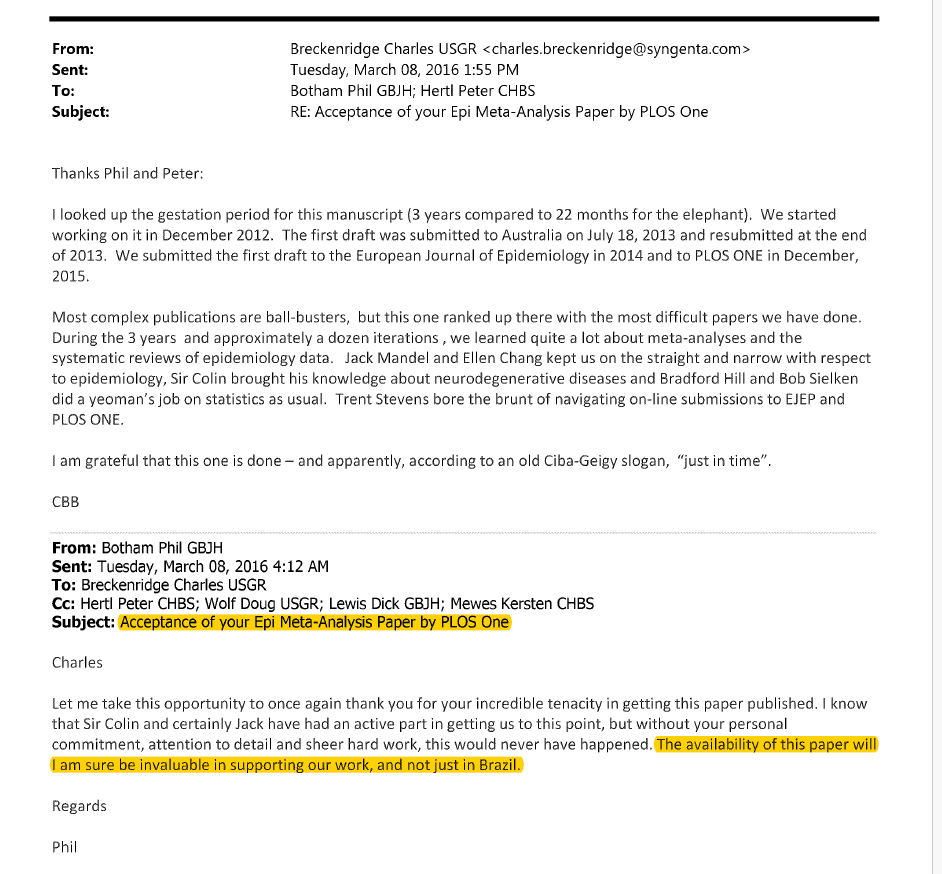
In contrast, the company focused on developing and promoting science showing paraquat safety that it could share with regulators, including one published in 2016 that company insiders noted would be “invaluable in supporting our work”.

Keep reading