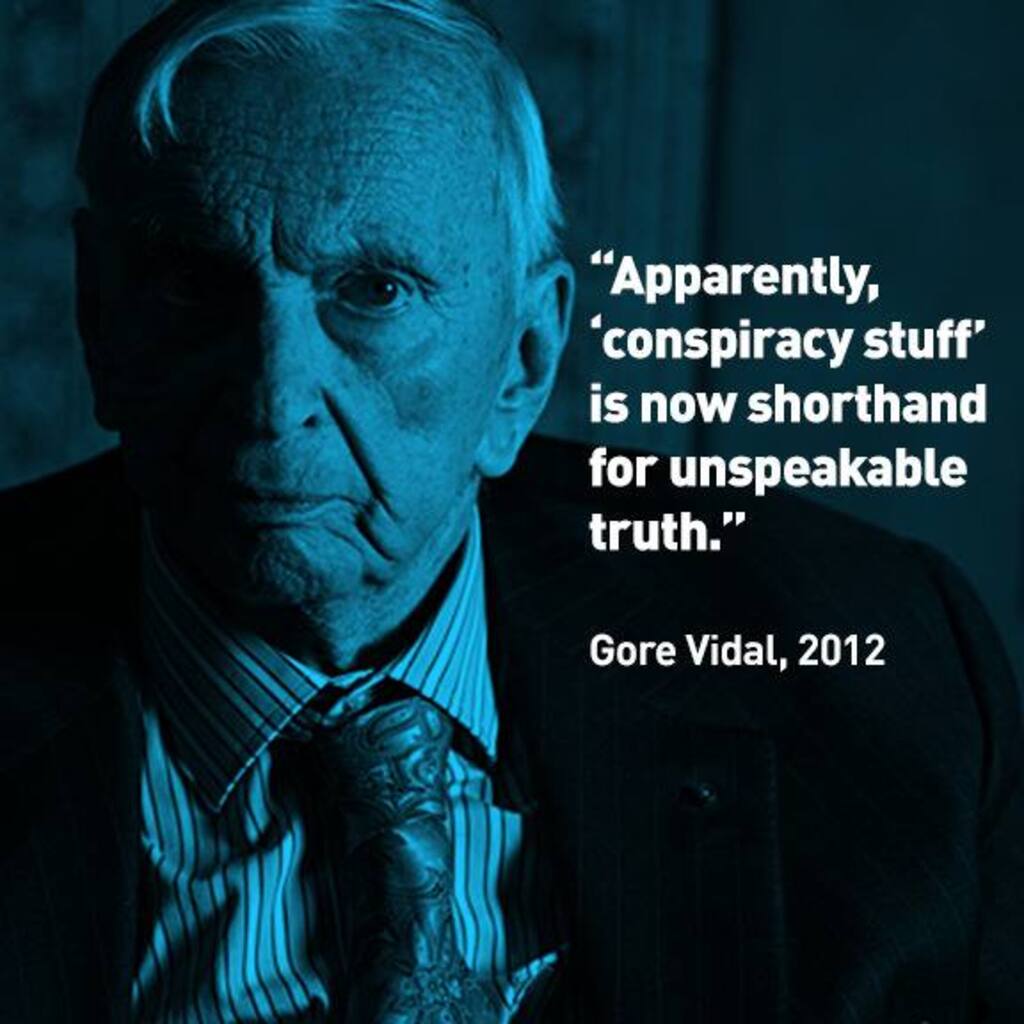
Gore Vidal on conspiracy theories…

Twitter is a “social” network that is paradoxically becoming ever more insular and anti-social – apparently, all in a bid to “protect” users from one another. This seems to be the idea behind testing new features such as the one called “Safety Mode,” that includes something called, “autoblock.”
At some point, the question might start arising in the minds of some, or even many, people: why even use a platform that you consider to be so potentially dangerous that it has to implement such a granular and complex system of separation and prevention of access to content and accounts?
But at this time, Twitter is still widely used and marching on its chosen path. And, right now, the “autoblock” is producing effects like a user getting blocked from viewing the profile of a public servant – in this case, that of House Speaker Nancy Pelosi.
While the problem has affected many, it was Laura Marston, an advocate for lowering the cost of insulin for diabetes sufferers, that most recently found her account blocked from highlighting problems with a recent bill that Marston feels falls short.
Those affected by the issue not only can’t comment on the politician’s tweets but they are also not even allowed to see them.
The Twitter notice that popped up instead of the Pelosi profile said that the user is temporarily blocked from interacting with the account’s tweets because “they were in Safety Mode” – while Twitter flagged previous interactions as “potentially” abusive or spammy.
The notice goes on to state that the social media company is aware “autoblocks” don’t work as intended all the time – another way of saying that flimsy automated algorithms and/or unreliable third party fact checkers are once again used to carry out the “Safety Mode” goals, and will highly likely be getting things wrong.

In April 2015, police in Indiana seized almost $10,000 from Terry Abbott after he was arrested for selling drugs to a confidential informant.
Cops used a process known as civil forfeiture, allowing them to proceed with pocketing those funds prior to securing a criminal conviction. Naturally, Abbott attempted to challenge that action in court. But he lost his attorney—as the money he would use to pay for that counsel had been taken by the state.
So for years he had to represent himself.
The Indiana Supreme Court on Tuesday decided that’s in keeping with the law—ruling that defendants have no right to use their seized funds to finance legal representation.
“We do not find the legislature intended this language to give the court equitable authority to order the seized property released to the defendant to defend the forfeiture action,” wrote Justice Steven H. David, noting that the court’s hands were tied by the relevant statute on the books.
Central to the American criminal justice system is that every defendant is innocent until proven guilty. But civil forfeiture isn’t a criminal action; it’s a civil one, occurring in civil court, where defendants are not necessarily entitled to a lawyer. Only in certain extraordinary circumstances, the court ruled, is the state required to provide one.
Abbott didn’t qualify. This means that, in cases like his, the government is able to put defendants in a chokehold by seizing the very assets that they would use to defend themselves against such a seizure. Fighting to get your cash back is a bit difficult when the government has taken all of your cash.


Special counsel John Durham published potentially conclusive evidence in the case against former Clinton campaign lawyer Michael Sussmann on Monday night, showing alleged text messages the cybersecurity lawyer sent to the FBI general counsel that he wasn’t working for any client when he provided information to the bureau.
Durham’s team charged Sussmann last year with lying to the FBI when he presented information about former President Donald Trump to former FBI General Counsel James “Jim” Baker in late 2016. Sussmann allegedly concealed that he was working for the Democratic National Committee, Hillary Clinton’s 2016 campaign, and tech executive Rodney Joffe when he provided claims that the Trump Organization had a secret link with a Russian bank, which the FBI later said was not credible.
“Jim – it’s Michael Sussmann. I have something time-sensitive (and sensitive) I need to discuss,” Sussmann allegedly wrote to Baker, according to the late-night court filing (pdf). “Do you have availibilty [sic] for a short meeting tomorrow? I’m coming on my own – not on behalf of a client or company – want to help the Bureau. Thanks.”
And Baker responded: “Ok. I will find a time. What might work for you?” Sussmann then replied, “Any time but lunchtime – you name it.”
Sussmann’s lawyers previously denied that their client made such claims to Baker, saying it was made orally. However, Durham’s latest filing suggests that Sussmann may have put it in writing.

“In war, truth is the first casualty.” This quote has been attributed to Aeschylus, a 6th BCE Greek tragedian noted for his “copious use of imagery, mythic allusion, grand language, wordplay and riddles.” It is only fitting, therefore, that the man who first gave word to the concept of modern-day war-time propaganda would see his quote come to life in the present-day Ukraine. The Kiev government and their Western information warfare advisers may have coopted all of Aeschylus’ playwright devices to craft a modern-day tragedy in the Ukrainian town of Bucha that exemplifies the notion of the lie as not just a byproduct, but also a weapon of war.
The main source of the Bucha tragedy reports is a videotape, taken by the Ukrainian National Police, of one of their convoys driving through a street in the town. A dozen or so corpses litter the roadway, many of them appearing to have been bound. This video has gone viral, producing a pandemic of anguish and anger that has swept over much of the world, capturing the attention of heads of state and the head of the Catholic Church alike, resulting in a tidal wave of condemnation and outrage directed at Russia and its president, Vladimir Putin. The cause-and-effect relationship between the video and the global backlash is clear – the former could not exist without the latter.
One of the first lessons of objectivity is to slow things down to make sure that fact is not obscured by emotion. The Bucha videotape is disturbing. The video has been released in its present form, it appears, with the express intent of producing a visceral “shock and awe” moment for the viewer. If this was indeed the case, then those who released it – the Ukrainian National Police – have succeeded beyond their wildest imagination. Or that of their advisors, as the case may be.
The linkage between the dead and the Russian military was established immediately, without any fact-based data to back it up, and subsequently echoed in all forms of media – mainstream and social alike. Anyone who dared question the established “Russia did it” narrative was shouted down and belittled as a “Russian shill,” or worse.
That these conclusions are the byproduct of mass hysteria is beside the point – why seek to be objective when the narrative fits every stereotype that had been carefully assembled beforehand by the same people parroting the Bucha story today. Social “preconditioning” of an audience unused to critical thinking is an essential step in getting this audience to accept at face value anything that is put before it, regardless of how egregiously the facts of the story strain credulity. And let’s be clear – the Ukrainian narrative of the events in Bucha seems to stretch credibility.
A very alarming global food shortage has already begun, and it is only going to get worse in the months ahead. I realize that this is not good news, but I would encourage you to share the information in this article with everyone that you can. People deserve to understand what is happening, and they deserve an opportunity to get prepared.
The pace at which things are changing around the globe right now is absolutely breathtaking, but most people assume that life will just continue to carry on as it normally does. Unfortunately, the truth is that a very real planetary emergency is developing right in front of our eyes. The following are 20 facts about the emerging global food shortage that should chill you to the core…


You must be logged in to post a comment.