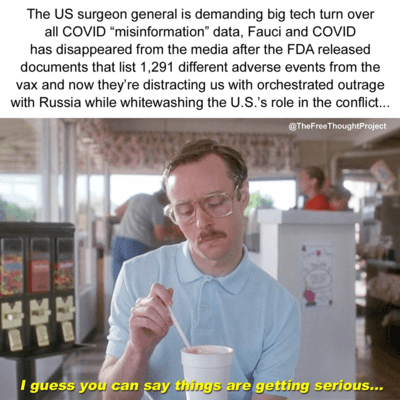
There’s a lot going on right now…

Hear us out here. The Donald himself is the approximate casus belli of the World War III prelude now raging in Ukraine, reminding us once again that sometimes history morphs in the strangest ways.
But the truth is, Trump single-handed generated such a deep, intense and irrational wave of TDS (Trump Derangement Syndrome) in the Imperial City that Washington – berserk with anti-Putin hysteria – essentially shoved Cool Hand Vlad right over the brink.
To to be sure, before Trump came down the escalator in June 2015 Washington was already rife with Russophobia. But that emanated chiefly from the war-loving neocons of the GOP and the porkers and bag carriers for the military industrial complex, including the vast array of think-tanks and NGOs whose livelihoods depend on military threats, real or imagined, to America’s security.
But what turned the Washington of these failed proponents of the Afghan, Iraq, Syria and Libya invasions into an implacable and aggressive foe of Russia’s legitimate security interest in its own backyard was the utter, absolute and unremitting demonization of Vlad Putin himself by the Dems and incumbent Washington political class, which bought hook, line and sinker the hoary RussiaGate story.
That is to say, America was allegedly besmirched and defiled by the election of Donald Trump in November 2016 to such a ghastly degree that the man who single-handedly made it possible–Vlad Putin – deserves a place in the pantheon of historical evil-doers right up there with Adolf Hitler and Attila the Hun.
That’s right. The everlasting blot of the Trump presidency never, ever could have happened, according to the RussiaGate narrative, save for Vlad Putin’s nefarious and sweeping interference in the 2016 election. So this evil needs be avenged and the most effective avenue now consists of raining smack right in Putin’s face on the Ukrainian frontier.
As a result of the Dem establishment’s raging, unquenchable quest for revenge, however, the normal balance of power within the Imperial City and the national security Deep State has been upended.


America’s Public Broadcasting Service (PBS) has published and promoted an interview with a renowed Neo-Nazi Ukrainian mayor, without disclosing the politician’s allegiances to World War II German leader Adolf Hitler and Ukraine’s own Nazi sympathizer Stepan Bandera.
The interview comes just days after PBS published an article downplaying the links between Neo-Nazi politicians and Ukraine’s current political situation.
On Thursday, March 4th, PBS hosted Mayor Artem Semenikhin of Konotop in the country’s North East.
Semenikhin described the Russian military as “cockroaches” before going on to thank the United States for supplying his people with weapons.
“My weapon is American, and I feel like our occupiers will be pleased that we are killing them with American weapons,” he concluded.
But Semenikhin is scarcely the liberty-minded freedom fighter PBS would have him seem. In 2015 the Jerusalem Post reported:
Two months after local elections were held across Ukraine, residents of the small northern city of Konotop are expressing shock and dismay over the behavior of newly chosen Mayor Artem Semenikhin of the neo-Nazi Svoboda party.
According to reports, Semenikhin drives around in a car bearing the number 14/88, a numerological reference to the phrases “we must secure the existence of our people and a future for white children” and “Heil Hitler”; replaced the picture of President Petro Poroshenko in his office with a portrait of Ukrainian national leader and Nazi collaborator Stepan Bandera; and refused to fly the city’s official flag at the opening meeting of the city council because he objected to the star of David emblazoned on it. The flag also features a Muslim crescent and a cross.
In fact, during the PBS interview Semenikhin posed with a Bandera portrait behind him, albeit blurred out by the network in their attempts to obscure their work with Ukrainian Neo-Nazis.
Emmanuel Macron said in a speech Wednesday it’s a lie that Russia is fighting Nazis in Ukraine. But in 2014, the BBC, the NYT, the Daily Telegraph and CNN — not just CN — reported on the Nazi threat.
Throughout the Ukraine crisis, the U.S. State Department and mainstream media have downplayed the role of neo-Nazis in the U.S.-backed Kiev regime, an inconvenient truth that is surfacing again as right-wing storm troopers fly neo-Nazi banners as they attack in the east, Robert Parry reports.
The New York Times reported almost in passing on Sunday (Aug. 10) that the Ukrainian government’s offensive against ethnic Russian rebels in the east has unleashed far-right paramilitary militias that have even raised a neo-Nazi banner over the conquered town of Marinka, just west of the rebel stronghold of Donetsk.
That might seem like a big story a U.S.-backed military operation, which has inflicted thousands of mostly civilian casualties, is being spearheaded by neo-Nazis. But the consistent pattern of the mainstream U.S. news media has been since the start of the Ukraine crisis to white-out the role of Ukraine’s brown-shirts.
Only occasionally is the word “neo-Nazi” mentioned and usually in the context of dismissing this inconvenient truth as “Russian propaganda.” Yet the reality has been that neo-Nazis played a key role in the violent overthrow of elected President Viktor Yanukovych last February as well as in the subsequent coup regime holding power in Kiev and now in the eastern offensive.
The war is not going well for Kyiv, and it would be unreasonable to expect that to change. As a vastly superior military force overwhelms the US client state, reality is in the process of crashing down hard in the face of western liberals who bought into the war propaganda that the brave, sexy comedian was leading an upset victory to kick Putin’s ass out of Ukraine.
Zelensky is now raging at NATO powers for refusing to intervene militarily against Russia, apparently having previously been given the impression that the US-centralized empire might risk its very existence defending its dear friends the Ukrainians from an invasion.
“Unfortunately, today there is a complete impression that it is time to give a funeral repast for something else: security guarantees and promises, determination of alliances, values that seem to be dead for someone,” Zelensky said Friday.
“All the people who will die starting from this day will also die because of you,” Ukraine’s president added. “Because of your weakness, because of your disunity.”
It must be hard, the process of learning that you were never actually a valued partner in western civilization’s fight for freedom and democracy. That you were always just one more sacrificial pawn on the imperial chessboard.
Ukraine’s President Zelensky has been urging the United States and NATO countries that his military desperately needs more fighter jets to take on the Russian invasion force, on Friday telling US lawmakers in a Zoom call “close the skies or give us planes” – according to a Congressional leader present for the address.
Apparently the Biden administration is busy working on just that, also at a moment Congress is still prepping a whopping $10 billion military and humanitarian aide package for Ukraine. The new aircraft deal would involve transferring Russian-made warplanes to Kiev from neighboring Poland, according to a new report in FT.
To expedite the deal – given the battlefield situation and Ukraine’s ability to defend itself depends largely on the speediness of getting sufficient arms – Washington would quickly replace Warsaw’s MiG-29 jets with F-16 fighters.
However, a White House official was quoted in the FT report as admitting the deal could be held up by “a number of challenging practical questions, including how the planes could actually be transferred from Poland to Ukraine.”
Further there’s the question of recent threat’s by Vladimir Putin himself against any country seeking to pour more weapons into the hands of the Ukrainian forces. Putin days ago issued a veiled threat of war against any country supplying weapons that are use to kill Russian soldiers, saying those outside nations would “bear the responsibility”.
A White House spokesperson had confirmed to FT that “We are also working on the capabilities we could provide to backfill Poland if it decided to transfer planes to Ukraine.” And previously Secretary of State Antony Blinken said the US is “very actively” looking at resupplying Poland if it can quickly transfer its own Russian-made aircraft to Ukraine.
“We are looking actively now at the question of airplanes that Poland may provide to Ukraine and looking at how we might be able to backfill should Poland decide to supply those planes,” Blinken said in Moldova, while on a trip that highlighted the growing refugee crisis from the war.
Crucially, there was this statement from an unnamed Polish official given to FT: “I can’t speak to a timeline but I can just say we’re looking at it very, very actively.” The official said further, “Poland is not in a state of war with Russia, but it is not an impartial country, because it supports Ukraine as the victim of aggression. It considers, however, that all military matters must be a decision of Nato as a whole.”
On Saturday, perhaps nervous about coming into Russia’s crosshairs amid the flurry of reporting, Poland’s government batted down the reports as “fake news” – saying there’s been no transfer of its aircraft to Ukraine nor does it intend to…


You must be logged in to post a comment.