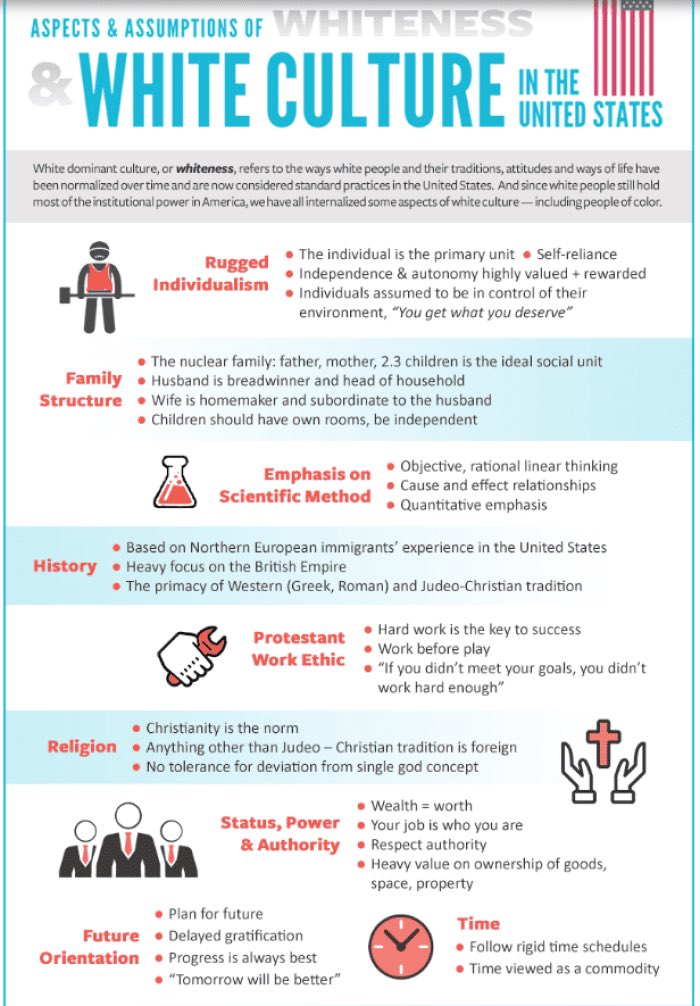
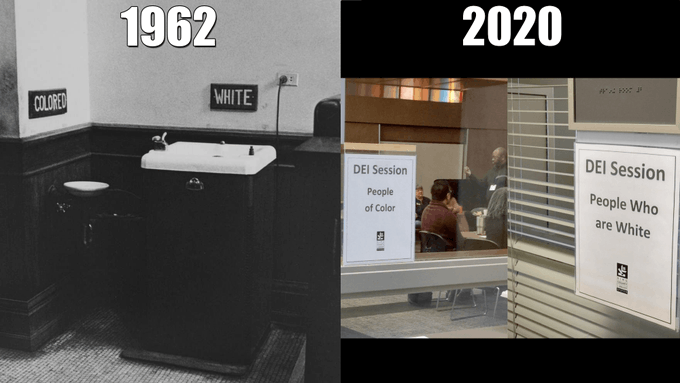
Everything is racist now…

Black votes in this country are worth less than white votes. Joe Biden won the Electoral College because Black voters in Atlanta, Detroit, Milwaukee, and Philadelphia turned out in significant numbers. But even with overwhelming Black support—94 percent of Detroit voted for Biden!—the outcomes in Georgia, Michigan, Wisconsin, and Pennsylvania were worryingly close.
The Argument is a column where writers and thinkers propose a provocative idea that may not be politically realizable in the short term but that pushes one to think broader about a pressing issue of public importance.
One core problem is the Electoral College. Wyoming, which has just 580,000 residents and is 93 percent white, gets three electors because of its two senators and one representative in the House. By comparison, Georgia’s Fifth Congressional District—which includes Atlanta, has 710,000 residents, and is 58 percent Black—has no dedicated electors or senators and can only occasionally overcome the mostly white and conservative votes from elsewhere in the state. This devaluation of Black votes allows our political system to ignore Black lives, and the consequences are devastating. Unequal representation has led to unequal health care outcomes, which the Covid-19 pandemic has only worsened. Without sufficient voting power, Black communities receive substandard education, and politicians are free to appoint judges who sanction mass incarceration, abusive policing, and electoral disenfranchisement.
This is all by design. The Constitution’s framers set up the Electoral College to protect the interests of slave states. Along with the Senate, the Electoral College was critical in the endurance of slavery and its continuation by other means. Abolishing this system would mean that ballots cast by Black voters—or any voters, for that matter—would count the same.
But there’s another way to undo the damage of the Electoral College and other structurally racist political institutions: We can implement vote reparations by double-counting ballots cast by all Black residents. The poisonous legacy of slavery applies to Black people regardless of when we or our ancestors arrived in this country. Vote reparations should also extend to Native Americans. Slavery is rightly called America’s original sin, but so too was the United States’ genocidal seizure of land from its original inhabitants. Various legal forms of disenfranchisement have applied to them. It wasn’t until 1962 that all Native Americans were allowed to vote, and even then they faced—and still face—electoral obstacles. These are not the only examples of American oppression; we should include in vote reparations others who have suffered similar disenfranchisement.

Cornell University has a new flu shot mandate in order to try and keep flu cases down so healthcare resources stay open for Covid patients. But the mandate applies to white people only, because of course it does, because we live in a clown world that gets clownier by the day.
That’s right, at Cornell you can duck the mandatory flu shot by claiming your race as an exemption. Unless you’re white, obviously.
Cornell has a FAQ page “especially for people of color” that explains how victimized they’ve been by white people and thus how they can’t be expected to trust someone to require them to get vaccinated (or something?) and ends with an invitation for non-white people to send an email to the department for an exemption to the vaccine mandate.
Operation Warp Speed, the “public-private partnership” created to produce and allocate COVID-19 vaccines to the American populace, is set to begin rolling out a mass-vaccination campaign in the coming weeks. With the expected approval of its first vaccine candidate just days away, the allocation and distribution aspects of Operation Warp Speed deserve scrutiny, particularly given the critical role one of the most controversial companies in the country will play in that endeavor.
Palantir Technologies, the company founded by Alex Karp, Peter Thiel, and a handful of their associates, has courted controversy for its supporting role in the US military occupation of Iraq and Afghanistan as well as its participation in the detention of “illegal” immigrants through their contracts with the Department of Homeland Security and in “predictive policing” law enforcement programs that disproportionately affect minority neighborhoods. Equally controversial, but perhaps lesser known, is Palantir’s long-standing and enduring ties to the CIA and intelligence community at large, which was intimately involved in the development of Palantir’s products that now run on the databases of governments and corporations around the world.
Facebook is ending race-blind hate speech moderation and will begin policing hate speech directed at black Americans, Muslims, multi-racial Americans, Jewish people and LGBTQ people more aggressively than hate speech directed at white Americans, according to the Washington Post.
The “WoW Project” is aimed at automatically detecting hate speech that is “the worst of the worst,” internal documents about the project that were obtained by the Washington Post said. The project will re-engineer Facebook’s automated moderation system to try and get better at detecting hateful language aimed at minority groups.
New Jersey lawmakers may include a so-called social equity tax in the legislation establishing a legal market for recreational marijuana, according to reports.
Bills in the state Senate and Assembly would give cannabis regulators the authority to impose the “social equity excise fee,” which would help fund programs aimed at reducing racial disparities caused by drug laws.
The influential Legislative Black Caucus has lobbied for programs aimed at helping Black communities, which have been hard-hit by marijuana prohibition. Black residents are likelier to be arrested on marijuana charges than white residents, for example.
The main focus of this allocation strategy is to deliver vaccines first to racial minorities but in such a way as to make those minorities feel “at ease” and not like “guinea pigs” when receiving an experimental vaccine that those documents admit is likely cause “certain adverse effects…more frequently in certain population subgroups.” Research has shown that those “subgroups” most at risk for adverse effects are these same minorities.
The documents also acknowledge that information warfare and economic coercion will likely be necessary to combat “vaccine hesitancy” among these minority groups. It even frames this clearly disproportionate focus on racial minorities as related to national concerns over “police brutality,” claiming that giving minorities the experimental vaccine first is necessary to combat “structural racism” and ensure “fairness and justice” in the healthcare system and society at large.
One school district in Washington state has evidently decided that Asians no longer qualify as persons of color.
In their latest equity report, administrators at North Thurston Public Schools—which oversees some 16,000 students—lumped Asians in with whites and measured their academic achievements against “students of color,” a category that includes “Black, Latinx, Native American, Pacific Islander, and Multi-Racial Students” who have experienced “persistent opportunity gaps.”
Most indicators in the report show that the achievement gap between white/Asian students and “students of color” is fairly narrow and improving over time. It would probably be even narrower if Asian students were categorized as “students of color.” In fact, some indicators might have even shown white students lagging behind that catch-all minority group. Perhaps Asians were included with whites in order to avoid such an outcome. (The superintendent did not respond to a request for comment.)
What the equity report really highlights is the absurdities that result from overreliance on semi-arbitrary race-based categories. The report also measured “students of poverty”—those who qualify for free or reduced-cost lunches—against non-poverty students, and unsurprisingly found a much more significant achievement gap. Students of poverty perform 28 percent worse on math tests, for instance. That socioeconomic category captures something real and meaningful in a way that the gerrymandered race category does not.
 Hellbound and Down
You must be logged in to post a comment.