WaPo now says covid “accidentally” escaped Chinese lab after year of claiming “misinformation”

After a full year of denial, The Washington Post is now claiming that the “lab accident covid-19 origin theory” might have some merit after all.

WaPo columnist Josh Rogin wrote an opinion piece saying that, while the origin of the Chinese Virus “remains a mystery,” several members of Congress are exploring “the theory” that it might have originated from an “accident at a Wuhan lab.”

For the first few months of the plandemic, the mainstream media claimed that Chinese Germs started to spread at a Wuhan wet market where people buy bats and other “exotic” animals to eat as food. Not long after that, the words Wuhan and China completely disappeared from all reporting on the Chinese Virus.

Today, we are no longer allowed to even talk about the Wuhan coronavirus (Covid-19) in relation to Wuhan – which is now completely back to normal, by the way, while the West remains locked down and masked.

Rogin would seem to take issue with the fact that there has thus far been no credible investigation into the true origins of the Wuhan coronavirus (Covid-19). He even calls out Beijing for spending the past year covering up any evidence.
Keep reading

Reporters Once Challenged the Spy State. Now, They’re Agents of It

After the Capitol riots of January 6th, the War on Terror came home, and “domestic extremists” stepped into the role enemy combatants played before. George Bush once launched an all-out campaign to pacify any safe haven for trrrsts, promising to “smoke ‘em out of their holes.” The new campaign is aimed at stamping out areas for surveillance-proof communication, which CNN security analyst and former DHS official Juliette Kayyem described as any online network “that lets [domestic extremists] talk amongst themselves.”

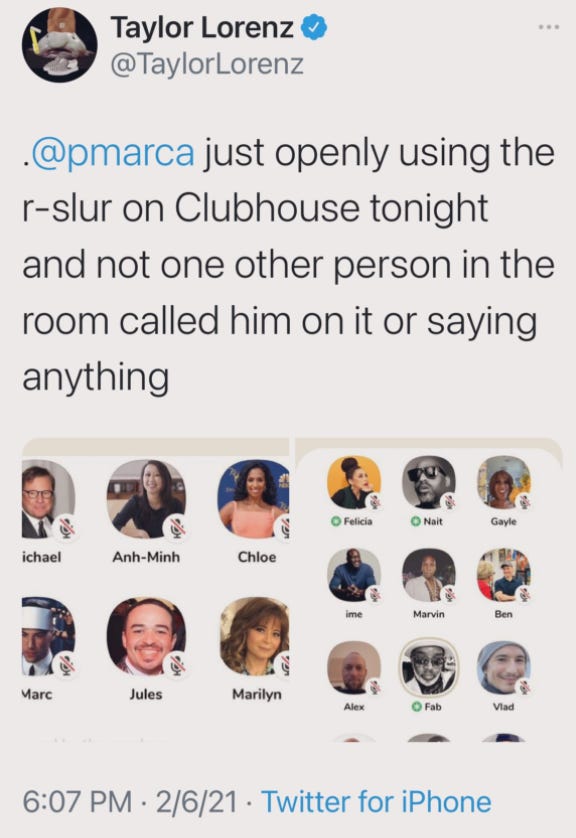
Reporters pledged assistance, snooping for evidence of wrongness in digital rather than geographical “hidey holes.” We’ve seen The Guardian warning about the perils of podcastsProPublica arguing that Apple’s lax speech environment contributed to the January 6th riot, and reporters from The Verge and Vice and The New York Times listening in to Clubhouse chats in search of evidence of dangerous thought. In an inspired homage to the lunacy of the War on Terror years, a GQ writer even went on Twitter last week to chat with the author of George Bush’s “Axis of Evil” speech about imploring the “authorities” to use the “Fire in a Crowded Theater” argument to shut down Fox News.

Multiple outlets announced plans to track “extremists” in either open or implied cooperation with authorities. Frontline, ProPublica, and Berkley Journalism’s Investigative Reporting Program used “high-precision digital forensics” to uncover “evidence” about the Boogaloo Bois, and the Huffington Post worked with the “sedition hunters” at the Twitter activist group “Deep State Dogs” to help identify a suspect later arrested for tasering a Capitol police officer. One of the Huffington Post stories, from February, not only spoke to a willingness of the press to work with law enforcement, but impatience with the slowness of official procedure compared to “sleuthing communities”:

The FBI wants photos of Capitol insurrections to go viral, and has published images of more than 200 suspects. But what happens when online sleuthing communities identify suspects and then see weeks go by without any signs of action…? There are hundreds of suspects, thousands of hours of video, hundreds of thousands of tips, and millions of pieces of evidence… the FBI’s bureaucracy isn’t necessarily designed to keep organized.

Keep reading

Reporters have to get quotes approved by White House before publishing

White House reporters are ​seething over a policy that requires them to submit quotes from interviews with Biden administration officials to the communications team for approval, editing or veto, according to a report on Tuesday.  ​

The White House is demanding that reporters who conduct interviews with administration officials do so under conditions known as “background with ​quote approval,” Politico reported. ​

The information from the interview can be used in a story, but for a reporter to be able to attach a name to the quote, ​the reporter must transcribe the comments and send them to the communications team, the report said. ​

At that point, the White House can approve them, edit them or veto their use.

Keep reading

Donald Glover: TV & Films Are Boring Because “People are Afraid of Getting Cancelled”

Actor and Grammy Award winning musician Donald Glover says that television shows and movies are becoming increasingly boring because “people are afraid of getting cancelled.”

Glover, also known by his stage name Childish Gambino, made the comments via his official Twitter account.

“Saw people on here havin a discussion about how tired they were of reviewing boring stuff (tv & film),” remarked Glover.

“We’re getting boring stuff and not even experimental mistakes(?) because people are afraid of getting cancelled.”

“So they feel like they can only experiment w/ aesthetic. (also because some of em know theyre not that good).”

Keep reading