Gadhafi’s ‘Missing Billions’ Stashed in US and Southern Africa, Officials Say

Billions of dollars stolen by former Libyan leader Moammar Gadhafi are hidden in clandestine bank accounts and secret vaults in the United States and two southern African countries, say intelligence operatives and financial investigators.

The latest news was first reported by online magazine, Africa Confidential, on May 9.

According to the report, Libya’s Asset and Management Recovery Office says at least $50 billion in oil revenues pillaged by Gadhafi between 1994 until his murder in 2011 were invested in “debt instruments”—including treasury bonds—using front companies, nominees, and banks that routed the money via Europe to the United States.

Separately, intelligence agents and a former top government official in Pretoria told The Epoch Times about $20 billion stolen by Gadhafi is spread across banks in South Africa.

They added that $30 million in cash flown by Gadhafi to South Africa in the months before his execution by rebels is now hidden in Eswatini—the small kingdom neighboring South Africa and the continent’s last absolute monarchy that was formerly called Swaziland.

The man leading the hunt for Libya’s missing public funds, Asset and Management Recovery Office Director-General Mohammed al-Mensli, confirmed that hundreds of billions of dollars were stolen during Gadhafi’s brutal military rule.

Keep reading

Trump administration working on plan to move 1 million Palestinians to Libya

The Trump administration is working on a plan to permanently relocate up to 1 million Palestinians from the Gaza Strip to Libya, five people with knowledge of the effort told NBC News.

The plan is under serious enough consideration that the administration has discussed it with Libya’s leadership, two people with direct knowledge of the plans and a former U.S. official said. 

In exchange for the resettling of Palestinians, the administration would potentially release to Libya billions of dollars of funds that the U.S. froze more than a decade ago, those three people said.

No final agreement has been reached, and Israel has been kept informed of the administration’s discussions, the same three sources said.

The State Department and the National Security Council did not respond to multiple requests for comment.  

Basem Naim, a senior Hamas official, said that Hamas, the U.S.-designated terrorist group that has run Gaza, was not aware of any discussions about moving Palestinians to Libya.

“Palestinians are very rooted in their homeland, very strongly committed to the homeland and they are ready to fight up to the end and to sacrifice anything to defend their land, their homeland, their families, and the future of their children,” Naim said in response to questions from NBC News. “[Palestinians] are exclusively the only party who have the right to decide for the Palestinians, including Gaza and Gazans, what to do and what not to do.”

Representatives of the Israeli government declined to comment. 

Keep reading

Donald Trump Planning to Send Migrants to Libya

President Donald Trump‘s administration is planning to deport migrants to Libya, according to reports.

The U.S. military could fly deportees to the country as soon as Wednesday, The New York Times and Reuters reported, citing officials who spoke on the condition of anonymity.

It was not immediately known how many migrants could be sent to Libya or the nationality of the individuals the administration may deport.

Newsweek has contacted the White House, State Department and Department of Homeland Security for comment outside regular business hours.

Libya has become notorious for its network of migrant detention centers, which human rights groups have described as inhumane.

In a 2021 report, Amnesty International called the facilities a “hellscape,” where detainees suffer torture, sexual violence, forced labor, and even slavery.

In an annual report on human rights practices in Libya released last year, the State Department described the conditions in the country’s detention centers as “harsh and life-threatening.”

It added that migrants in these facilities, including children, had “no access to immigration courts or due process.”

Keep reading

The Mass-Media Memory Hole – Blair, Ukraine and Libya

A key function of state-corporate media is to keep the public pacified, ignorant and ill-equipped to disrupt establishment power.

Knowledge that sheds light on how the world operates politically and economically is kept to a minimum by the ‘mainstream’ media. George Orwell’s famous ‘memory hole’ from ‘Nineteen Eighty-Four’ signifies the phenomenon brilliantly. Winston Smith’s work for the Ministry of Truth requires that he destroys documents that contradict state propaganda:

‘When one knew that any document was due for destruction, or even when one saw a scrap of waste paper lying about, it was an automatic action to lift the flap of the nearest memory hole and drop it in, whereupon it would be whirled away on a current of warm air to the enormous furnaces which were hidden somewhere in the recesses of the building’.

(Orwell, ‘Nineteen Eighty-Four’, 1949, Penguin edition, 1982, p. 34)

The interests of power, hinging on the domination of an ignorant population, are robustly maintained:

‘In this way every prediction made by the Party could be shown by documentary evidence to have been correct, nor was any item of news, or any expression of opinion, which conflicted with the needs of the moment, ever allowed to remain on record. All history was a palimpsest, scraped clean and reinscribed exactly as often as was necessary. In no case would it have been possible, once the deed was done, to prove that any falsification had taken place.’

(Ibid., p. 36)

As the Party slogan puts it:

‘Who controls the past, controls the future: who controls the present controls the past.’

(Ibid., p. 31)

In today’s fictional ‘democracies’, the workings of propaganda are more subtle. Notably, there is a yawning chasm between the rhetoric of leaders’ professed concern for human rights, peace and democracy, and the realpolitik of empire, exploitation and control.

Keep reading

The Road to World War III: How US-NATO Forces Turned Libya into Hell on Earth

The war in Ukraine is basically about the US-NATO’s long-term plan to destroy Russia’s rise as a major player on the world stage.  In 2019, The Rand Corporation published ‘Overextending and Unbalancing Russia: Assessing the Impact of Cost-Imposing Options’ which recommended several measures that would essentially disrupt Russia’s inevitable rise. 

The Rand Corporation’s measures are extremely dangerous and irresponsible, in fact, one of the measures that has been already implemented since the war began between Russia and Ukraine has resulted in serious consequences that can lead the world into a nuclear war:

“Providing lethal aid to Ukraine would exploit Russia’s greatest point of external vulnerability. But any increase in U.S. military arms and advice to Ukraine would need to be carefully calibrated to increase the costs to Russia of sustaining its existing commitment without provoking a much wider conflict in which Russia, by reason of proximity, would have significant advantages”

The other measure that would be a direct threat to Russia which would have allowed NATO to place all sorts of military weapons in Ukrainian territory and that is something Russia would not allow close to its borders,

Reposturing bombers within easy striking range of key Russian strategic targets has a high likelihood of success and would certainly get Moscow’s attention and raise Russian anxieties.”  

Lastly, deploying tactical nuclear weapons pointing at Russia as a measure would be an open invitation to a nuclear war between the West and Russia,

deploying additional tactical nuclear weapons to locations in Europe and Asia could heighten Russia’s anxiety enough to significantly increase investments in its air defenses.” 

To the West, it seems like a risk they are willing to take,

“In conjunction with the bomber option, it has a high likelihood of success, but deploying more such weapons might lead Moscow to react in ways contrary to U.S. and allied interests.”

Keep reading

Destroying Libya: It Seemed Like a Good Idea at the Time

You must break a few eggs to make an omelet, Washington’s social engineers apparently believe when intervening in other societies. Sure, a few people might die. Others might end up disabled or displaced. But think of all the good that will be done when America’s plans are realized for [fill in the blank country], which will be well on its way to the bountiful future that its people deserve.

This mindset has repeatedly afflicted U.S. policymakers. Get rid of Iraq’s Saddam Hussein. Oust the Afghan Taliban. Toss out Syria’s Bashar al-Assad. Dump Libya’s Muammar Khadafy. Don’t worry, the good times will come.

One might forgive George W. Bush for Iraq. At least a little. His father intervened in Iraq a decade before, bombed Baghdad, destroyed some tanks, freed Kuwait, and got out. Sanctions and no-fly zones remained, but the US didn’t fight an interminable guerrilla war or engage in nation-building. It looked easy. So why shouldn’t Bush fils one-up Bush pere and completely transform the country and region?

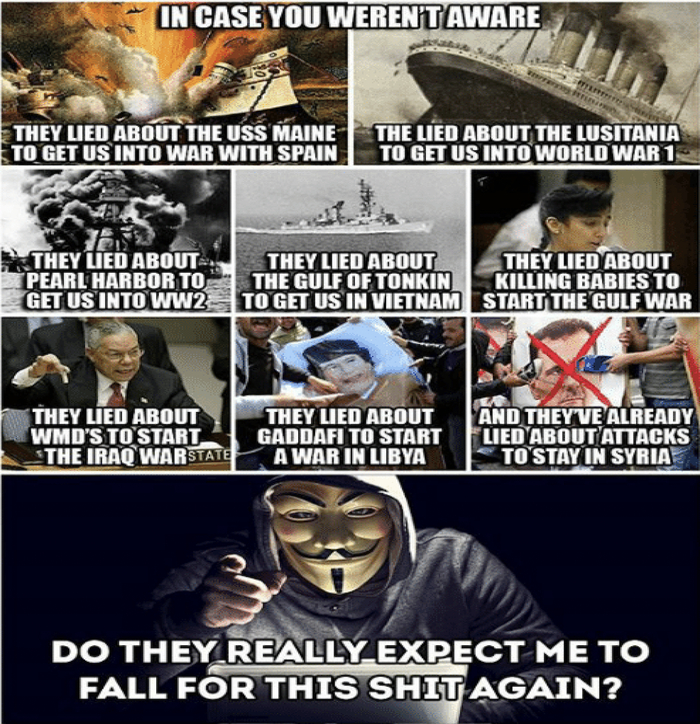
Yet after Iraq II how could anyone so carelessly launch another war? Why would anyone assume that blowing up Libya would generate good results, that peace, stability, and democracy would magically appear? President Barack Obama always posed as a reluctant warrior, but he recklessly lent the U.S. military to European states which hoped to force their way back into an area where they once had colonial ties and economic interests.

The more proximate architect of the disaster was Secretary of State Hillary Clinton. She was proud of her handiwork. After hearing reports of Muammar Khadafy’s death, she joked with a reporter: “We came, we saw, he died.” Her laughter, more a maniacal cackle, foreshadowed the horror that unfortunate nation had only just begun to suffer.

Keep reading