
Calm down…

Millions of bees bound for Alaska died on a Delta Air Lines flight after the plane was left on the tarmac in Atlanta, Georgia, following a diversion.
Alaska Public Media (APM) reported on Wednesday that a Delta plane carrying a shipment of around 5 million bees bound for Anchorage, Alaska, was forced to reroute to Atlanta. Most of the bees died in the Georgia city.
The shipment of 200 crates, ordered by Sarah McElrea of Sarah’s Alaska Honey on behalf of 300 Alaskan beekeepers, carried 800 pounds of bees and was worth an estimated $48,000.
The crates had been due to travel from Sacramento, California, to Anchorage Airport via Seattle, Washington. But the bees did not fit on the Seattle-bound flight and were instead rerouted through the Delta hub in Atlanta.
Delta told McElrea the bees would have to wait in a cooler last Saturday but they were transferred to the tarmac the next day over fears the bees were escaping. McElrea told APM the temperature in Atlanta was 80 degrees Fahrenheit on the day they were left there.
In March, several agricultural groups—including the American Bakers Association, American Farm Bureau Federation, and Agricultural Retailers Association—wrote to the USDA (pdf), requesting that farming be allowed on idle land under the Conservation Reserve Program (CRP). About 26 percent of CRP acres are classified as prime farmland.
However, the USDA rejected the request, insisting that such a move would harm climate goals (pdf).
“It is critical to point out that if we allow the tillage of CRP acres, the marginal at best benefit to crop production will be coupled with a significant and detrimental impact on producers’ efforts to mitigate climate change and maintain the long-term health of their land,” the agency said in its response.
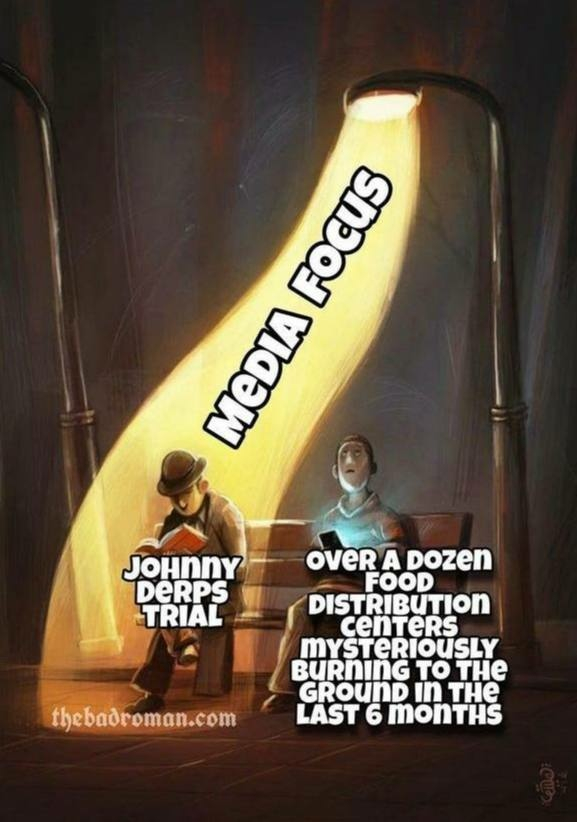
The American people are noticing that many fires are happening at food processing plants, and the timing of these fires exposes that there is no way that it is all just a coincidence. Some Conservative media are awake to the fact as well, but the lapdog media is ignoring the entire timeline of unfolding danger.
Recently as many as 20 plus US food processing plants that are headquarters of food processing companies have been damaged or destroyed, but that isn’t anything our government is concerning themselves with at this time.
A General Mills facility was recently hit by a plane in Georgia, and a plant in Idaho appeared to be in the crosshairs well.
New reports indicate that yet another General Mills facility has been damaged in some way—this time by a fire.
This brings the grand total to 22 food processing plants or headquarters, that we know of, which have been destroyed or damaged in some way over the course of just one week, and the odds of that happening organically are making people everywhere wonder if we are watching the managed decline of the United States of America.
CF Industries Holdings, Inc. (NYSE: CF), a leading global manufacturer of hydrogen and nitrogen products, today informed customers it serves by Union Pacific rail lines that railroad-mandated shipping reductions would result in nitrogen fertilizer shipment delays during the spring application season and that it would be unable to accept new rail sales involving Union Pacific for the foreseeable future. The Company understands that it is one of only 30 companies to face these restrictions.
CF Industries ships to customers via Union Pacific rail lines primarily from its Donaldsonville Complex in Louisiana and its Port Neal Complex in Iowa. The rail lines serve key agricultural areas such as Iowa, Illinois, Kansas, Nebraska, Texas and California. Products that will be affected include nitrogen fertilizers such as urea and urea ammonium nitrate (UAN) as well as diesel exhaust fluid (DEF), an emissions control product required for diesel trucks.
CF Industries is the largest producer of urea, UAN and DEF in North America, and its Donaldsonville Complex is the largest single production facility for the products in North America.
“The timing of this action by Union Pacific could not come at a worse time for farmers,” said Tony Will, president and chief executive officer, CF Industries Holdings, Inc. “Not only will fertilizer be delayed by these shipping restrictions, but additional fertilizer needed to complete spring applications may be unable to reach farmers at all. By placing this arbitrary restriction on just a handful of shippers, Union Pacific is jeopardizing farmers’ harvests and increasing the cost of food for consumers.”
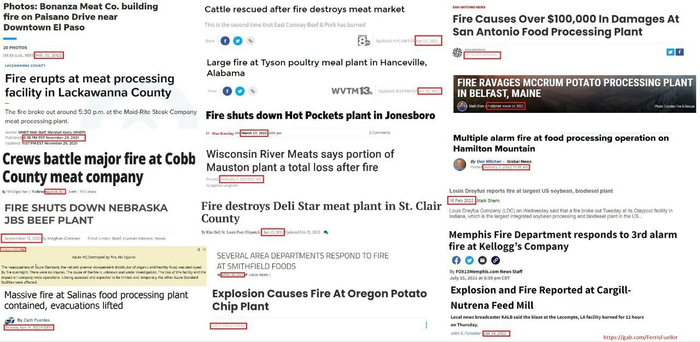
As food uncertainly lingers on the horizon thanks to US sanctions and government decimation of the economy during the past two years, there is another factor contributing to the problem. Since the beginning of the year, there have been several very large food processing facilities that have exploded or burned to the ground across the U.S.
This week, a vegetable and nut processing facility in Dufur, Oregon became engulfed in flames for unknown reasons.
“Lights flickered; They heard a pop and went up there to check it out and there was a fire,” according to a report made to Wasco County 911 records listed in the Wasco County Sheriff’s log.
The independent distributor of natural, organic and non-GMO foods which employees around 150 people burned to the ground.
One week before that fire in Oregon, a massive fire brought down a meat processing plant in Conway, New Hampshire. After burning for 16 hours, multiple fire crews finally put out the fire at East Conway Beef and Pork but the facility is completely destroyed.
That same week, in Salinas, California, a massive fire at the Taylor Farms Processing Facility led to the evacuation of residents as it burned for over 17 hours. Taylor Farms is a major agriculture company that processes and delivers many of the salad kits seen in grocery stores. The cause of this fire is currently under investigation.
Just weeks before that, a massive fire engulfed a Walmart distribution center in Plainfield, Indiana where over 1,000 employees shipped food and other supplies all over the region. The fire destroyed the massive 1 million square foot operation.
That same week, one of the largest food facilities of its kind in South Texas caught fire and burned to the ground. Prior to burning down, the Rio Fresh facility in San Juan, Texas, grew, packed and shipped a variety of Texas-grown items including Texas 1015 sweet onions, melons, greens, cabbage, and kale. The cause of the fire is currently unknown.
In Hermiston, Oregon, in February, a massive food processing facility suddenly exploded, injuring 7 of the nearly 400 employees who work at the Shearer’s Foods plant. According to reports, the cause of the explosion which originated near a boiler is still under investigation.

A leading manufacturer of hydrogen and nitrogen products was informed Union Pacific rail lines were reducing and limiting shipments of fertilizer during the planting season this year.
Who made this decision?
CF Industries reported:
CF Industries Holdings, Inc. (NYSE: CF), a leading global manufacturer of hydrogen and nitrogen products, today informed customers it serves by Union Pacific rail lines that railroad-mandated shipping reductions would result in nitrogen fertilizer shipment delays during the spring application season and that it would be unable to accept new rail sales involving Union Pacific for the foreseeable future. The Company understands that it is one of only 30 companies to face these restrictions.
CF Industries ships to customers via Union Pacific rail lines primarily from its Donaldsonville Complex in Louisiana and its Port Neal Complex in Iowa. The rail lines serve key agricultural areas such as Iowa, Illinois, Kansas, Nebraska, Texas and California. Products that will be affected include nitrogen fertilizers such as urea and urea ammonium nitrate (UAN) as well as diesel exhaust fluid (DEF), an emissions control product required for diesel trucks. CF Industries is the largest producer of urea, UAN and DEF in North America, and its Donaldsonville Complex is the largest single production facility for the products in North America.
“The timing of this action by Union Pacific could not come at a worse time for farmers,” said Tony Will, president and chief executive officer, CF Industries Holdings, Inc. “Not only will fertilizer be delayed by these shipping restrictions, but additional fertilizer needed to complete spring applications may be unable to reach farmers at all. By placing this arbitrary restriction on just a handful of shippers, Union Pacific is jeopardizing farmers’ harvests and increasing the cost of food for consumers.”
 Hellbound and Down
You must be logged in to post a comment.