CIA Partners with Google, Amazon and IBM in Latest Big Tech Procurement Drive

The vaunted “17 intelligence agencies” that comprise the U.S. intel community will be sharing a network of private-sector cloud computing service providers which includes Microsoft, Google, Oracle, IBM, and Amazon Web Services (AWS) as part of a 15-year contract said to be worth tens of billions of dollars.

AWS currently holds the sole contract to provide cloud computing services to a number of intelligence agencies, including the FBI and the NSA. That contract is set to expire in 2023 and this new award – managed by the CIA – will further weaken Amazon’s once privileged position in the federal money sweepstakes, which had already taken a hard hit when Microsoft was unexpectedly chosen over Bezos’ company for the Department of Defense’s own cloud services contract for the Joint Enterprise Defense Infrastructure (JEDI) program.

The Central Intelligence Agency will take full advantage of its access to money without oversight to disburse the government funds at the agency’s discretion. Although speculated to rise into the tens of billions, the CIA has no plans to disclose the real value of the C2E contracts. The Commercial Cloud Enterprise (C2E) procurement program was unveiled in February by the premier U.S. spy agency in a bid to establish a cloud computing service platform for the country’s intelligence agencies separate from JEDI, which remains enmeshed in a protracted legal contest with AWS and is two years behind implementation.

Keep reading

Suspect AI Software Verified Mail-In Ballots With Little Human Oversight in Key Battleground States

Though accusations of election fraud in the 2020 US presidential election have been swirling across social media and some news outlets for much of the past week, few have examined the role of a little known Silicon Valley company whose artificial intelligence (AI) algorithm was used to accept or reject ballots in highly contested states such as Nevada.

That company, Parascript, has long-standing cozy ties to defense contractors such as Lockheed Martin and tech giants including Microsoft, in addition to being a contractor to the US Postal Service. In addition, its founder, Stepan Pachikov, better known for cofounding the app Evernote in 2007, is a long-standing and 2020 donor to Democratic presidential candidates.

Parascript’s AI software was used during this election in at least eight states for matching signatures on ballot envelopes with those in government databases in order to “ease the workload of staff enforcing voter signature rules” resulting from the influx of mail-in ballots. Reuters, which reported on the use of the technology, asked the company to provide a list of counties and states using its software for the 2020 election. Parascript, however, declined to supply the list, replying, instead, that their clients “included 20 of the top 100 counties by registered voters.”

Despite not receiving the official list from Parascript, Reuters was able to compile its own partial list, which revealed that several counties in Florida, Colorado, Washington, and Utah, among others, utilized the AI software to determine the validity of ballots. Reuters also reported that Clark County, Nevada, which is one of the hotspots of litigation between the Trump and Biden campaigns and fraud allegations, was one that used the software. Reuters was able to determine how the software was used in some counties, with many counties allowing the software to approve anywhere from 20 to 75 percent of mail-in ballots as acceptable. For several counties included in the Reuters list,staff reviewed 1 percent or less of the AI software’s acceptances. Figures were not available for Clark County, Nevada.

Keep reading

Gender Activists Are Trying to Cancel My Book. Why is Silicon Valley Helping Them?

The day after I tweeted about the ongoing attempts to block sales of my book, Irreversible Damage: The Transgender Craze Seducing Our Daughters, I was stuck on the phone with my parents’ real estate agent. “How’s your book going?” she wanted to know. “Is there a lot of controversy?”

I know it’s fashionable these days to claim to be an introvert—something to do with an unwarranted assumption of depth, maybe—but I actually am an introvert. Small talk exhausts me, not because I believe it’s beneath me, but because it feels like being handed a socket wrench. I have no idea what to do with it.

“Well, you had to expect that, right?” she added casually. “When you write a book like that, that’s what you’re expecting.”

This is, more or less, most people’s reaction to the efforts to suppress my book. It isn’t that they agree with censorship per se. But you also can’t go setting fires without expecting Big Tech’s cops to shut them down. “If you’re going to talk about the trans thing, I mean, what did you expect?” I think the agent may have said those very words.

Except that I didn’t write about “the trans thing.” I wrote specifically about the sudden, severe spike in transgender identification among adolescent girls. I fully support medical transition for mature adults. And I have no desire to be a provocateur. (I dislike pointless provocation, in part because I think provocateurs often have a good argument—one they’re too lazy or inept to make). Nor do I have any prurient interest in others’ social lives.

What I aim to do, as a journalist, is to investigate cultural phenomena, and here was one worth investigating: Between 2016 and 2017, the number of females seeking gender surgery quadrupled in the United States. Thousands of teen girls across the Western world are not only self-diagnosing with a real dysphoric condition they likely do not have; in many cases, they are obtaining hormones and surgeries following the most cursory diagnostic processes. Schoolteachers, therapists, doctors, surgeons, and medical-accreditation organizations are all rubber-stamping these transitions, often out of fear that doing otherwise will be reported as a sign of “transphobia”—despite growing evidence that most young people who present as trans will eventually desist, and so these interventions will do more harm than good.

The notion that this sudden wave of transitioning among teens is a worrying, ideologically driven phenomenon is hardly a fringe view. Indeed, outside of Twitter, Reddit, Tumblr, and college campuses, it is a view held by a majority of Americans. There is nothing hateful in suggesting that most teenagers are not in a good position to approve irreversible alterations to their bodies, particularly if they are suffering from trauma, OCD, depression, or any of the other mental-health problems that are comorbid with expressions of dysphoria. And yet, here we are.

The efforts to block my reporting have been legion, starting with staff threats at a publishing house, which quickly reversed its original intention to publish my book. Once I obtained a stalwart publisher, Regnery, Amazon refused to allow that company’s sales team to sponsor ads on its site. (Amazon allows sponsored ads for books that uncritically celebrate medical transition for teenagers).

Because the book tackles an interesting phenomenon, a number of established journalists wanted to review it. The issue of trans-identification has seemed to come out of nowhere with Gen Z, the generation begun in 1995 whose large-scale mental-health crisis already has us so on edge. And the issue has created surprising bedfellows. Religious conservatives are concerned about the trend—but so are lesbians, who look upon the shocking numbers of teen girls transitioning with abject alarm. Many suspect that all this transitioning of girls is effectively euthanizing a generation of young lesbians.

Keep reading

FBI launches open attack on ‘foreign’ alternative media outlets challenging US foreign policy

The FBI has publicly justified its suppression of dissenting online views about US foreign policy if a media outlet can be somehow linked to one of its adversaries. The Bureau’s justification followed a series of instances in which Silicon Valley social media platforms banned accounts following consultations with the FBI.

In a particularly notable case in 2018, the FBI encouraged Facebook, Instagram and Google to remove or restrict ads on the American Herald Tribune (AHT), an online journal that published critical opinion articles on US policy toward Iran and the Middle East. The bureau has never offered a clear rationale, however, despite its private discussions with Facebook on the ban.

Keep reading

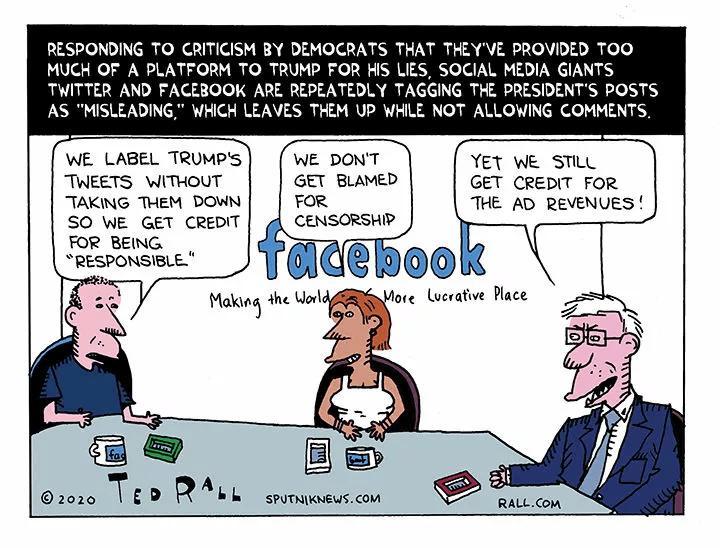
Report: Half of Trump’s Twitter and Facebook Posts Since Election Day Flagged as Misinformation

A recent report states that half of President Donald Trump’s posts since election day have been flagged as misinformation by Facebook and Twitter and censored on each platform.

Forbes reports that half of President Trump’s social media posts on Facebook and Twitter since election day have been labeled as false or questionable by the social media giants.

Of President Trump’s 22 posts on Facebook and Twitter, 11 have been labeled by the Silicon Valley tech firms. The posts include the President’s claims to victory and assertions of election fraud taking place. Twitter hid some posts on the President’s timeline and warned users that “some or all of the content shared in this Tweet is disputed and might be misleading about an election or other civic process,” and restricted users’ ability to like or retweet the tweets.

Underneath some of President Trump’s Facebook posts, the social media company warned users that “final votes may different from the initial vote counts” or “elections officials follow strict rules when it comes to ballot counting, handling and reporting,” but users were still able to reply to and share the posts.

Keep reading

San Francisco Tech CEO Emails 10 Million Customers Urging Them To Vote For Biden

Offering yet another reminder of just how far-removed the hysterical hyper-liberalism of San Francisco and the Bay Area is from the normal American political baseline, the CEO of Expensify, one of the world’s largest providers of expense account software, recently emailed all 10 million users of the firms’ software pleading with them to vote for Vice President Joe Biden.

According to Bloomberg, the idea elicited “strong debate” within the company, which is based in San Francisco, with some employees disagreeing with the gesture. But CEO David Barrett, the driving force behind the message, said he decided to press ahead and hit ‘send’.

“We needed to stand true for what we believe in and hope that most people agree with us,” Barrett said in an interview. “It’s not like we did this with a lot of enthusiasm. We did this out of a perceived necessity.”

At one point in the email, Barrett wrote that “anything less than a vote for Biden is a vote against democracy,” and that if President Trump were reelected, Barrett wrote, it would “damage our democracy to such an extent, I’m obligated on behalf of shareholders to take any action I can to avoid it.”

Keep reading