
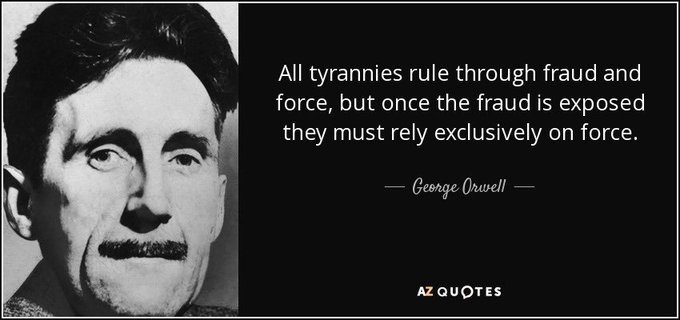
George Orwell, 1984…

Scores of Government bodies, the armed forces and even the gambling regulator will legally be allowed to use child spies – including against their parents.
Police and the security services are among those who will be allowed to use under-18s as covert human intelligence sources (CHIS) under ‘exceptional circumstances’ according to official documents.
But guidance for the Covert Intelligence Bill, currently going through the Lords, outlines other public bodies who will be allowed to employ them as undercover agents.
As well as police, MI5, MI6 and the National Crime Agency, they include the Gambling Commission, county and district councils, the Environment Agency and the Food Standards Agency.
The document, which has been published online, prohibits those under 16 from being used to inform on their parents or guardians.
But it permits the use of older teenagers to be used against their own family under special circumstances.
Wednesday’s mob assault on Capitol Hill was shocking and brazen: Hundreds of MAGA-hat-wearing rioters broke into the seat of American democracy. They stormed the halls, looting property and assaulting law enforcers, all in service of an absurd political demand: reversing the outcome of an election.
Now where had I witnessed such scenes before? The answer: in blue-governed cities in my native Pacific Northwest throughout last summer and into the fall and winter.
The right-wing political violence was met with universal rebuke from politicians of both parties and the media. But many of those who are loudest in condemning the Capitol Hill riot went radio-silent when rioters destroyed and looted in the name of Black Lives Matter.
“Whoever would overthrow the liberty of a nation must begin by subduing the freeness of speech.”
Benjamin Franklin
Even before this week’s unprecedented siege of the U.S. Capitol by a mob of supporters of President Donald Trump, which you can read about in the War Zone‘s rolling coverage of the events as they unfolded, there were ominous indicators of what was to come. This included the discovery of pipe bombs in the vicinity of nearby Congressional office buildings earlier in the day, which had prompted evacuations, at least in part through underground tunnels. When the Capitol itself was breached, members of Congress and Vice President Mike Pence, among others, were also ushered to safety via subterranean passageways.
These incidents highlighted the large tunnel network that lies under Capitol Hill, as well as other underground links throughout Washington, D.C. Many of these are used on a day-to-day basis just to conveniently get between government buildings without going outside, but, as was shown yesterday, they also have a clear value in helping people escape to safety during a crisis. Legislators had already been advised to make increased use of them on Jan. 6, simply to avoid encountering pro-Trump protesters.

The arrival of government-operated autonomous police robots does not look like predictions in science fiction movies. An army of robots with gun arms is not kicking down your door to arrest you. Instead, a robot snitch that looks like a rolling trash can is programmed to decide whether a person looks suspicious—and then call the human police on them. Police robots may not be able to hurt people like armed predator drones used in combat—yet—but as history shows, calling the police on someone can prove equally deadly.
Long before the 1987 movie Robocop, even before Karel Čapek invented the word robot in 1920, police have been trying to find ways to be everywhere at once. Widespread security cameras are one solution—but even a blanket of CCTV cameras couldn’t follow a suspect into every nook of public space. Thus, the vision of a police robot continued as a dream, until now. Whether they look like Boston Dynamics’ robodogs or Knightscope’s rolling pickles, robots are coming to a street, shopping mall, or grocery store near you.
With the normalization of mass shootings in the United States it is more than understandable that members of Congress feared for their lives when they learned protestors had forced their way into the Capitol in unknown numbers and were roaming around at will.
But by the time it was over we knew that: only five weapons were seized by police so most of the intruders were probably unarmed; the only shots fired were by police who killed an unarmed female protestor; video and photos showed the demonstrators taking pictures of chambers and art work like they were tourists; and the occupiers were peacefully led out of the Capitol six hours later. (Had they been anti-racism protestors one wonders how differently it would have ended.)
A dramatic event such as this is an old-time reporter’s dream, to just describe the facts and details as they emerged, painting a picture in words in print or on the radio. With so many mobile phone pictures and video as well as TV cameras everywhere, that journalistic function has been greatly diminished if not extinguished. In its place are preaching, partisan, editorialists masquerading as mainstream journalists.
By the time it was over it was clear what had not happened: it wasn’t a “coup,” it wasn’t an “insurrection,” it had nothing to do with Putin, or China or Iran and it wasn’t like Pearl Harbor, as Sen. Chuck Schumer ridiculously tried to call it.
It wasn’t the storming of a “temple of democracy,” interrupting Congress’ “sacred duty,” or “desecrating” the “hallowed halls” of the Capitol. Such quasi-religious rhetoric inflates the self-importance of officials elevating themselves above the people they are supposed to serve.

 Hellbound and Down
You must be logged in to post a comment.