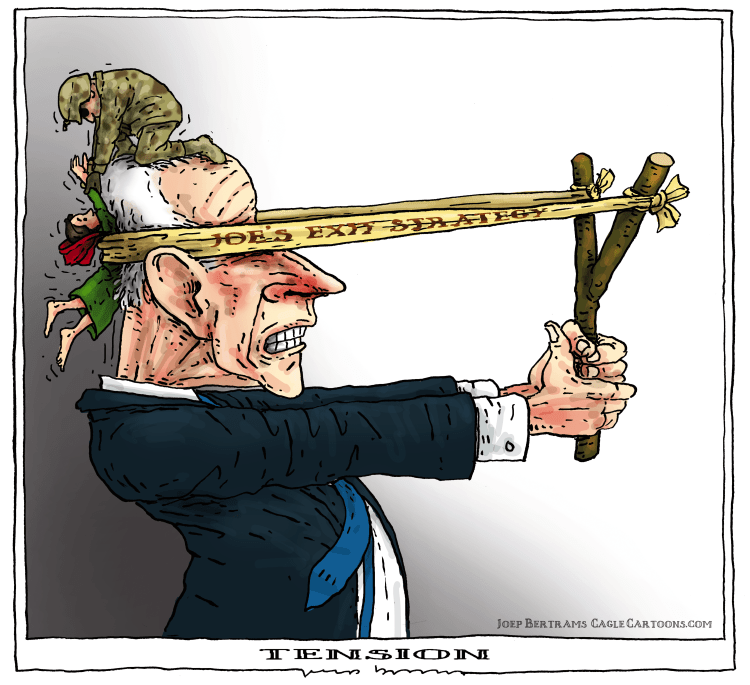
Brilliance in action…

According to classified documents obtained by Politico, senior Pentagon leaders discussed plans for a “mass casualty event” at a video meeting the day before nearly 200 died in a Kabul suicide attack, including 13 US Marines.
The outlet described the document as a transcript of high-level military meetings.
Politico claimed Defense Secretary Lloyd Austin instructed top leaders in over a dozen departments to prepare for such an event in a meeting on Wednesday, citing the documents.
It also quoted Chairman of the Joint Chiefs of Staff Gen. Mark Milley claiming to have “significant” information about a “complex attack” by a terrorist organization.
Commanders frequently identified the Abbey Gate, where the suicide bombing occurred and Americans were gathering, to be the “highest risk.”
“I don’t believe people get the incredible amount of risk on the ground,” Politico quoted Austin as saying.
Politico did not publish the document itself but claimed to have verified its authenticity through an anonymous defense official. The Pentagon itself has neither confirmed nor denied the report at press time.
Just as the United States completed its troop withdrawal from Afghanistan on Monday after two decades of war and occupation, House Republicans announced plans to push for a $25 billion increase in annual military spending—a proposal that progressive lawmakers and advocacy groups swiftly rejected.
Led by Rep. Mike Rogers (R-Ala.), the top Republican on the House Armed Services Committee, the GOP intends to pursue a National Defense Authorization Act (NDAA) amendment that would add $25 billion to President Joe Biden’s $753 billion topline military spending request for Fiscal Year 2022.
The House Armed Services panel—which is awash in donations from weapons makers and other major industry players—is expected to begin marking up Biden’s request on Wednesday.
“Rogers’ amendment would dole out $15 billion to address a spate of military unfunded priorities that weren’t included in the Pentagon’s budget request,” Politico reported Monday. “It would add $9.8 billion to weapons procurement accounts, including money for four more Navy ships, more planes and helicopters for the Navy, Marine Corps, and National Guard, and upgraded Army combat vehicles.”
Approval of the GOP’s amendment would bring the House version of the NDAA—a sprawling annual defense policy bill that typically passes with overwhelming bipartisan support—into line with the Senate’s. Last month, as Common Dreams reported, the Senate Armed Services Committee agreed to pile $25 billion onto Biden’s proposal, which already calls for an increase over Trump-era Pentagon spending levels.
California’s Democrat-controlled state legislature may pass Assembly Bill 101 into law this week. If signed by Gov. Gavin Newsom, it will mandate “ethnic studies” as a high school graduation requirement for all California public schools.
“Ethnic studies” is a series of courses that focus on history, but through perspectives advocates see as “marginalized,” including black, Asian American, and Latin American/Chicano studies. California’s adoption of the proposal could set a precedent for the rest of the country.
We now have precise evidence about who has been developing the ethnic studies curricula that could soon be taught to California’s more than 6 million public school children—and they are Marxist revolutionaries.
Union del Barrio is a revolutionary socialist group that has “dedicated [themselves] to struggle on behalf of ‘la Raza.’” They define “la Raza” as the indigenous and Latino inhabitants of North and South America who must unite as “Nuestra América” to defeat colonialism, capitalism, and neoliberalism. They are fundamentally opposed to the “international capitalist elite that is currently led by United States imperialism.”
Their goals are explicit and extreme: “Revolutionary Nationalism demands a complete transformation of the social, economic, and political institutions that presently form the basis of our oppression,” they argue. Their political philosophy for ethnic studies calls for the complete abolition of borders, government by a race-based socialist collective, and the destruction of Western liberalism.
Roughly 50 years ago, Don McLean released his son song, “American Pie” with its famous line about “The Day the Music Died.” It was a reference to when Buddy Holly, Ritchie Valens and J.P. Richardson died along with pilot Roger Peterson in an airplane crash. For Afghans, the day the music died coincided with the Taliban takeover of their country. Nothing drove home that fact than the horrific killing of Afghan folk singer Fawad Andarabi, who was executed by the Taliban for playing music.
The singer’s son said that the Taliban came to their farm and shot his father in the head. They targeted him because of his fame for playing the ghichak (above), a bowed lute, and preserving the traditional songs about his country.
While the Taliban told the media it would investigate, Taliban spokesman Zabihullah Mujahid emphasized that “Music is forbidden in Islam.” Just days before, he announced to the media that music was banned. It was one of the first things the Taliban did after retaking power. Music was also banned under Taliban rule from 1996 until 2001.
You can see one of the last folk sons of Andarabi here as he sings of “our beautiful valley.”
Pushing back against a lower court ruling that leaves apartment dwellers vulnerable to warrantless surveillance and arrests, The Rutherford Institute has asked the U.S. Supreme Court to rule that the hallways outside apartments are protected curtilage which police may not invade without a warrant or a resident’s consent. In an amicus brief filed in Sorenson v. Massachusetts, Rutherford Institute attorneys argue that just as the “curtilage” of detached homes are off-limits to police without a warrant, areas immediately adjacent to an apartment should also be considered protected curtilage under the Fourth Amendment.
Affiliate attorneys David J. Feder, Nathaniel P. Garrett, and Jeremy R. Kauffman of Jones Day in California assisted in advancing the arguments in the Sorenson brief.
“As James Otis recognized, ‘A man’s house is his castle.’ Whether that castle takes the form of an apartment, a humble hut, or a mansion is not the issue,” said constitutional attorney John W. Whitehead, president of The Rutherford Institute and author of Battlefield America: The War on the American People. “Privacy should not depend on your home’s square footage. The Fourth Amendment forcefield that protects against warrantless government invasions and surveillance does not discriminate.”

As TFTP previously reported, a police officer from the Bossier City Police Department was arrested in December 2018 for filming unspeakable acts with animals. Officer Terry Yetman, 38, was charged with multiple counts of sexual abuse of animals—producing the evidence himself—including filming sex with his own police K9. This decorated cop was also charged with 31 counts of child pornography several months later. Now, nearly 3 years after his initial arrest, Yetman has pleaded guilty.
TFTP learned at the time, Yetman, who had only been out on bail for two days for the 40 counts of animal abuse charges, was taken into custody once more and charged with 31 counts of possession of pornography involving juveniles.
According to the Louisiana State police, Yetman was originally arrested on December 19, 2018 and charged with 20 counts of sexual abuse of animals by performing sexual acts with an animal, and 20 counts of filming sexual acts with an animal.
In a plea deal, however, Yetman — despite facing over 70 charges — pleaded guilty to just one count of possession of child pornography and five counts of sexual abuse of an animal.
Animal rights group American Humane has blasted the Biden administration for allegedly leaving U.S. Military contract dogs in Afghanistan, effectively handing down a “death sentence” to the animals.
Dr. Robin R. Ganzert, president and CEO of American Humane, released a statement Monday condemning the apparent decision to leave the animals behind.
“I am devastated by reports that the American government is pulling out of Kabul and leaving behind brave U.S. military contract working dogs to be tortured and killed at the hand of our enemies,” Ganzert said. “These brave dogs do the same dangerous, lifesaving work as our military working dogs, and deserved a far better fate than the one to which they have been condemned.”
The CEO said the organization is ready to help these animals escape their fate of death.
“This senseless fate is made all the more tragic, as American Humane stands ready to not only help transport these contract K-9 soldiers to U.S. soil but also to provide for their lifetime medical care,” American Humane said.
Multiple states now have policies in action where drinking and driving can get your blood drawn by force — for a misdemeanor. While many states require a medically trained professional to conduct the blood draw, Georgia has upped the ante by training cops to draw your blood.
The Governor’s Office of Highway Safety received an impaired driving grant this month and is using it to train police officers to be vampires. While police won’t actually suck out your blood with their teeth, they will use a syringe to remove your blood from your body — even if you do not consent.
“A blood test is often the key piece of evidence needed to convict a DUI driver in court, but the barriers law enforcement officers are facing in getting blood drawn during a DUI investigation are resulting in too many of these cases going to trial without any toxicology evidence,” Allen Poole, director of the Governor’s Office of Highway Safety, said.
The agency claims that not only will the blood evidence help prosecute cases, this could also be a deterrent if a driver knows a cop is also a phlebotomist.
“Knowing law enforcement will be able to gather forensic evidence and better prosecute the case, we’re hoping to get voluntary compliance with people not getting behind the wheel and driving,” said Roger Hayes, GOHS Law Enforcement Services Director.
But forced blood draws and increased DUI stops have done nothing to deter drunk drivers. In spite of their increased presence over the last decade, DUI checkpoints and Soviet-style roadblocks have not proven to significantly decrease DUIs.


You must be logged in to post a comment.