Glenn Greenwald SLAMS ‘study’ claiming he caused Taylor Lorenz to be targeted by ‘harmful speech’

Glenn Greenwald defended himself after a study accused him and Tucker Carlson of causing a NYT journalist to be targeted by online hate.

On Wednesday, journalist Glenn Greenwald shared an email he had received from an NBC producer citing a study that showed he and Tucker Carlson’s comments on former New York Times journalist Taylor Lorenz were linked to her receiving hate online. Greenwald responded, defending himself and arguing that high-profile journalists are not off-limits for criticism.

“We’re covering a recent study that found a segment on Fox News’ ‘Tucker Carlson Tonight’ and a Tweet send by you resulted in a ‘sharp increases in harmful speech’ directed toward [Lorenz],” the email from NBC producer Aaron Franco read.

The study in question was conducted by NYU’s Center for Social Media and Politics and the International Women’s Media Foundation. They claimed that “large-scale quantitative data … showed sharp increases in harmful speech after [Lorenz was] targeted by Carlson and Greenwald.”

Upon receiving the email, Greenwald penned a scathing response, lambasting the notion that journalists should be off-limits for criticism, and pointing out that he has been the victim of such attacks in the past.

“Every day,” Greenwald began, “employees of large media corporations such as NBC post insults and attacks which ‘target’ me and my journalism and me personally, often resulting in vile and bigoted attacks against me based on homophobia, anti-semitism, and the nature of my inter-racial marriage and family.”

“But I don’t whine about it or try to claim that nobody can criticize me or my work,” he continued, “because I understand that those who seek out a large and influential journalistic platform that affects people’s lives are fair game for criticisms, and that my critics aren’t responsible for the bigoted and hateful bile I receive daily as a result of the hatred they stimulate.”

He then took aim at Franco and other men shielding journalists like Lorenz, who he argues are actually enforcing the stereotypes that women and minorities are fragile and can’t defend themselves.

Keep reading

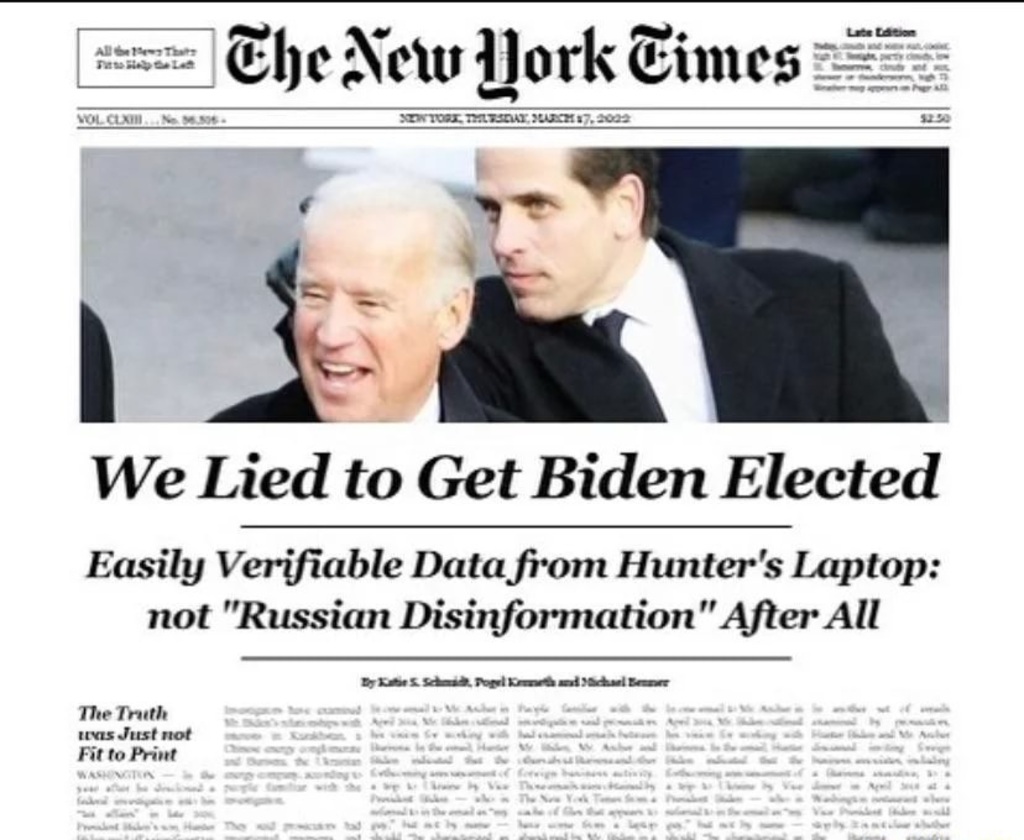
The New York Times Doesn’t Care If You Know That Big Tech Helped Rig Joe Biden’s Election

On March 17, 2022, The New York Times stated it had verified the authenticity of a laptop and its data as belonging to the president’s son, Hunter Biden. This was the same laptop holding information that Twitter, Facebook, and other corporate media immediately suppressed when The New York Post, a right-leaning competitor of The New York Times, reported on it three weeks before the 2020 presidential election.

If they had known about one of the Biden family scandals, such as the Hunter Biden laptop information, 17 percent of Joe Biden’s voters wouldn’t have voted for him, found a 2020 post-election poll. This means big tech’s suppression of this story likely made enough difference to tip Joe Biden into his low-margin win in the Electoral College.

Back in October 2020, Twitter and Facebook immediately responded to The New York Post’s publication of information from Hunter Biden’s laptop by effectively banning it from their platforms that effectively monopolize public discussion. Twitter punished the Post for reporting the repeatedly authenticated laptop information by suspending its account for two weeks.

“What this means is that, in the crucial days leading up to the 2020 presidential election, most of the corporate media spread an absolute lie about The New York Post’s reporting in order to mislead and manipulate the American electorate,” commented independent investigative reporter Glenn Greenwald.

Keep reading

The NYT Now Admits the Biden Laptop — Falsely Called “Russian Disinformation” — is Authentic

One of the most successful disinformation campaigns in modern American electoral history occurred in the weeks prior to the 2020 presidential election. On October 14, 2020 — less than three weeks before Americans were set to vote — the nation’s oldest newspaper, The New York Post, began publishing a series of reports about the business dealings of the Democratic frontrunner Joe Biden and his son, Hunter, in countries in which Biden, as Vice President, wielded considerable influence (including Ukraine and China) and would again if elected president.

The backlash against this reporting was immediate and intense, leading to suppression of the story by U.S. corporate media outlets and censorship of the story by leading Silicon Valley monopolies. The disinformation campaign against this reporting was led by the CIA’s all-but-official spokesperson Natasha Bertrand (then of Politico, now with CNN), whose article on October 19 appeared under this headline: “Hunter Biden story is Russian disinfo, dozens of former intel officials say.”

These “former intel officials” did not actually say that the “Hunter Biden story is Russian disinfo.” Indeed, they stressed in their letter the opposite: namely, that they had no evidence to suggest the emails were falsified or that Russia had anything to do them, but, instead, they had merely intuited this “suspicion” based on their experience:

We want to emphasize that we do not know if the emails, provided to the New York Post by President Trump’s personal attorney Rudy Giuliani, are genuine or not and that we do not have evidence of Russian involvement — just that our experience makes us deeply suspicious that the Russian government played a significant role in this case.

But a media that was overwhelmingly desperate to ensure Trump’s defeat had no time for facts or annoying details such as what these former officials actually said or whether it was in fact true. They had an election to manipulate. As a result, that these emails were “Russian disinformation” — meaning that they were fake and that Russia manufactured them — became an article of faith among the U.S.’s justifiably despised class of media employees.

Keep reading

NY Times reporter admits a “ton” of federal informants were in the crowd during Jan. 6 Capitol “riot,” says “ridiculous pee tape” of Trump does not exist

A veteran reporter for The New York Times has made several stunning admissions and statements that were captured on undercover video by Project Veritas, including verification that the FBI had scores of informants in the crowd during the Jan. 6 false flag incident at the U.S. Capitol Building.

In a two-part series, the investigative journalism organization recorded statements by Times reporter Matthew Rosenberg, who at one point was talking about his sources including one for “that ridiculous, like pee tape” — a false claim made in a fake ‘dossier’ assembled ahead of the 2016 election by former British spy Christopher Steele on behalf of the Hillary Clinton campaign that also accused then-GOP presidential nominee Donald Trump of being a dupe for Vladimir Putin.

Specifically, the claim was that Trump hired hookers to pee on a bed in a Moscow hotel where President Barack Obama and first lady Michelle Obama reportedly stayed.

Rosenberg also talked about what happens in the newsroom at The New York Times, explaining that there is “a real internal tug of war between, like, the reasonable people and some of the crazier leftist sh*t that’s worked it’s way in there.”

“They’re not the majority, but they’re very vocal, loud minority that dominate social media and, therefore, has just hugely outsized influence,” he continued, adding that he believes it is “alienating” Times subscribers whom he describes as “prosperous.”

The 11-year veteran reporter also said that many of his colleagues at the paper are “bullies” and “not the clearest thinkers, some of them,” before going on to describe those who end up at the Times as “very neurotic people.”

Keep reading

The New York Times Lauded The ‘Political Ascendancy’ Of a Democrat Mayor Now Facing Over 10 Felony Child Sex Assault Charges.

ADemocratic Mayor for the city of Sebastopol, California will stand trial following an indictment for nearly a dozen felony crimes in connection to a child sex assault investigation.

Robert Jacob, 44, was arrested in April 2021 on 11 felony and one misdemeanor sexual assault charges against a minor.

The charges against the Black Lives Matter (BLM) supporter and “defund the police” advocate included committing lewd acts with a child ages 14 to 15, participating in sexual penetration of a child under 16, making a child under 16 available to another person for lewd or lascivious acts, and distribution of child pornography.

At the conclusion of a three-hour preliminary hearing on March 7th, Judge Christopher Honigsberg found that the prosecution had presented enough evidence to establish that a crime had occurred.

“There is sufficient cause to believe the defendant is guilty,” he asserted.

Keep reading

Project Veritas Releases Video of New York Times Journalist Admitting ‘There Were a Ton of FBI Informants’ at Jan. 6 Riot

Project Veritas has released video of Pulitzer Prize-winning New York Times journalist Matthew Rosenberg admitting that feds were embedded in the Jan. 6, 2021 riot and that the fake news media has lied about the nature of the threat of the infamous election integrity protest.

Rosenberg can be seen on hidden camera speaking candidly about snowflakes who work for the Times. He called the young reporters “f*ckin’ b*tches” for their histrionics in the aftermath of the Jan. 6 rally.

“It’s like January 6th stuff, but it’s like I’m so over it at this point. I’m so over it,” Rosenberg said.

“The left’s overreaction – the left’s reaction to [Jan. 6], in some places, was so over the top. It was like, me and two other colleagues who were there who were outside and we were just having fun,” he continued, adding that the New York Times staff “were not in any danger” during Jan. 6.

Rosenberg also confirmed that there were many federal agents embedded in the crowd when the violence in and around the U.S. Capitol took place on Jan. 6.

“There were a ton of FBI informants among the people who attacked the Capitol… For the CIA and NSA, if you work there, you get polygraphed every year, and you’re asked if you’ve spoken to a reporter and your answer is anything but no, you’re in deep trouble. So I’ve been talking to former people who are talking to people who are still in,” Rosenberg said about how he gathered his intel.

Keep reading

The absurd ‘Russiagate’ Pulitzer of the NY Times and Washington Post

“For deeply sourced, relentlessly reported coverage in the public interest,” the citation from the Pulitzer Prize board begins, “that dramatically furthered the nation’s understanding of Russian interference in the 2016 presidential election and its connections to the Trump campaign, the president-elect’s transition team and his eventual administration.”

Except the journalism that the Pulitzers honored — a 2018 National Reporting prize shared by The Washington Post and The New York Times for reporting on Russiagate — did no such thing.

It led to a dramatic misunderstanding, suggesting that Donald Trump colluded with Vladimir Putin to help sway the 2016 election — a grand conspiracy we now know never existed.

Keep reading