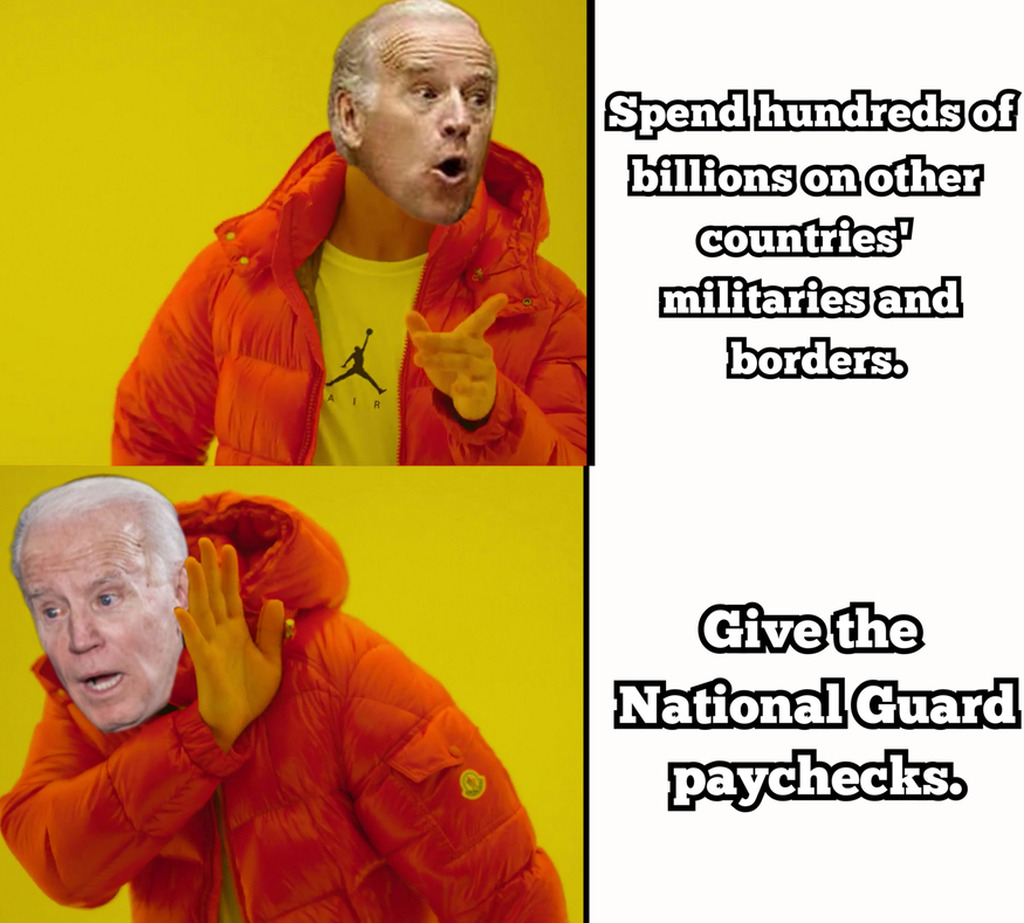
So who is running the show?


The president of the United States has once again committed the U.S. military to direct hot war with China in the event of an attack on Taiwan, a commitment that was once again walked back by his White House handlers.
In a Sunday 60 Minutes interview, Biden was asked point-blank by CBS News’ Scott Pelley if U.S. forces would defend Taiwan from an attack by the mainland.
“Yes, if in fact there was an unprecedented attack,” Biden said.
“After our interview a White House official told us U.S. policy has not changed,” Pelly narrates after the comment. “Officially, the U.S. will not say whether American forces would defend Taiwan. But the commander-in-chief had a view of his own.”
“So unlike Ukraine, to be clear, sir, U.S. forces, U.S. men and women would defend Taiwan in the event of a Chinese invasion?” Pelley asked.
“Yes,” Biden replied.
This is by my count the fourth time the U.S. president has made such remarks in transgression of his government’s standing policy of “strategic ambiguity” on this issue only to have them walked back by administration staff.
This past May Biden said “yes” when asked by the press if the U.S. would defend Taiwan militarily in the event of a Chinese invasion, adding, “That’s the commitment we made.” A White House official later stated that the president’s comments did not reflect a change in U.S. policy.
At a CNN forum in October of last year Biden responded in the affirmative when asked by an audience member if the U.S. would intervene to defend Taiwan, and said “Yes, we have a commitment” when asked to clarify if he meant intervening against an attack from China. Again, the White House quickly clarified that “there is no change in our policy.”
Fact-checking under President Trump was a bustling business. Seemingly every day, and sometimes by the hour, the 45th president’s every word was scrutinized, which all comes with the job.
But under President Biden, fact checkers are enjoying what feels like extended vacations or have simply checked out in terms of scrutinizing the many ways that he is misleading the public.
Take CNN fact-checker Daniel Dale as a prime example of apathy around holding the current president accountable.
From June 2019 until November 2020, Dale appeared or was mentioned on CNN more than once per day, on average, according to Mediaite. Estimating conservatively,
that’s more than 500 appearances or mentions on a national network in the span of just 16 months.
But Dale has become the fact-checker version of Edward Snowden under Biden. He’s almost impossible to find these days. In fact, Dale has not conducted even one fact-check of the president since June.
Of course, Biden supporters will insist that Dale simply doesn’t have any material to work with. But that’s not true. In August, Biden declared that inflation in July was zero, despite the number being near a 40-year high at 8.3 percent.
Last week, Biden claimed the Inflation Reduction Act, which numerous studies have concluded will do almost nothing to reduce inflation, had already “helped reduce inflation at the kitchen table.” In a related story, food prices rose again in August, with the Consumer Price Index up 10.6 percent year-over-year.
There are many other examples from the summer, but you get the point: The most powerful man in the country needs to be held accountable for his words and actions, particularly in an election year, when each side is attempting to shape the narrative through the press. But fact-checkers at mainstream outlets refuse to do it.
President Biden on Friday signed a bill that will eliminate the statute of limitations for people who were sexually abused as minors to file civil claims.
The Eliminating Limits to Justice for Child Sex Abuse Victims Act was passed by the House by voice vote on Tuesday after passing the Senate by unanimous consent in March.
The bill eliminates time constraints for survivors to file civil claims related to sex abuse crimes against minors, including forced labor, sex trafficking, sexual abuse and sexual exploitation of children.
Previously, minors who survived such abuse were able to file federal claims until they reached the age of 28 or until a decade after the violation or injury was discovered.
No federal statute of limitations was in place for criminal claims regarding child sex abuse.
The Joe Biden administration rolled out a new assistance agreement with Jordan. Washington will send Amman $10.15 billion over the next seven years. The new deal will make Jordan the third largest recipient of American aid, following only Ukraine and Israel.
The White House signed the new memorandum of understanding (MOU) on Friday. The Biden administration first discussed the new agreement with Jordan on the sidelines of the Jeddah summit in July. The MOU is the largest aid package the US has ever signed with Amman.
Jordanian officials celebrated the aid, and claimed it was essential. “It’s an extremely important MOU. It speaks to the strong friendship the two countries have,” foreign minister Ayman Safadi said. He added, “The US has gone above and beyond for Jordan.”
The State Department stressed Amman’s strategic importance to America’s foreign policy goals in the Middle East. “The MOU represents a major commitment to Jordan’s stability and the durability of the strategic partnership,” the press release said.
While the US sees Jordan as an important partner in the Middle East, Washington and Amman do not see eye-to-eye on Syria policy. Jordan recently endorsed the Russian presence in Syria as “stabilizing.” Some of the aid will help Amman manage the 1.3 million Syrian refugees. The reconstruction of Syria is currently being stifled by American sanctions.
Under the Biden administration, more than 90 federal agencies have pledged their commitment to equity by adopting action plans that put gender, race and other such factors at the center of their governmental missions.
The Equity Action Plans, which have received little notice since they were posted online last month following a document request from RealClearInvestigations, represent a “whole of government” fight against “entrenched disparities” and the “unbearable human costs of systemic racism.”
The equity blueprints show that:
The Equity Action Plans are a response to an executive order President Biden signed on his first day of office in January 2021, committing his administration to pursuing “a comprehensive approach to advancing equity for all, including people of color and others who have been historically underserved, marginalized, and adversely affected by persistent poverty and inequality.”
“Tech platforms are notoriously opaque,” the White House complained last week, saying Americans deserve to know more about how online forums decide “when and how to remove content from their sites.” Yet the Biden administration, which routinely pressures social media companies to suppress speech it does not like, is hardly a model of transparency in this area.
In a lawsuit filed last May, Louisiana Attorney General Jeff Landry and Missouri Attorney General Eric Schmitt argue that the administration’s “Orwellian” crusade against “misinformation” violates the First Amendment. They are trying to find out more about this “vast ‘Censorship Enterprise’ across a multitude of federal agencies,” and the administration is fighting them every step of the way.
So far, Landry and Schmitt have identified 45 federal officials who “communicate with social media platforms” about curtailing “misinformation.” Emails obtained during discovery show those platforms are desperate to comply with the government’s demands for speech restrictions, including the removal of specific messages and accounts.
A senior official in the Pentagon‘s education wing who has written books on anti-racism has a history of mocking white people on Twitter, recently-resurfaced posts revealed on Tuesday.
Kelisa Wing is the chief diversity, equity and inclusion officer in the Department of Defense’s Education Activity office, which oversees schooling for children of Pentagon employees including active duty service members.
But before she landed the role, Wing made a few controversial social media posts including one that disparaged a woman for stating that black people ‘can be racist too.’
She’s also listed as an author on several progressive children’s books in a series called ‘Racial Justice In America.’
One book is called ‘What Is White Privilege,’ while another is ‘What Does it Mean To Defund the Police?’
The former has lines such as: ‘If you are White you might feel bad about hurting others or you might feel afraid to lose this privilege.’
It also asks white children to consider if they will ‘really feel good at the end of the race when you look back and see others fighting obstacles that you didn’t even have?’
But the main controversy is with Wing’s now-private Twitter account.
The evolving landscape of lithium batteries is creating both contradictions and infrastructure hurdles that, according to some, need to be addressed sooner rather than later. A critical component of this is waste management.
More than 6 million electric vehicle (EV) battery packs will end up as scrap between now and 2030, and the recycling and reuse industries are racing to keep up. Some researchers project that recycling alone will be an over $12 billion industry by 2025.
U.S. President Joe Biden wants to make America a key player in the EV battery industry with a $3.1 billion spending package for automobile production to transition away from fossil fuels.
Much of this dream is pinned on a dusty stretch of soil in the Nevada high desert called Thacker Pass. It serves as the lynchpin in Biden’s push for increased domestic lithium production and more EV batteries. That’s because Thacker Pass is the largest hard rock lithium reserve in the United States.
Currently, China dominates the world’s EV battery production, with more than 80 percent of all units developed there.
Yet while Biden’s administration has its sights on the top spot for EV battery production, insiders are pointing out industry trapdoors.
Joe Biden’s ‘Build Back Better’ is not working as planned, or is it?
Gas prices are at record highs, the economy is in recession, parents are having difficulty finding a baby formula, and the cost of everything is way up.
According to the U.S. Department of Agriculture (USDA), there are currently no nationwide food shortages in the country.
“There are currently no nationwide shortages of food, although in some cases the inventory of certain foods at your grocery store might be temporarily low before stores can restock,” the agency said on their website. “Food production and manufacturing are widely dispersed throughout the U.S. and there are currently no wide-spread disruptions reported in the supply chain.”
You must be logged in to post a comment.