
Meta deletes Al Jazeera presenter’s profile after show criticising Israel

Al Jazeera Arabic presenter Tamer Almisshal has had his Facebook profile deleted by Meta 24 hours after the programme Tip of the Iceberg aired an investigation into Meta’s censorship of Palestinian content titled The Locked Space.

The programme’s investigation, which aired on Friday, included admissions by Eric Barbing, former head of Israel’s cybersecurity apparatus, about his organisation’s effort to track Palestinian content according to criteria that included “liking” a photo of a Palestinian killed by Israeli forces.

Then the agency would approach Facebook and argue that the content should be taken down.

According to Barbing, Facebook usually complies with the requests and Israel’s security apparatus follows up cases, including bringing court cases if need be.

The investigation followed up on Barbing’s admissions by interviewing a number of human and digital rights experts who agreed that there was a distinct imbalance in how Palestinian content is restricted.

The programme also interviewed Julie Owono, a member of Facebook’s oversight board, who admitted there is a discrepancy in how rules are interpreted and applied to Palestinian content and added that recommendations had been sent to Facebook to correct this.

Al Jazeera has asked Facebook about why Almisshal’s profile was shut down with no prior warning or explanation. It had not received a response by the time of publication.
Keep reading

Israel expanded an apartheid law last week. No one is talking about it.

There has been a lot of noise from the Israeli protests concerning the judicial overhaul. The recent central law that was passed last week reduced the supreme court’s ability to overturn government policy, the so-called “reasonableness law.” But another law also passed just a day later — an amendment to a core apartheid law known as the “Village Committees Law” of 2010, more officially named the Cooperative Societies Ordinance. It passed without opposition, and was hardly noticed. 

Adalah, the Legal Center for Arab Minority Rights in Israel, explained how “these committees, which to date exist in the Galilee and in the Naqab (Negev), have the power to approve or to deny applicants who wish to reside there, based on their perceived ‘social suitability’ to the ‘social and cultural fabric’ of a community. In practice, this power has led to the exclusion of Palestinian citizens of Israel from these communities, which are built on state-controlled land.”

The amendment that was passed (nr. 12) expands the existing law, which was limited to towns of up to 400 households, by introducing a new category called a “Continued Communal Town,” which allows towns with up to 700 households to have such admission committees. “Furthermore,” Adalah notes, “in five years, the Minister of Economy and Industry will be authorized to permit admissions committees in towns with more than 700. This provision, de facto, cancels the restriction on the number of households specified in the law.”

Keep reading

TEXAS STATE POLICE PURCHASED ISRAELI PHONE-TRACKING SOFTWARE FOR “BORDER EMERGENCY”

THE TEXAS DEPARTMENT of Public Safety purchased access to powerful software capable of locating and following people through their phones as part of Republican Gov. Greg Abbott’s “border security disaster” efforts, according to documents reviewed by The Intercept.

In 2021, Abbott proclaimed that the “surge of individuals unlawfully crossing the Texas-Mexico border posed an ongoing and imminent threat of disaster” to the state and its residents. Among other effects, the disaster declaration opened a spigot of government money to a variety of private firms ostensibly paid to help patrol and blockade the state’s border with Mexico.

One of the private companies that got in on the cash disbursements was Cobwebs Technologies, a little-known Israeli surveillance contractor. Cobwebs’s marquee product, the surveillance platform Tangles, offers its users a bounty of different tools for tracking people as they navigate both the internet and the real world, synthesizing social media posts, app activity, facial recognition, and phone tracking.

Keep reading

Placement of ancient hidden lamps, skulls in cave in Israel suggests Roman-era practice of necromancy

A pair of archaeologists, one with the Israel Antiquities Authority, the other from Bar-Ilan University, has found evidence of Roman-era necromancy practices in a cave in Israel. In their study, reported in the journal Harvard Theological Review, Eitan Klein and Boaz Zissu analyzed artifacts excavated from the Te’omim Cave over the past 14 years.

The Te’omim Cave has played a role in the history of what is now the Jerusalem hills region west of the famous city. During the Bar-Kokhba Revolt, for example, it served as a hideout for Jewish rebels. In this new effort, the researchers studied artifacts that multiple groups have removed from the cave since 2009 as part of a collaboration between several entities in Israel. Such artifacts have been dated to approximately 2,000 years ago, during the Roman era.

Researchers have found more than 120 oil lamps, various weapons, vessels, coins and even three human skulls. Many of the artifacts were found wedged into tight spaces. In this new effort, the researchers analyzed the artifacts and the places where they were found and hypothesize that at least some of them were used in attempts to speak with dead people, a practice called necromancy.

Necromancy is the practice of enchanted conjuring, involving attempts to communicate with the dead by calling forth their spirits or visualizations of them for the purpose of divination or revealing future events, or to discover secrets. It is also generally associated with black magic or witchcraft. Klein and Zissu suggest that the placement of many of the lamps, for example, is indicative of behavior associated with necromancy—mostly because of the presence of the skulls.

Keep reading

When Did Humans Start Settling Down?

Twelve thousand years ago, long before the beginning of recorded history, a group of perhaps 200 people lived in a small village by a stream flowing into the Sea of Galilee, in what today is northern Israel. The villagers hunted gazelle and hares, fished for carp, built stone houses, and buried their dead in a cemetery next to their homes. When I hiked to the site early one morning, it was easy to imagine them: A few figures setting off with nets to the lakeshore, others walking toward the hills with bows and arrows to look for game, and more down by the riverbank, spinning thread or crushing barley, shooing children out of the way—a community waking up together and getting to work, unaware of their position at the dawn of a new age.

I came to the village with Leore Grosman, an archaeologist from the Hebrew University of Jerusalem. We turned up a dirt track off the two-lane road that circles the Sea of Galilee. On the far shore, across five miles of placid water, lights in the city of Tiberias were blinking off. The sun wasn’t quite up, but the caffeine was kicking in. Grosman lit a cigarette and told me about herself in a gravelly voice. She started out studying math, then moved to Egyptology. She loved hieroglyphics. “But it’s a lot of sitting in libraries, and it’s a matter of personality,” she said. “I need to be outside.” She began digging here in 2010 with a feeling that the site, known as Nahal Ein Gev II, had something to say about a great change in the human story. She has returned each summer since.

Keep reading

Israel Killed Civilians, Targeted Hospitals in Jenin With US Weapons and Support

From July 3-4, Israeli Occupation Forces (IOF) — using weapons funded by the United States — mounted the most violent military assault in the occupied West Bank in two decades.

In what Israel dubbed “Operation Home and Garden,” more than 1,000 ground troops invaded the Jenin refugee camp. Assisted by helicopter gunships and armed drones, the IOF killed 12 Palestinians — including six civilians (five of them children) — and wounded more than 120 others (including 14 children), according to the Palestinian Centre for Human Rights. The IOF partially destroyed 109 houses, extensively damaged the infrastructure, leveled the streets and created a power outage. About 4,000 Palestinians were forcibly displaced from their homes.

While the IOF has used armed drones against Gazans, they are now using them against Palestinians in the occupied West Bank as well.

Meanwhile, the U.S. government, as usual, issued no criticism of the brutal IOF assault on Jenin. Instead, the White House declared that the United States “supports Israel’s security and right to defend its people against Hamas, Palestinian Islamic Jihad and other terrorist groups.”

Under international law, the occupying power (Israel) is not entitled to self-defense against the people it occupies (the Palestinians). A UN-appointed Commission of Inquiry determined last year that Israel’s occupation of Palestinian territory is illegal and called on the General Assembly to seek an advisory opinion from the International Court of Justice.

Keep reading

Ancient Bird Bones May Have Been Fashioned Into Flutes for Catching More Birds

12,000-year-old bird bones found in the far north of Israel may have been used as instruments by prehistoric humans to lure more birds to their death, according to a team of archaeologists that studied the artifacts.

The perforated bones were found in Israel’s Hula Valley, just west of the Golan Heights, which Israel seized from Syria in 1967. The bones were first excavated in 1955 but were recently reexamined.

Seven wing bones from the site belonged to coots and teals. Upon recent inspection, a team of archaeologists found that marks on the bones were actually minuscule holes bored into their sides.

The team posits that the bones were used as flutes (aerophones, to use scientific language) to mimic the calls of birds of prey. These calls would frighten the migratory birds into taking wing, making them easier targets for Natufian hunters, the scientists speculate. The team’s analysis of the bones was published today in Scientific Reports.

“If the flutes were used for hunting, then this is the earliest evidence of the use of sound in hunting,” said Hamudi Khalaily, an archaeologist at the Israel Antiquities Authority and co-author of the paper, in a Hebrew University of Jerusalem release.

Keep reading

BIDEN EMBRACES ANTISEMITISM DEFINITION THAT HAS UPENDED FREE SPEECH IN EUROPE

DURING A GRADUATION speech at the City University of New York’s law school last month, Fatima Mousa Mohammed, a Yemeni American student, criticized “Israeli settler colonialism” and advocated for “the fight against capitalism, racism, imperialism, and Zionism.”

Her words, which the university administration condemned as “hate speech,” kicked off a new round of public debate about the distinction between criticism of Israel and antisemitism. Republican members of Congress responded by introducing legislation that would deny federal funding to academic institutions that “authorize Anti-Semitic events.”

The bill cites a definition of antisemitism that the Israeli government and its supporters have been pushing in the United States and elsewhere, one that conflates prejudice toward Jews with criticism of Zionism and the state of Israel. And it comes on the heels of President Joe Biden nodding to the definition in the White House’s national strategy to combat antisemitism, released in late May.

In the 60-page document, the Biden administration referred to the IHRA definition — named after the International Holocaust Remembrance Alliance, which promotes it — as the “most prominent” of several definitions of antisemitism and one the administration has “embraced.” But it emphasized that it has no legal value and does not supersede existing laws or constitute binding guidance for public agencies and local government.

Still, by providing neither a rejection nor a full endorsement of the definition, the Biden administration left room for further lobbying for its adoption. Indeed, conservative and pro-Israel groups hailed the strategy as a victory, even as the single reference fell far short of what they had lobbied for: a full-throated endorsement of the IHRA framework as the “sole definition” of antisemitism and as the foundation for federal policy.

Keep reading

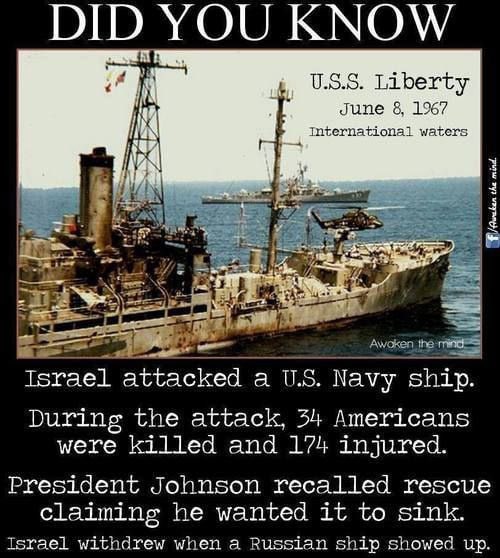
This Day in History: Israel Attacks The USS Liberty, Killing 34 Americans, Wounding 171

On June 8th, 1967, Israel launched an air and sea attack using fighter jets and torpedo boats against the USS Liberty, an American Navy ship with ties to the NSA that was sailing in the Mediterranean Sea near the Sinai Peninsula during the Six-Day War, in which America politically supported Israel’s fight against neighboring Arab states. The attack killed 34 Americans and wounded 171 more.

The Israeli attack on the USS Liberty remains shrouded in secrecy decades later and most files documenting the attack and its aftermath remain classified. What is known, is that the Liberty was sailing through international waters, monitoring radio chatter during Israel’s Six-Day War with the Arab states, when Israeli rockets tore through the ship. Israeli forces even deployed Napalm against the Americans.

Despite the ship clearly marking itself as an American vessel and flying a large American flag, the Israeli attack came without warning and persisted even after American distress calls were made.

While for decades the attack has been labeled as accidental by the US and Israeli governments, CIA documents that remain partially redacted and were published by numerous news agencies, including the Israeli outlet Haaretz, show that Israeli pilots were ordered to attack the Liberty, even after telling their commanders that the ship was American.

“This is an American ship. Do you still want us to attack?” an Israeli pilot asked the “IDF war room” in a communication obtained by the United States.

“Yes, follow orders,” the war room responded.

“But sir, it’s an American ship – I can see the flag!” the pilot said back.

“Never mind; hit it,” the war room commanded.

According to the USS Liberty Veterans’ Association:

“At 1400 hours, while approximately about 17 nautical miles off the northern Sinai coast and about 25 nautical miles northwest of El Arish, USS Liberty’s crew observed three surface radar contacts closing with their position at high speed. A few moments later, the bridge radar crew observed high speed aircraft passing over the surface returns on the same heading. Within a few short moments, and without any warning, Israeli fighter aircraft launched a rocket attack on USS Liberty. The aircraft made repeated firing passes, attacking USS Liberty with rockets and their internal cannons. After the first flight of fighter aircraft had exhausted their ordnance, subsequent flights of Israeli fighter aircraft continued to prosecute the attack with rockets, cannon fire, and napalm.”

At no point during the Israeli attack on the Liberty did the Americans return fire.

Keep reading