Fossil evidence of photosynthesis gets a billion years older

It’s not an exaggeration to suggest that the most significant event on Earth was the evolution of photosynthesis. The ability to harvest energy from light freed life from the need to scavenge energy from its environment. With this new capability, life grew in complexity and invaded new environments, ultimately reshaping the Earth.

For such a pivotal event, we know remarkably little about it. Tracing the presence of oxygen in the atmosphere suggests photosynthesis evolved at least 2.4 billion years ago, although the rise in oxygen levels turns out to be impressively complicated. Tracing the variations of present-day genes places photosynthesis’ origin at about 3 billion years ago. That timing is similar to the origin of the photosynthetic cyanobacteria, which both continue to live independently and have been incorporated into plant cells as chloroplasts.

What we don’t have is clear evidence of photosynthetic cells of similar age. A few microfossils with similarities to cyanobacteria have been identified, but it’s impossible to determine whether they were making the proteins that power photosynthesis. Now, new fossils described by a team at the University of Liège push unambiguous evidence of photosynthesis back over a billion years to 1.7 billion years ago.

Keep reading

Male or Female: There’s Nothing In Between

The male and female sexes are ancient, having emerged on the evolutionary landscape more than a billion years ago. This is much older than humans, older than most plant and animal species, older than most marine life, and even older than the brain itself.

More than just keeping an individual alive, as food and water do, the two sexes keep entire species alive by producing more genetically unique individuals through sexual reproduction: the mixing of genomes and the fusion of sex cells called gametes. The evolution of male and female sexes is a major reason why the diversity of plant and animal species exists. It’s why we humans exist. It’s why you exist.

More than 99.9 percent of animal species that have developed since the emergence of male and female sexes reproduce sexually. And 95 percent of those animal species—including humans—have male and female sexes in separate individuals, whereby organisms are either male or female for their entire lives.

It may be surprising, but the two sexes follow a universal biological definition that applies to all species with male and female systems: the male sex is the phenotype (or structure) that produces the smaller gametes (i.e., sperm), while the female sex is the phenotype (or structure) that produces the larger gametes (eggs). The sperm are numerous and fast, contributing half the genetic material of the parent, but no resources for the survival of the fertilized egg (zygote). The eggs are relatively few, and very slow, contributing half the genetic material of the parent and all the resources for the zygote’s survival. Combine these two different gamete types together and a genetically unique individual is formed.

The technical term for this system is known as anisogamy (from the Greek aniso, meaning unequal; and gámos, meaning marriage), which involves the fusion of two gametes with different size and form. It is so efficient for reproduction and producing genetic diversity that it has evolved independently in nearly all lineages of multi-cellular organisms.

Biologists consider the evolution of the two sexes mathematically inevitable, because this system maximizes the efficiency of sexual reproduction—providing resources to the offspring through investment in large, nutrient-heavy eggs, while also maximizing gamete fusion through the production of many sperm that can quickly find an egg. This efficiency explains why the same system has evolved independently so many times.

Keep reading

‘Scientist’ Neil deGrasse Tyson claims biology is ‘insufficient’ during unhinged rant defending radical trans agenda

Astrophysicist and noted science personality Neil deGrasse Tyson spoke out in favor of gender ideology and the ability of a person to actually change their sex. He made the remarks on the Stephen A Smith podcast “K[no]w Mercy.”

“Apparenly the XX/XY chromosomes,” he said with obvious derision, “are insufficient because when we wake up in the morning, we exaggerate whatever feature we want to portray the gender of our choice. Either the one you’re assigned, the one you choose to be—whatever it is!”

“And so now,” he went on as though swapping sex was the most obvious thing in the world, “just to tie a bow on this, I say to you, somewhere I read— somewhere, I think I read— that the United States was a land where we have the pursuit of happiness. Suppose no matter my chromosomes today, I feel 80 percent female, 20 percent male. Now I’m gonna, I’m gonna put on makeup. Tomorrow, I might feel 80 percent male. I’ll remove the makeup and I’ll wear a muscle shirt. Why do you care? What businesses is it of yours to require that I fill your inability to think of gender on a spectrum?”

Detransitioner Chloe Cole took issue with Tyson, noting that in his assessment, he conflates appearance and cosmetics with biology, as though a person’s external presentation has an effect on their biological reality.

Keep reading

Veteran biology professor who teaches scientific fact that sex is determined by chromosomes X and Y is FIRED after four students walked out of his reproductive class – accusing him of ‘religious preaching’

A veteran biology professor in Texas who has been teaching that sex is determined by X and Y chromosomes for over 20 years was allegedly fired after four students walked out of his classroom. 

Dr. Johnson Varkey has claimed he was let go from his teaching position at St. Philip’s College in San Antonio after he was accused of ‘religious preaching’.

He was discussing the human reproductive system on November 28, 2022, when four students stormed out of the lecture. 

Varkey was then accused of ‘discriminatory comments about homosexuals and transgender individuals, anti-abortion rhetoric, and misogynistic banter’. 

The professor said he received an email from the Alamo Colleges District Human Resources department in January, which said his credentials would be revoked pending an investigation. He was later fired. 

Keep reading

Biologists Create a New Type of Human Cells

Professor Vincent Pasque and his colleagues at KU Leuven have used stem cells to create a new kind of human cell in the lab. The new cells closely mirror their natural counterparts in early human embryos. As a result, scientists are better able to understand what occurs just after an embryo implants in the womb. The was recently published in the journal Cell Stem Cell.

A human embryo implants in the womb around seven days after fertilization if everything goes correctly. Due to technological and ethical constraints, the embryo becomes unavailable for study at that point. That is why scientists have already created stem cell models for various kinds of embryonic and extraembryonic cells in order to investigate human development in a dish.

Vincent Pasque’s team at KU Leuven has developed the first model for a specific type of human embryo cells, extraembryonic mesoderm cells. Professor Pasque: “These cells generate the first blood in an embryo, help to attach the embryo to the future placenta, and play a role in forming the primitive umbilical cord. In humans, this type of cell appears at an earlier developmental stage than in mouse embryos, and there might be other important differences between species. That makes our model especially important: research in mice may not give us answers that also apply to humans.”

The model cells were created by the researchers using human stem cells, which can still grow into all cell types in an embryo. The new cells closely resemble their natural counterparts in human embryos and hence serve as an excellent model for that cell type.

Keep reading

PayPal and Etsy ban evolutionary biologist Dr. Colin Wright

Dr. Colin Wright, an evolutionary biologist, has been banned from PayPal and Etsy. The online financial service and e-commerce platform did not specify why he was banned.

At the end of May, Dr. Wright provided an expert declaration for the Women’s Liberation Front, which is working to protect single-sex prisons.

“The only factual, objective meaning of the words ‘woman’ and ‘man’ are as references to adult human females, and adult human males, respectively,” Wright wrote in the declaration.

“From an objective standpoint, a person’s subjective feelings do not define or change their sex, which is factually and statically either male or female, determined before birth, and defined by objective reproductive anatomy.”

Dr. Wright announced the PayPal ban on Twitter, saying that he used the service to receive both recurring and one-time donations from his supporters.

PayPal wrote to Dr. Wright that, “after a review, we have decided to permanently limit your account as there was a change in your business model or your business model was considered risky.”

Keep reading

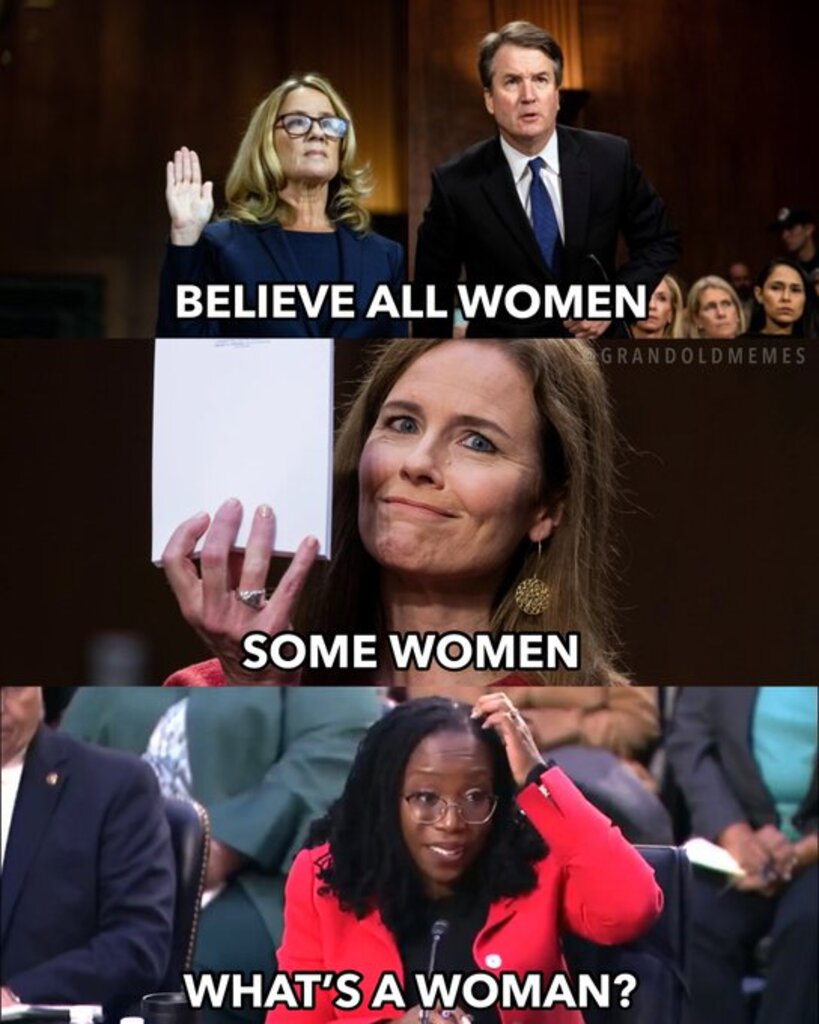
How Can Ketanji Brown Jackson Rule In Sex Discrimination Cases If She Can’t Define ‘Woman’?

Judicial confirmation hearings are rarely illuminating. Since the introduction of television cameras, they mostly serve as a way for senators to say what they want their constituents to hear and for judicial nominees to say as little as possible. Nothing is learned, at least not on purpose.

But occasionally, we learn something by accident. At Judge Ketanji Brown Jackson’s confirmation hearing on Tuesday, Sen. Marsha Blackburn of Tennessee asked a seemingly innocuous question: “Can you provide a definition of the word ‘woman’?”

The nominee was unable to do so.

It might seem like a question that goes more to politics than to the job of a judge, but when sex discrimination is frequently before the court — including as recently as last year in Bostock v. Clayton County — it behooves a judge to have some inkling about what “sex” means.

Blackburn’s questioning began with a reference to the 1996 case of United States v. Virginiain which the Supreme Court struck down the Virginia Military Institute’s policy of only admitting men by a 7-1 vote, with Justice Ruth Bader Ginsburg writing the opinion of the court. (You can watch the testimony here, beginning at about 13:10:00.) Blackburn quoted from that opinion, specifically to Ginsburg’s point that “[p]hysical differences between men and women, however, are enduring: ‘[T]he two sexes are not fungible; a community made up exclusively of one [sex] is different from a community composed of both.’”

“Do you agree with Justice Ginsburg,” Blackburn asked, “that there are physical differences between men and women that are enduring?”

It sounds like a softball — even young children know that there are physical differences between men and women. Jackson knows it, too. Everyone in that room knows it. But she declined to admit it.

“I am not familiar with that particular quote or case,” she said, which strains credulity. Had she committed that line to memory? Probably not. But to be unfamiliar with a landmark case, the most consequential majority opinion Justice Ginsburg ever authored? United States v. Virginia was surely a topic of discussion in 1996, Jackson’s third year of law school, where she was an editor of the Harvard Law Review. It beggars belief to say she was unfamiliar with it entirely.

The senator pressed on: “Do you interpret Justice Ginsburg’s meaning of ‘men and women’ as ‘male and female’?”

Judge Jackson demurred. “Again, because I don’t know the case, I don’t know how I interpret it.”

So Blackburn made it even simpler: “Can you provide a definition of the word ‘woman’?”

Again, Jackson pretended to not understand something that people have understood since the beginning of time.

“I can’t,” she said. “Not in this context, I’m not a biologist.”

Keep reading