
Another handy chart…


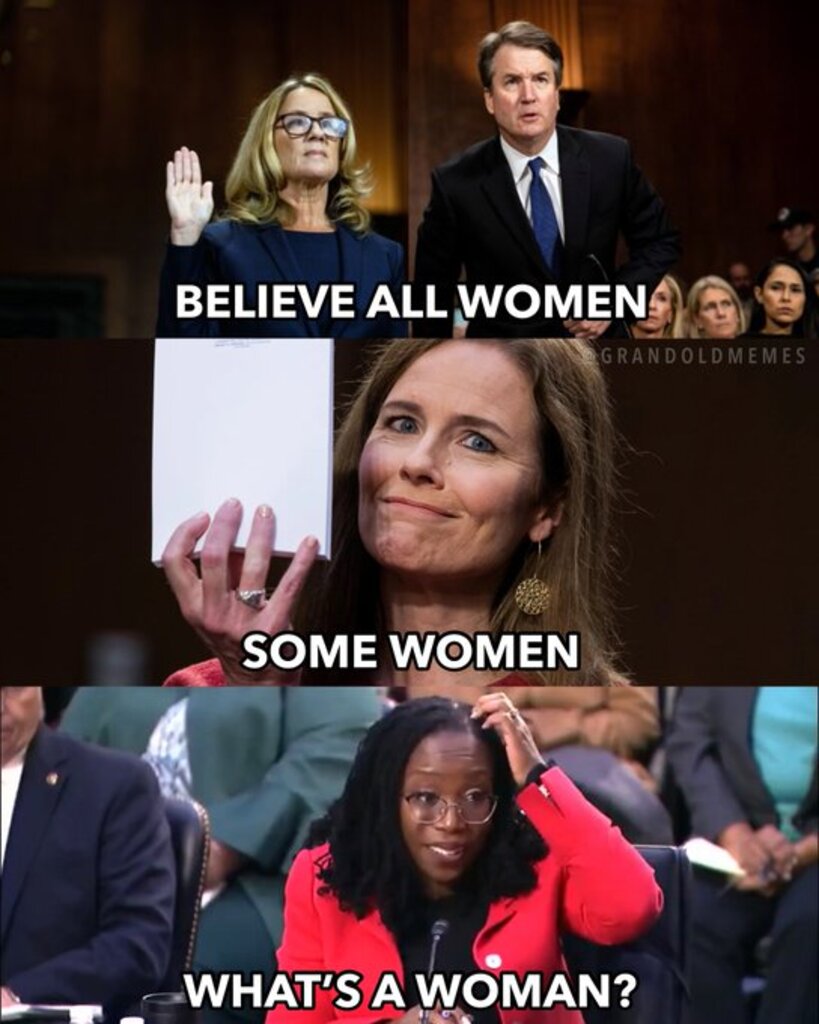
Judicial confirmation hearings are rarely illuminating. Since the introduction of television cameras, they mostly serve as a way for senators to say what they want their constituents to hear and for judicial nominees to say as little as possible. Nothing is learned, at least not on purpose.
But occasionally, we learn something by accident. At Judge Ketanji Brown Jackson’s confirmation hearing on Tuesday, Sen. Marsha Blackburn of Tennessee asked a seemingly innocuous question: “Can you provide a definition of the word ‘woman’?”
The nominee was unable to do so.
It might seem like a question that goes more to politics than to the job of a judge, but when sex discrimination is frequently before the court — including as recently as last year in Bostock v. Clayton County — it behooves a judge to have some inkling about what “sex” means.
Blackburn’s questioning began with a reference to the 1996 case of United States v. Virginia, in which the Supreme Court struck down the Virginia Military Institute’s policy of only admitting men by a 7-1 vote, with Justice Ruth Bader Ginsburg writing the opinion of the court. (You can watch the testimony here, beginning at about 13:10:00.) Blackburn quoted from that opinion, specifically to Ginsburg’s point that “[p]hysical differences between men and women, however, are enduring: ‘[T]he two sexes are not fungible; a community made up exclusively of one [sex] is different from a community composed of both.’”
“Do you agree with Justice Ginsburg,” Blackburn asked, “that there are physical differences between men and women that are enduring?”
It sounds like a softball — even young children know that there are physical differences between men and women. Jackson knows it, too. Everyone in that room knows it. But she declined to admit it.
“I am not familiar with that particular quote or case,” she said, which strains credulity. Had she committed that line to memory? Probably not. But to be unfamiliar with a landmark case, the most consequential majority opinion Justice Ginsburg ever authored? United States v. Virginia was surely a topic of discussion in 1996, Jackson’s third year of law school, where she was an editor of the Harvard Law Review. It beggars belief to say she was unfamiliar with it entirely.
The senator pressed on: “Do you interpret Justice Ginsburg’s meaning of ‘men and women’ as ‘male and female’?”
Judge Jackson demurred. “Again, because I don’t know the case, I don’t know how I interpret it.”
So Blackburn made it even simpler: “Can you provide a definition of the word ‘woman’?”
Again, Jackson pretended to not understand something that people have understood since the beginning of time.
“I can’t,” she said. “Not in this context, I’m not a biologist.”

Joe Biden’s recent Supreme Court nominee Judge Ketanji Brown Jackson, whom the president has admitted was nominated in part because she is a woman, stunned listeners on Tuesday when she refused to give a definition of what a woman is.
“I can’t. … I’m not a biologist,” Jackson said after Republican Sen. Marsha Blackburn asked her to provide a definition of the word “woman.”
But for not knowing what a “woman” is, Jackson loves to use the word. Here are 14 times she invokes the fairer sex in just the first two days of her confirmation hearings, plus 34 times she’s used the word in her legal opinions as a judge


High schoolers in a Massachusetts biology class were asked during a lesson on human genetics to erase “gendered terms” from their vocabulary.
In a lesson on human genetics, Needham High School biology students learned to use inclusive language when discussing sex. An accompanying slideshow, which Parents Defending Education released last week, defines gender as an individual’s “psychological sense of self” and asks students to research “gender fluidity” in nature.
Progressive ideology has crept into classrooms across the country. Radical education activists have called for “antiracist” math curricula that eliminate such “racist” practices as showing your work and arriving at the correct answer. One Virginia school district has proposed eliminating homework grades and extra credit assignments to promote “equity.”
The presentation boasts popular progressive arguments on gender and sexuality. One slide includes definitions of “anatomical sex,” “gender identity,” “gender expression,” and “attraction” and says that sex is not gender.
“Sex (sometimes called biological sex, anatomical sex, or physical sex) is comprised of things like genitals, chromosomes, hormones, body hair, and more,” the slide provides as a definition for anatomical sex. “But one thing it’s not: gender.”
That slide defines “gender identity” as an individual’s “psychological sense of self.”
“Who you, in your head, know yourself to be, based on how much you align (or don’t align) with what you understand to be the options for gender,” the slide reads.
Eliminating “gendered terms,” according to another slide, ensures that “people with diverse (a)sexualities, (a)genders, bodies, and (a)romantic orientations are included and respected.” Discussing biological sex in terms of men and women “marginalizes” those born with both male and female genitalia, “who have been persistently discriminated against.”
After giving examples of hermaphroditic and sex-transitioning plants and animals, the presentation ends with an assignment: Students must research other examples of “gender fluidity” in nature.
Needham High School principal Aaron Sicotte told the Washington Free Beacon in a statement that the school is “proud” of its curriculum and hopes that lessons “appropriately reflect the needs of a diverse student body and the standards, values, and high academic expectations of the Needham community.” Needham High School’s course catalog notes that lessons in biology—including those offered to freshmen—and physiology include lessons on human sexuality. Parents have the option to remove their children from lessons they deem inappropriate.
On Wednesday, Texas Representative James Talarico told fellow commitee members that there were more than two biological sexes.
Talarico pointed out the other biological sexes in a Committee on Public Education hearing on Wednesday, in which Talarico holds a seat.
“Modern science obviously recognizes that there are many more than two biological sexes, in fact, there are six,” stated Talarico. “Which honestly surprised me too cause I am not well versed in this issue area, I’m not a scientist I’m a politician, a lot worse than a scientist.”


You must be logged in to post a comment.