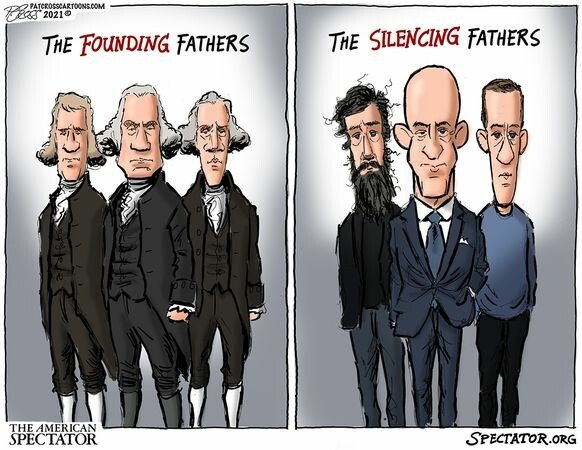
Wait for it…


Instagram has deleted a clip of President Joe Biden falling up the stairs of Air Force One three times, stating that it is “violence and incitement.”
The post was shared by Ashley StClair, a political commentator, along with the caption “Joe Biden vs his biggest opponent yet…stairs.”
“We removed your story because it goes against our Community Guidelines. We created these guidelines to support and protect our community on Instagram,” Instagram stated.
Facebook announced Wednesday that it will restrict the popularity of groups and users that accrue violations and, in some cases, remove them altogether in order to reduce harmful content and misinformation.
“We’ve taken action to curb the spread of harmful content, like hate speech and misinformation, and made it harder for certain groups to operate or be discovered, whether they’re Public or Private. When a group repeatedly breaks our rules, we take it down entirely,” Facebook announced in a press release Wednesday.
Building upon its decision to stop recommending political groups to U.S. users in January after the Jan. 6 attack on the U.S. Capitol, Facebook will now reduce the privileges and popularity of groups that violate its content moderation rules.
This means users will be less likely to discover groups that have had Facebook community violations in the past and will see warnings when they try to join them.
Groups with a large number of members who have broken Facebook rules will be required to get administrator and moderator approval before posts can be published.
Individual users who have repeatedly violated Facebook policies within a group will be blocked altogether from posting in groups or inviting others to groups and creating new groups themselves.
Spotify has removed an anti-lockdown song by Ian Brown, the former lead vocalist of English rock band The Stone Roses. The music streaming service claims the song violated its policies against COVID-19 misinformation.
Brown released the anti-lockdown song “Little Seed Big Tree” last September. “NO LOCKDOWN NO TESTS NO TRACKS NO MASKS NO VAX,” he tweeted while launching the song.
On March 12, Brown took to Twitter to announce that Spotify had removed his song.
“SPOTiFY stream the streams and censor artists like they have with my last song TOOK IT DOWN just put it down the memory hole! FREE EXPRESSiON AS REVOLUTION,” he wrote.
On Monday, Twitter filed a complaint in court against Texas Attorney General Ken Paxton, who launched an investigation into the platform’s content censorship policies. Twitter argues that Paxton launched the investigation in retaliation to the de-platforming of former president Trump, which the company ironically claims is an abuse of power.
We obtained a copy of the complaint for you here.
“Twitter seeks to stop AG Paxton from unlawfully abusing his authority as the highest law-enforcement officer of the State of Texas to intimidate, harass, and target Twitter in retaliation for Twitter’s exercise of its First Amendment rights,” the company wrote in the court filing.
Following the suspension of Trump’s accounts on most mainstream social media platforms after the Jan 6 riot, Paxton launched an investigation into the moderation policies at Twitter, Facebook, Twitter, Apple, and Amazon.

The treasure trove of data currently being gathered through social media networks and other electronic means is a completely unregulated space, with microtargeting, in particular, spurring intense discussion in the wake of widely publicized allegations of Russian “interference” in the 2016 U.S. elections and the liberal use of data analytics, by Brexit promoters in the UK and the Trump campaign itself, to sway voters.
Hovering in the background of the simmering debate is the growing power of Facebook, Apple and other platform owners, whose monopolistic business practices are facing increasing push back around the world. Nevertheless, our content landlords still hold the key to the big-data realm by virtue of their dominant position, and whoever wants access to the new oil must kiss the ring of the Big Tech overlords.
Twitter failed to respond to a letter by Republican Reps. Jim Jordan from Ohio, and Ken Buck from Colorado, who requested documentation and data to aid a Congressional investigation by the House Judiciary Committee. The request was first made in July 2020.
In the letter, the Republican House representatives requested Twitter provide the House Judiciary Committee with documentation and data related to several issues, including the platform’s content moderation policies, its assertion that President Trump’s warnings to protesters violated its policies (last summer Trump warned rioters they would face violence from the National Guard), and its decision to fact check the then-President’s tweets.
In the recent letter, dated March 4, the Republican Reps claim that the request was first sent last July. Twitter did not provide the requested information then, and is yet to respond to the most recent letter.
Earlier this week, the internet was in an uproar amid the controversy over the company who owns the rights to Dr. Seuss announcing that several of their titles will no longer be sold because they were deemed to contain “insensitive and racist imagery.”
Dr. Seuss Enterprises, which preserves the author’s legacy, announced this week six books – “And to Think That I Saw It on Mulberry Street,” “If I Ran the Zoo,” “McElligot’s Pool,” “On Beyond Zebra!,” “Scrambled Eggs Super!,” and “The Cat’s Quizzer” – would no longer be printed.
“These books portray people in ways that are hurtful and wrong,” Dr. Seuss Enterprises told The Associated Press in a statement.
“Ceasing sales of these books is only part of our commitment and our broader plan to ensure Dr. Seuss Enterprises’ catalog represents and supports all communities and families,” it said, noting that they came to the decision internally.
Whether planned or not, the companies decision to stop selling these six titles sent sales of Dr. Seuss books through the roof. As of Thursday “The Cat in The Hat,” “Oh, The Places You’ll Go” and “Green Eggs and Ham,” three of Seuss’s best-known works, were all out of stock on Amazon and other places.
For a brief moment, the banned books were gaining premium prices of several hundred dollars on eBay as well.
People aren’t buying these now-cancelled books for hundreds of dollars each to preserve the imagery of the controversial content so they can teach their children racial stereotypes. They are simply snagging — what they think will be — a valuable collectable in the future because of nostalgia and to make sure the books don’t entirely disappear; which they should absolutely be doing.
While outlets like Amazon and others all continued to sell Dr. Seuss’s works, sites like eBay quickly moved to ban the sale of these six titles in a failed attempt at virtue signaling that was embarrassing on many fronts. What’s more, it exposed a hypocrisy that runs deep in the realm of big tech.
On eBay right now, there are multiple auctions for books on how to make improvised explosives and racism. Yet the auction giant is worried about questionably offensive children’s books with messages on how to be a good person.
Kurt Saxon, 88, is a former member of the American Nazi Party and author of The Poor Man’s James Bond, a series of books on improvised weapons and munitions. Currently, there are dozens of copies of these books for sale on eBay.
If Nazi bomb making isn’t your thing, there are also dozens of copies of the U.S. Army Improvised Munitions Handbook US Army Survival Paperback for sale on the platform.
In fact, there are countless “controversial” books that remain for sale on eBay despite the auction giant cancelling Dr. Seuss.
“Digital giants have been playing an increasingly significant role in wider society… how well does this monopolism correlate with the public interest?,” Russian President Vladimir Putin said on January 27, 2021.
“Where is the distinction between successful global businesses, sought-after services and big data consolidation on the one hand, and the efforts to rule society[…] by substituting legitimate democratic institutions, by restricting the natural right for people to decide how to live and what view to express freely on the other hand?”
Was Mr. Putin defending democracy? Hardly. What apparently worries him is that the Big Tech might gain the power to control society at the expense of his government.
What must be a nightmare for him — as for many Americans — is that the Tech giants were able to censor news favorable to Trump and then censor Trump himself. How could the U.S. do this to the president of a great and free country?
Putin made these comments at the Davos World Economic Forum, in which he and Chinese President Xi Jinping, sped on by the “Great Reset” of a fourth industrial revolution, used enlightened phrases to mask dark plans for nation states in a globalist New World Order. Thus did Xi caution attendees “to adapt to and guide globalization, cushion its negative impact, and deliver its benefits to all countries and all nations.”
In March 2019, Putin signed a law “imposing penalties for Russian internet users caught spread ‘fake news’ and information that presents ‘clear disrespect for society, government, state symbols the constitution and government institutions.'” Punishments got even heavier with new laws in December.
Meanwhile, opposition leader Alexei Navalny has been sentenced to prison for more than three years (with a year off for time served), in part because he revealed photos of a lavish Russian palace allegedly belonging to Putin on the coast of the Black Sea. Its accouterments supposedly include an $824 toilet brush. Many of the thousands of people protesting Navalny’s imprisonment have since been protesting Putin by waving gold-painted toilet brushes.
How nice that American Big Tech companies is pushing democracy in Russia — even while it is denying it at home. Do you notice how many leaders in Europe have risen to condemn censorship in America even though many in Europe are censoring their citizens as well, and are not exactly fans of the person who was being censored, former President Donald J. Trump? Like Putin, they probably do not want Big Tech competing with their governments, either.
You must be logged in to post a comment.