
EEOC chair makes appeal to white men who may have discrimination claims

Andrea Lucas, the chair of the Equal Employment Opportunity Commission (EEOC), called on white men to come forward with employment and workplace discrimination complaints. 

Lucas said Wednesday in a video on the social platform X that white men may have a claim to recover money under federal civil rights laws, and should contact the EEOC as soon as possible. 

The EEOC, established under the Civil Rights Act of 1964, enforces federal antidiscrimination laws in hiring or the workplace, which make it illegal for employers to discriminate against an applicant or employee because of their race, color, religion, sex, national origin, age, disability or genetic information.

“The EEOC is committed to identifying, attacking and eliminating all forms of race and sex discrimination, including against white male applicants and employees,” Lucas added.

Most employers with at least 15 employees and the majority of labor unions and employment agencies are subject to EEOC laws, according to the commission’s website. The laws apply to hiring, firing, promotions, trainings, wages and benefits. 

Lucas, appointed by President Trump in November, had served as acting chair since January. She has been on the commission since 2020, when Trump appointed her during his first term. 

Prior to her time at the EEOC, she worked at the law firm of Gibson, Dunn & Crutcher and clerked for U.S. District Judge James C. Cacheris. Cacheris, who died earlier this year, was appointed to his post in the Eastern District of Virginia by former President Reagan. 

On her LinkedIn page, Lucas promoted a page on the EEOC’s website concerning what people should do if they experience discrimination due to diversity, equity and inclusion (DEI) policies. The Trump administration has targeted federal DEI initiatives since the president returned to office in January.
Keep reading

After Affirmative Action Win Over Harvard, Group Takes On West Point

The group that triumphed in a landmark Supreme Court case that struck down affirmative action policies at Harvard University earlier this year hopes to build on the victory with a lawsuit targeting similar policies at the U.S. Military Academy at West Point.

Students for Fair Admissions (SFFA) filed the lawsuit on Sept. 19 with high hopes, but the organization has strayed into a legal and political minefield as the academy and the Biden administration try to block the lawsuit on the grounds that an institution training military officers isn’t subject to the same rules as private universities and that diversity, equity, and inclusion (DEI) policies help, rather than hinder, effectiveness in combat.

Largely as a result of the perceived disparity between those standards that apply to private colleges and universities and those applicable to entities under federal oversight, the SFFA faces one of the most formidable legal challenges, the outcome of which will have implications for every school and academy in the nation.

Since President Joe Biden took office, a marked cultural shift has been underway in virtually all branches of the military.

Keep reading

‘Color-Blind’ Supreme Court Bars Consideration Of Race In College Admissions

The Supreme Court has ruled that it is unconstitutional to consider race in university admissions.

In Thursday’s 6-3 decision (along ideological lines), the justices rejected arguments by Harvard College and the University of North Carolina that their admissions programs are warranted to ensure campus diversity.

The high court majority effectively overturned a 2003 decision, known as Grutter v. Bollinger, that had reaffirmed the right of universities to consider race as one of many admissions factors.

In a concurring opinion, Justice Clarence Thomas said that ruling “is, for all intents and purposes, overruled.”

As The Wall Street Journal reports, the ruling will force a reworking of admissions criteria throughout American higher education, where for decades the pursuit of diversity has been an article of faith.

Specifically, The 14th Amendment ensures that individuals receive equal protection of the laws from state agencies including public universities, a standard that also applies to most private colleges that receive federal funding.

In general, the court has permitted racial preferences only to remedy specific acts of illegal discrimination, not compensate for general social injustices said to stem from historical practices.

Does it really need SCOTUS to decide this? Of course, race should not be considered!

“Eliminating racial discrimination means eliminating all of it,” Chief Justice John Roberts wrote in the majority opinion.

“And the Equal Protection Clause, we have accordingly held, applies ‘without regard to any differences of race, of color, or of nationality’—it is ‘universal in [its] application.’”

The court’s three liberals dissented. Society “is not, and has never been, colorblind,” Justice Sonia Sotomayor wrote, joined by Justices Elena Kagan and Ketanji Brown Jackson.

“The Court ignores the dangerous consequences of an America where its leadership does not reflect the diversity of the People.”

The dissenters exclaimed that the court’s conservative majority was “entrenching racial inequality in education.”

“Today, this Court stands in the way and rolls back decades of precedent and momentous progress. It holds that race can no longer be used in a limited way in college admissions to achieve such critical benefits,” wrote Sotomayor.

“In so holding, the Court cements a superficial rule of colorblindness as a constitutional principle in an endemically segregated society where race has always mattered and continues to matter.”

Brace for the snowflakes to unleash their hatred of this color-blind ruling…

Keep reading

Here Are 7 Major Cases The Supreme Court Has Yet To Decide This Term

Among the dozens of opinions yet to be released by the Supreme Court this term are cases on affirmative action, compelled speech and social media companies’ liability for content posted on their platforms.

To date, the Court has released 18 opinions, issuing rulings that enabled those facing complaints from administrative agencies to press constitutional challenges in federal court and allowed a death row inmate’s request for a DNA test to proceed. But opinions in 40 more cases are expected to be released before the end of June, including some of the most consequential cases on this term’s docket.

Keep reading

Central Inclusive Agency! Fury as CIA lists ‘equal employment opportunity specialist’ role for up to $184,000 per year (almost TRIPLE the $67,000 per year starting salary for field agents)

The CIA has sparked fury by advertising for an equal opportunities officer at up to triple the pay of a foreign intelligence job.

An Equal Employment Opportunity (EEO) Specialist position at the agency is being offered at an eye-watering starting salary of between $154,428 and $183,500.

The job description includes pushing outreach and education initiatives to help raise awareness of equity issues within the CIA.

In stark contrast, a Collection Management Officer role – which involves the collection of foreign intelligence – starts at between $67,122 and $102,166.

Keep reading

Why so many Canadians pretend to be indigenous

‘Pretendians’ must be among the fastest growing cultural groups in Canada. A Pretendian is someone with little or no indigenous background who pretends to be indigenous. The latest to be uncovered is Vianne Timmons, president of Memorial University of Newfoundland. Last week, Timmons was forced to apologise for misrepresenting her background and is now taking a leave of absence.

Timmons claimed in CVs and elsewhere that she was descended from Mi’kmaq First Nations peoples. A recent CBC News report questioned whether or not Timmons actually had any First Nations ancestry at all. Looking at her family tree, the report found that she is probably only one-1024th to one-2048th indigenous.

Timmons’ story is noteworthy because she is a high-profile academic. She is director on the board of Universities Canada. She was named as one of Canada’s Top 100 most-powerful women in 2008 and was the 2013 winner of the Saskatchewan Humanitarian Award from the Red Cross. In 2017, she was even named an Officer of the Order of Canada for her lifetime contributions to inclusive education, family literacy, indigenous post-secondary education and women’s leadership.

Timmons even accepted an Indspire trophy – ‘the highest honour the indigenous community bestows upon its own people’ – while holding an eagle feather. At that ceremony, she claimed that her father once told her: ‘We’re Mi’kmaq, but I was raised to be ashamed of it so I hid it, all my life.’ In 2021, Timmons spoke about ‘discovering’ her indigenous roots: ‘It’s like trying to find your story that somebody hid from you, not just hid from you, but changed for you.’

Timmons is far from the only high-profile academic to have claimed minority status on dubious grounds. In 2016, author Joseph Boyden, an award-winning author of fiction and non-fiction about First Nations Canadians, faced doubts about his claims to indigenous ancestry. A 2020 CBC investigation raised similar concerns about filmmaker Michelle Latimer, whose film, Inconvenient Indian, won the People’s Choice Award for Documentaries and the award for Best Canadian Film at the Toronto International Film Festival. In 2021, the CBC revealed that Carrie Bourassa, Canada’s leading indigenous health scientist, appeared to be of entirely European ancestry. She had to resign her position at the University of Saskatchewan. Last year, Mary Ellen Turpel-Lafond – a former judge, scholar and another recipient of the Order of Canada – was also found to have made inconsistent claims about her heritage.

Keep reading

Big Tech, Pharma, Finance Urge SCOTUS to Uphold Race-Based Discrimination in College Admissions

A large cross-section of corporate America filed briefs with the Supreme Court on Aug. 1 urging the court to allow colleges to continue using race as a factor in student admissions.

The court is poised to hear challenges to these racially discriminatory policies in its new term that begins in October. The challengers say so-called affirmative action not only hurts white applicants, but works out to be an “anti-Asian penalty” as well. Asian American applicants generally have higher academic scores and higher extracurricular scores, they say.

Some legal observers speculate that the nine-member court—whose six-member conservative majority broke new ground in June by curbing environmental regulatory powers, declaring that the court was wrong to recognize a constitutional right to abortion 49 years ago, and declaring that there is a constitutional right to carry firearms in public for self-defense—wouldn’t have agreed to hear challenges to race-based college admissions unless it intended to curb them.

The use of race-based criteria by institutions of higher learning in the admissions process isn’t popular in the United States.

Surveys from both Pew Research Center and Gallup have indicated that nearly 75 percent of Americans of all races “do not believe race or ethnicity should be a factor in college admissions.”

Keep reading

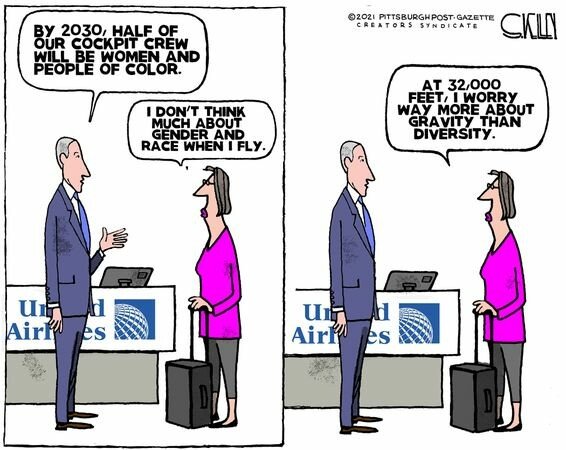
United Airlines prepares to shake up white, male-dominated pilot population

United Airlines said on Tuesday it wants women and people of color to make up at least half of the 5,000 pilots it plans to train this decade at its new flight school, a push to diversify a career traditionally dominated by white men.

The announcement comes as U.S. airlines resume pilot hiring halted last year during the pandemic and as they find themselves in the crosshairs of politically charged issues involving race.

“We want to make sure that we are tapping into a big deep talent pool and not limiting ourselves to just one section of the pond,” Chief Communications Officer Josh Earnest said on a Zoom call with journalists.

Chicago-based United joined Delta Air Lines and American Airlines on Monday in speaking out against voting restrictions following recent legislation in states like Georgia that activist groups say unfairly target Black and other racial minority voters.

Keep reading

End the ‘Systemic Racism’ of Affirmative Action

As the nation’s incipient racial reckoning following last May’s killing of George Floyd morphed into the summer’s riotous anarchy, the term “systemic racism” emerged as a fixture of our public discourse. What began as a somewhat arcane dialogue about purported police “militarization” and the “qualified immunity” legal doctrine soon took on a much more insidious tone. America, those like the New York Times‘ “1619 Project” fabulists told us, was rotten to its very core, blemished by the indelible taint of “systemic racism.”

In reality, as many courageously pointed out amid unprecedented “cancel culture” headwinds seeking to stifle all dissent, there is no such thing as “systemic racism” that afflicts all of America’s leading institutions. Despite the claim attaining mythological status, there is no factual basis to support it. There will, sadly, always be individual racists from all backgrounds and all walks of life, but American society in the 2020s simply does not have anything remotely resembling a legally enshrined regime under which its racial majority “systemically” oppresses its racial minorities. America in the year 2021 is not Germany in 1936; it is not South Africa in 1985; it is not—after the Civil Rights Act of 1964 and the Voting Rights Act of 1965—the Jim Crow South. This ought to be astoundingly obvious.

Keep reading