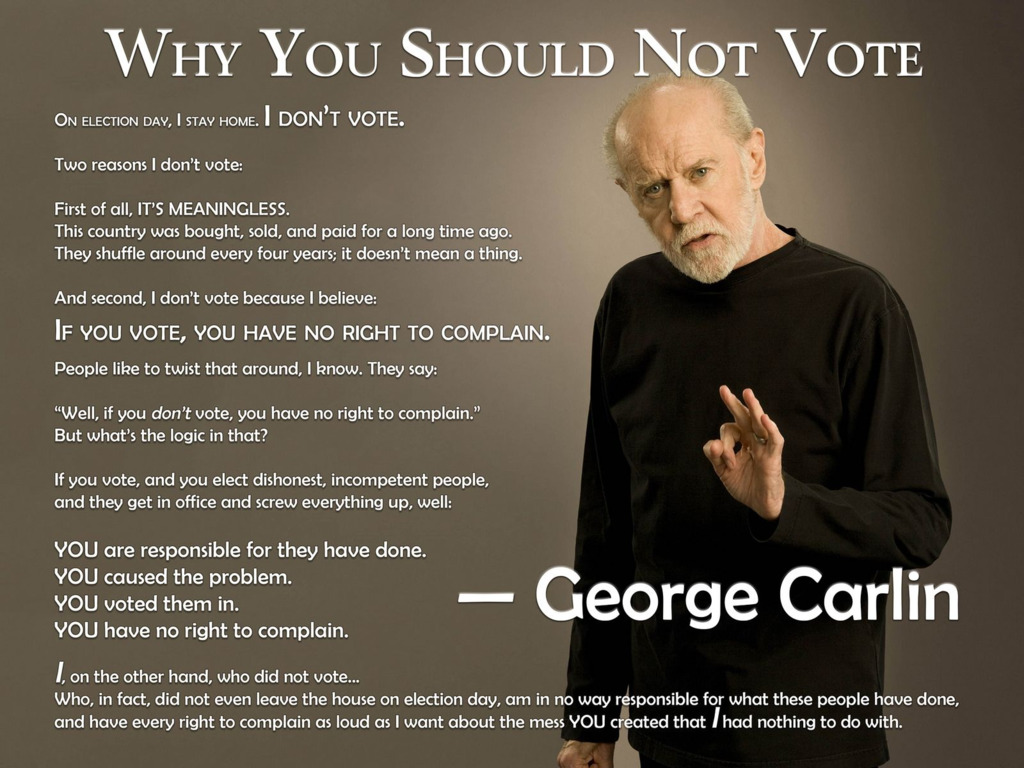
George Carlin on voting…

US National Security Agency (NSA) whistleblower Edward Snowden says a 1983 interview with former CIA officer Frank Snepp, detailing how the agency used mainstream newspapers in the US to distribute disinformation, is still the “most important video of the year.”
Snowden, who currently lives in Russia after gaining citizenship in the country, posted a short clip from Snepp’s interview on Monday. In the video, the former intelligence officer explained how he had served as an interrogator, agent debriefer and chief strategy analyst while working in the US embassy in Saigon during the Vietnam War.
Snepp said one his duties was to brief the press when the CIA wanted to “circulate disinformation on a particular issue,” noting that this information was not necessarily a lie, and could be a half-truth.
“We would pick out a journalist, I would go do the briefing, and hope that he would put the information in print,” Snepp said, noting that the journalists would usually have no way of actually verifying any of the information provided to them.
Snepp went on to name a few journalists who the CIA had specifically targeted over their “terrific influence,” and named a few “respected journalists” who were working in Saigon at the time, such as Robert Chaplin of the New Yorker, Kies Beach of the Los Angeles Times, Malcolm Brown of the New York Times, and Maynard Parker of Newsweek magazine, among others.
As US voters head to the polls for the much-anticipated Midterms, talk of Russian trolls monkeying with US democracy is back in the news. But does the country really need Russia’s help in “stoking anger” among the electorate?
If the hyper-liberal New York Times can be taken at face value just two days before an epic election, Russia’s underground army of trolls is, once again, attempting to seed the minds of malleable US voters to the Kremlin’s advantage. If those charges sounded outlandish in 2016, when the Democrats accused Russian ‘influencers’ of denying Hillary Clinton the presidency, they seem doubly so today.
The Times reported that the goal of the reactivated Internet Research Agency in St. Petersburg is to “stoke anger among conservative voters and to undermine trust in the American electoral system.” Judging by the looks of things, the Russians are a bit late to the party. It would be hard to name another period in US politics when the level of anger and distrust has been so extreme, and that is something the Russian trolls, despite their supposed superhuman abilities, can’t take credit for.
Take inflation, for example, the single most pressing issue among US voters. It doesn’t require any sort of Russian mind-bending operation to inform Americans that the economic situation is deteriorating before their eyes, and has been ever since Biden entered office. They only need to look at their food and utility bills each month, and the price at the gas pump, to feel fury for what the Biden administration has done to the economy in a shockingly short period of time. Any effort to blame these negative sentiments on “the Russians” is just another way of the Democrats saying that soaring prices is “disinformation” and unworthy of your attention.
Palmer Luckey, defense contractor and the father of modern virtual reality, has created a VR headset that will kill the user if they die in the game they’re playing. He did this to commemorate the anime, Sword Art Online. Luckey is the founder of Oculus, a company he sold to Facebook in 2014 for $2 billion. This is the technology that Mark Zuckerberg rebranded as the foundation for Meta.
Luckey’s killer headset looks like a Meta Quest Pro hooked up with three explosive charge modules that sit above the screen. The charges are aimed directly at the user’s forebrain and, should they go off, would obliterate the head of the user.
“The idea of tying your real life to your virtual avatar has always fascinated me—you instantly raise the stakes to the maximum level and force people to fundamentally rethink how they interact with the virtual world and the players inside it,” Luckey wrote in a blog post explaining the project. “Pumped up graphics might make a game look more real, but only the threat of serious consequences can make a game feel real to you and every other person in the game.”
According to Luckey, the anime and light novel series Sword Art Online made people interested in virtual reality, especially in Japan. In SAO, players put on a NeveGear virtual reality headset and log into a new game called Sword Art Online only to discover a mad scientist has trapped them in a virtual world. The players have to fight their way through a 100 floor dungeon to escape. If they die in the game, they die in real life. Luckey published his post about the killer headset on November 6, the day that Sword Art Online went live in the world of the game’s fiction.
“The good news is that we are halfway to making a true NerveGear. The bad news is that so far, I have only figured out the half that kills you,” Luckey said. In SAO, the NerveGear kills players with a microwave emitter. According to Luckey, the device’s creator “was able to hide from his employees, regulators, and contract manufacturing partners. I am a pretty smart guy, but I couldn’t come up with any way to make anything like this work, not without attaching the headset to gigantic pieces of equipment.”
Unable to make the perfect recreation, Luckey opted for explosive modular charges. He tied them to a narrow-band photo sensor that detects the headset views a specific red screen that flashes at a specific frequency. “When an appropriate game-over screen is displayed, the charges fire, instantly destroying the brain of the user,” Luckey said.
When George W. Bush signed the Homeland Security Act in 2002, the goal was to improve national security by strengthening government at various levels and helping them identify and respond to threats, particularly terrorism.
”The continuing threat of terrorism, the threat of mass murder on our own soil, will be met with a unified, effective response,” said Bush. ”Dozens of agencies charged with homeland security will now be located within one cabinet department with the mandate and legal authority to protect our people.”
The law contained “severe privacy and civil liberties problems,” the ACLU argued, but the legislation enjoyed broad bipartisan support. Only nine Senators voted against it (eight Democrats and one Independent).
Bush tapped Tom Ridge as the first secretary of the Department of Homeland Security, but public policy experts admitted it was unclear precisely what the new department would do.
”The first challenge is to lower expectations,” Paul C. Light of the Brookings Institution told The New York Times. ”People should think they will be safer, but remember we have a long way to go.”
Actress Leah Remini testified Monday that the lawsuit accusing Oscar-winning director Paul Haggis of rape was fabricated by the Church of Scientology — telling Manhattan jurors “it is Paul who is the victim here.”
“The purpose of Scientology lawsuits is just to destroy your life,” Remini said, appearing via video link from Beverly Hills, with an Emmy Award statue visible in the background.
Lawyers for Haggis, 69, called the “King of Queens” star to the stand in his trial over the suit from former publicist Haleigh Breest, who alleges he raped her in his Soho apartment after a film premiere on Jan. 31, 2013. The “Crash” director has denied the accusation, claiming the encounter was consensual.
He claims the suit is part of a vendetta by Scientology for speaking out against the church when he broke with it in 2009 after three decades of membership.
Remini — arguably one of the most prominent ex-Scientologists — told the court about the repercussions of disavowing the church and acted as a character witness for Haggis.
Blood that has been grown in a laboratory has been put into people in a world-first clinical trial, UK researchers say.
Tiny amounts – equivalent to a couple of spoonfuls – are being tested to see how it performs inside the body.
The bulk of blood transfusions will always rely on people regularly rolling up their sleeve to donate.
But the ultimate goal is to manufacture vital, but ultra-rare, blood groups that are hard to get hold of.
These are necessary for people who depend on regular blood transfusions for conditions such as sickle cell anaemia.
If the blood is not a precise match then the body starts to reject it and the treatment fails. This level of tissue-matching goes beyond the well-known A, B, AB and O blood groups.
Prof Ashley Toye, from the University of Bristol, said some groups were “really, really rare” and there “might only be 10 people in the country” able to donate.
At the moment, there are only three units of the “Bombay” blood group – first identified in India – in stock across the whole of the UK.
Deception, lying, and hiding the truth are nothing new. Whenever there was a struggle for power, influence, money, or dominance, there was a conspiracy… Countless conspiracies turnout out to be true and today we will explore some examples.
As it turns out many of them hail from the United States, the land of “the brave and the free” (just kidding…). So, let’s check out some of the theories peddled across multiple sites over the last couple of decades.
About a week ago, Igor Chudov came across a Substack titled ‘Boostershots’. When he investigated, he discovered that Boostershots was the coordinating site of a “viruses do not exist” psychological operation (“psyop”). The site instructed people how to post on forums promoting the “no virus” theory and the Substack’s author(s) even bragged about getting people worked up about it.
We’re not saying everyone who posts “viruses do not exist” comments are part of this psyop, but what we are saying is that people need to be mindful that those who run psyops will infiltrate all sides of a debate in order to take control of the narrative to serve their purposes. At all times, we need to take care and assess what we read and watch with wisdom and discernment, not only in corporate media but also on social media, independent media, blogs and citizen journalist sites.
Also remember that just because certain words are repeated over and over again, it does not make them true. In fact, psyops use repetitive slogans – “build back better” comes to mind – to influence behaviour and perceptions. But as soon as we ask, for example, “Build what? Better than what?” the slogan falls apart. One indicator a statement is at least credible is whether it can withstand scrutiny – a repetitive slogan “viruses do not exist” providing no further information does not pass the scrutiny test, just as with the example of “build back better.” Another indicator is to look, for example, at the social media profile of the person commenting or posting to try to assess whether they appear genuine or not.
Further reading: The Ultimate Guide to Psychological Operations (Psyops), Intelligence 101, 19 February 2021
The Russian bots and trolls blamed for former president Donald Trump’s 2016 election victory have reportedly returned to US social media platforms, ahead of next week’s midterm elections.
The New York Times claimed on Sunday that they are focusing their discord-sowing, disinfo-promoting attacks on alternative networks like Gab and Parler, citing researchers from Recorded Future, Mandiant and Graphika.
Questionable accounts believed to be linked to Russian “troll farm” Internet Research Agency are targeting conservatives ahead of Tuesday’s midterm elections, the researchers said, hitting familiar themes like voter fraud, Democrats’ perceived leniency on crime, the administration’s blank check to Ukraine, transgender children, and other hot-button issues.
The researchers acknowledged that any influence campaign waged on Gab, Gettr, or the former president’s Truth Social is necessarily much smaller than the IRA’s Facebook campaign from 2016, and admitted some of the content “did not spread virally to other platforms.” A Gab account held up as an example of an IRA personality resurfacing to meddle in the midterms had just 8,000 followers, with a post receiving as few as 43 responses.
However, they argued less effort was needed to sow discord than in previous elections. “Since 2016, it appears that foreign states can afford to take some of the foot off the gas, because they have already created such sufficient division that there are many domestic actors to carry the water of disinformation for them,” Twitter executive turned election security expert Edward Perez told the Times.


You must be logged in to post a comment.