
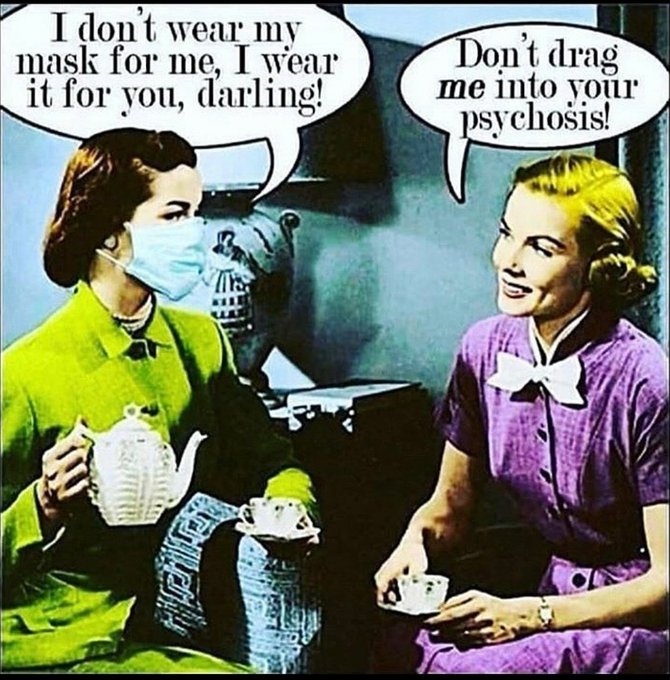
On face masks…


Child advocates across the country recognize Montana Department of Health and Human Services as among the worst in the nation for confiscating children, often without court orders or probable cause. Entire rallies have been held through the state for several years, with citizens protesting the heavy-handed actions of DPHHS for illegally taking parents from their children. One of those advocates demanding DPHHS child-confiscation reform is running for Montana House District 82. Her campaign’s tagline is, “Treasuring Family and Community” and she is an outspoken critic of DPHHS for stealing children from their parents without just cause.
Debbie Westlake isn’t alone in her concerns. Many Montana lawmakers have noted the epidemic of childhood confiscation that happens in far higher numbers here than in other surrounding states like Wyoming, Idaho, North Dakota, and South Dakota. In fact, Montana ranks per capita as the state with the second highest number of children being stolen from their parents, only behind West Virginia. More than 16 children out of 100 are stolen and never returned.
Westlake, in particular, has focused much of her campaign on ending the child-stealing tendencies of DPHHS and announced her candidacy while advocating against their human rights abuses. Rep. Randy Garcia warned in that very episode on Excellence in Voting Radio that DPHHS goes out of their way to punish their political opponents. And for Westlake, today was payback by DPHHS for criticizing their kidnapping policy.
Westlake’s sad saga, which includes DPHHS wrongfully stealing her child, landed the story at the prominent news network The Blaze, just last year. The story was surreal; Westlake was admitted and then released from the hospital when hospital workers notified DPHHS that there was something amiss. The state then stole Westlake’s 4-year-old son for no apparent reason. According to DPHHS later, they just wanted to make sure that Westlake had a backup plan for the child’s care in case she got sick again (so they stole him from a childcare facility while Westlake was recovering at home).
Westlake did nothing wrong. The health problems that landed her in the hospital was a routine and ordinary illness that many Americans face, not substance abuse or suicidal thoughts. It was a physical ailment. And yet, the judge terminated her parental rights and gave the child out for adoption to another set of parents. The miscarriage of justice made national news.
Now that Westlake is running for office to curb the draconian powers of Montana’s DPHHS, they have struck back, confiscating her grandchildren.


The question of truth is at the heart of the story Holland tackles—the deadly famine, engineered by Stalin’s regime, that swept through Ukraine, the Volga Basin, the Kuban and Don regions of the North Caucasus, and Kazakhstan in the winter of 1932-1933. In Ukraine alone, where it is known by its Ukrainian name of Holodomor and often referred to as the terror-famine, it took an estimated 4 million lives. In this exceptionally fertile land, Stalin imposed impossible production demands, expropriating all available grain and livestock and using the ensuing starvation to break the back of the peasantry, whose resistance to collectivization threatened to undermine his industrialization efforts.
But Stalin’s crime was only one face of the story. The other face was the extraordinary failure on the part of the world to report and acknowledge the facts. Many were complicit in this failure, but the starring role undoubtedly belonged to the Moscow-based Western journalists, who misreported, underreported, and failed to report about what was plainly happening under their noses. Walter Duranty, the New York Times’ man in Moscow, outright lied about the events, deliberately misleading his readers. In 1932, he was awarded the Pulitzer Prize for reporting. Holland’s exploration of the complicity of the press in one of Joseph Stalin’s greatest crimes lends the film an unexpected relevance to our current moment, when the role and purpose of the media and of journalism itself seem to be under attack—from both would-be dictators and people for whom virtue is the arbiter of truth.
Some of the Covid-19 vaccines currently in development could increase the risk of acquiring HIV, warned a group of researchers in the The Lancet medical journal Monday, potentially leading to an increase in infections as vaccines are rolled out to vulnerable populations around the world.
 Hellbound and Down
You must be logged in to post a comment.