
You learn something every day…


The gunman in Boulder who killed 10 people at a supermarket would routinely threaten his classmates with threats of filing fake hate crime charges after violently attacking them, eyewitnesses told the media.
As we highlighted yesterday, Ahmad Al-Issa would typically be described as an “anti-racist activist,” with his Facebook page having featured criticism of Donald Trump, advocacy for refugees and Muslim immigrants.
Despite the gunman’s family telling the Daily Beast that the reason for his rampage was as a result of him being the victim of “bullying” in high school, Al-Issa’s classmates say the opposite is true.
A Fox 31 report reveals that Al-Issa once punched a classmate and continued to hit him as he lay on the ground.
Al-Issa tried to justify the attack by claiming the victim “had made fun of him and called him racial names weeks earlier,” although no other classmates could corroborate this.
The shooter’s wrestling team classmate Dayton Marvel also told the Denver Post that in Al Issa’s senior year, “during the wrestle-offs to see who makes varsity, he actually lost his match and quit the team and yelled out in the wrestling room that he was like going to kill everybody.”
“Nobody believed him. We were just all kind of freaked out by it, but nobody did anything about it,” said Marvel.
“He would talk about him being Muslim and how if anybody tried anything, he would file a hate crime and say they were making it up,” he added.
Given this history and the fact that Al-Issa was an avid reader of mainstream media, questions now must be asked about his real motivation given that all the gunman’s victims were white and whether he was radicalized by anti-white racism that has been institutionalized by the press.
Critical Race Theory sees people not as individuals, but more like the Borg from Star Trek. It insists that white people are inevitably oppressors and that African-Americans are inherently oppressed. And everyone else, like Schrödinger’s cat, exist in a kind of liminal position, playing the role of victims or victimizers depending on the situation. That is how, in the context of the admissions process at Stuyvesant, Asians are seen as “white-adjacent” and privileged, but in the context of street crime, they are cast as victims. Attributes of specific races are assumed.
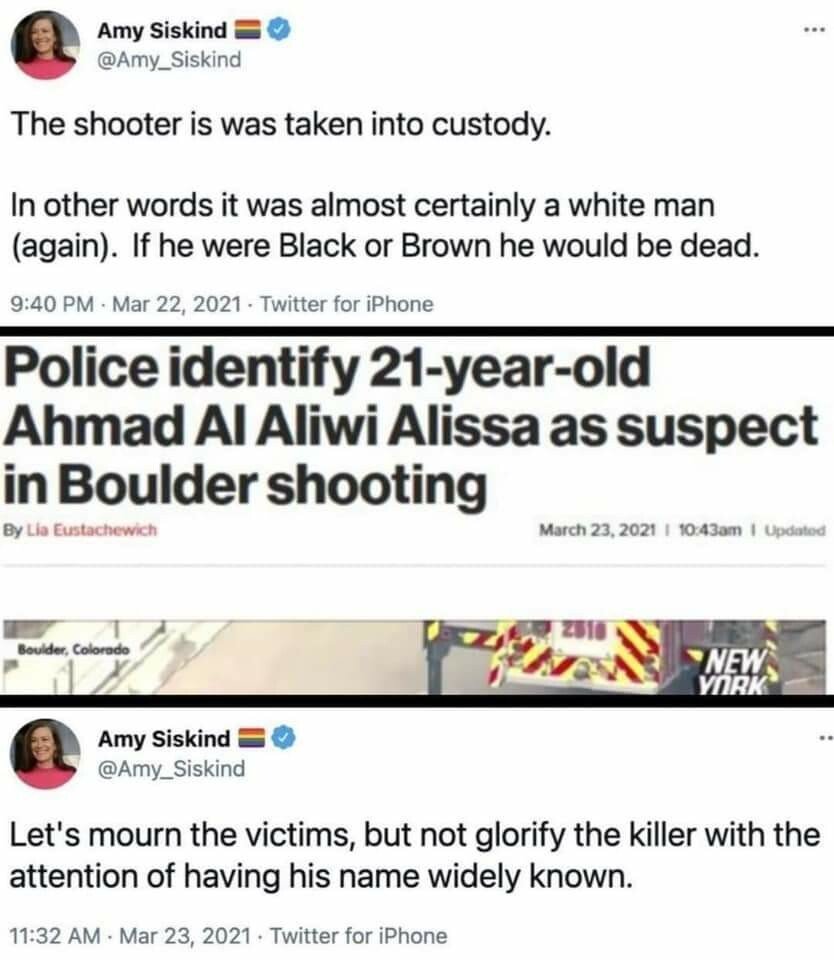
Even after yesterday’s tragic shooting in a Boulder grocery store, this racist illogic reared its head. “It’s always an angry white man. always,” tweeted a “race and inclusion editor” at USA Today. A senior editor at Deadspin tweeted: “Extremely tired of people’s lives depending on whether a white man with an AR-15 is having a good day or not.” Kamala Harris’s niece, Meena, offered: “violent white men are the greatest terrorist threat to our country.”
It turns out the suspected shooter wasn’t white. The suspect’s name is Ahmad Al Aliwi Alissa. And the fact that he is alleged to have carried out a mass shooting should not surprise us: If you look at the data on the ethnic composition of mass shooters they reflect, roughly, the ethnic composition of the American population. But given the rules of this ideology — that the importance of the lives lost depends on the group characteristics of the perpetrator — you can bet that the mainstream press will now pivot to a different story.

Vice President Kamala Harris’ niece, Meena Harrris, declared that “violent white men” are the “greatest terrorist threat” to the United States following the deadly grocery store shooting in Boulder, Colorado, later setting off a firestorm on social media by erroneously assuming the suspect, a Syrian immigrant, was white.
“The Atlanta shooting was not even a week ago. Violent white men are the greatest terrorist threat to our country,” Harris, a New York Times best-selling author, wrote in a now-deleted tweet Monday.
Earlier Monday, suspected gunman Ahmad Al Aliwi Al-Issa, 21, allegedly opened fire inside a King Soopers store, shooting dead 10 people, including active-duty police officer Eric Talley, 51, before he was taken into custody by responding officers. Al Aliwi Al-Issa, a resident of Denver who reportedly moved to the U.S. from Syria at age three, was shot in the leg during the rampage and has received medical treatment for his wounds at a hospital. He was charged with 10 counts of murder earlier Tuesday.
Harris conceded that she removed her tweeted Tuesday because she falsely identified the suspected killer as white, claiming her assumption was predicated on “being taken into custody alive and the fact that the majority of mass shootings in the U.S. are carried out by white men.”
Twitter failed to respond to repeated requests for comment about a tweet from the Root that compared whiteness to a disease, refusing to say if the tweet violates its policies against dehumanizing language.
The social media platform updated its policy on hate speech in December last year, with a specific focus on dehumanizing language.
“Our primary focus is on addressing the risks of offline harm, and research shows that dehumanizing language increases that risk,” said Twitter in a statement announcing the change.
Yet a tweet stating “whiteness is a pandemic,” from a verified account with over 600,000 remains on the platform.
In one 2011 tweet, McCammond wrote, “Outdone by Asian. #Whatsnew.” In another, she wrote, “Now Googling how to not wake up with swollen, Asian eyes…” In a third, McCammond mused, “Give me a 2/10 on my chem problem, cross out all of my work and don’t explain what I did wrong… thanks a lot stupid Asian TA [teaching assistant]. You’re great.”
Despite the tweets being a decade old, and despite McCammond herself being a black woman, this warranted a media frenzy that ultimately resulted in her early departure from Teen Vogue, despite a public apology from McCammond.
“I should not have tweeted what I did and I have taken full responsibility for that,” wrote McCammond. “I wish the talented team at Teen Vogue the absolute best moving forward. Their work has never been more important, and I will be rooting for them.”
Last week, President Biden signed the American Rescue Plan Act into law. The bill, comprised of $1.9 trillion in the name of “COVID relief,” received no support from Republicans in the House or Senate, and it’s not hard to see why.
The legislation includes carveouts for dozens of leftist priorities, including a bridge in Senate Majority Leader Chuck Schumer’s New York and a tunnel in House Speaker Nancy Pelosi’s Silicon Valley. These items clearly have nothing to do with pandemic relief for the millions of Americans out of work or the businesses shuttered by blue state governors’ harsh public health regulations. To the hardworking Americans everywhere, this bill should reek of the far-left’s desire to shove their ill-conceived policy priorities wherever they can stash them.
What most don’t know about this bill, however, is the small provision known as “Section 1005” that authorizes the secretary of agriculture to make payments of 100 to 120 percent of the “outstanding indebtedness of socially disadvantaged farmers.” Under this provision, those included in the socially disadvantaged category are American Indians, Alaskan Natives, Asians, Blacks, Native Hawaiians, Pacific Islanders, and Hispanics.
Putting aside all of the Washington jargon that makes little sense outside of a committee hearing room, this provision—specifically written into the American Rescue Plan by Democrats—pushes a blurred vision of so-called “social equity” by providing relief for farmers based on the color of their skin. Rather than offering much needed relief to all farmers, Sec. 1005 prioritizes race, just as it would ethnicity, sex, or any other factor.
It bears repeating: Sec. 1005 focuses debt relief on farmers based on their race, not based on how harshly the pandemic has affected them—the very reason for relief in the first place. Ironically, this racial discrimination is the very focus of what officials at the U.S. Department of Agriculture (USDA) have worked so hard to combat.


You must be logged in to post a comment.