
Land of the free!

If you thought Common Core was bad, hang on to your hats. Establishment politicians in Congress from both parties are plotting to nationalize the teaching of civics, all but ensuring that the unhinged obsession with indoctrinating children will be supercharged to dangerous new levels.
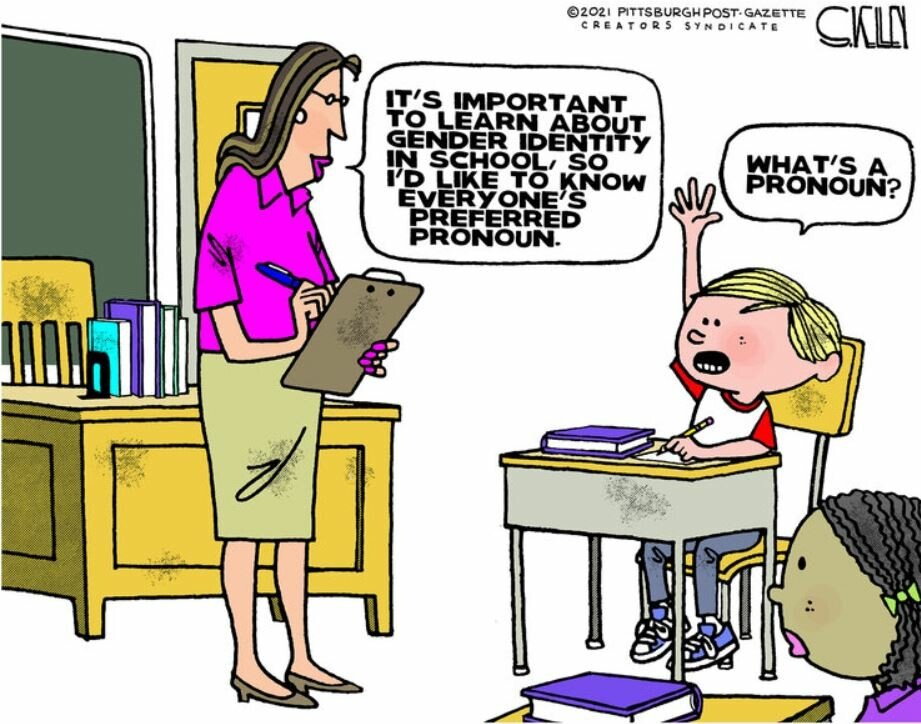
Experts are warning of disaster. Indeed, under the absurdly named “Civics Secures Democracy Act,” the lies, fake history, LGBT fanaticism and hyper-race-mongering that now permeates indoctrination centers in California and Illinois will soon be in every government school nationwide.
History and civics are both in the cross-hairs. And despite the relatively innocuous-sounding language in the legislation, experts and analysts say it will open the door wide for Washington, D.C., to shove Critical Race Theory and “community organizing” into every government school in America.
This is Joe Biden’s America.
Illegal aliens come first and Americans are second class citizens.
California – According to San Diego County Supervisor Jim Desmond, the San Diego County Board of Education will be sending teachers for in-person learning for the illegal alien migrant children at the convention center.
The illegal aliens will be learning in person while many schools in San Diego County are still closed for in-person learning.
More than 500 unaccompanied minor migrants, most of whom are from El Salvador, Guatemala and Honduras, were flown from Texas to San Diego over the weekend to take shelter at the San Diego Convention Center.
The first group of illegal aliens arrived on Saturday night after flying from Texas to San Diego airport.
They were then taken by buses to their temporary shelter.
The second group of 250 migrants arrived to San Diego on Monday, according to Fox 5.
The unaccompanied migrants will be provided “vital services” such as medical care, food, a place to sleep and showers.
The illegal alien children aged 13-17 will also be in-person learning while American children are forced to attend Zoom classes and fall behind.
It gets worse.
A California teacher appeared to suggest that parents who want to send their children back to school are white supremacists who ‘bullied a board into making schools less safe for teachers and kids’.
Damian Harmony, who teaches Latin at John F. Kennedy High School in Sacramento, made the remarks to the school board.
He later posted the content to Facebook, but as of Tuesday morning, it has been deleted from his page.
During his remarks, Harmony said: ‘I come to you as a grateful parent. I’m grateful that I kept my children home. And I’m especially grateful for what I heard from parents last week. Until then, the only way I could measure the level of white supremacy in my neighborhood was the Next Door app.
‘The people clamoring for a district to break its legally-negotiated MOU with teachers who are going to be teaching their own children, who treat the teachers’ efforts as though they’ve not been exhausting and ever-present, while also going through a pandemic themselves, made it much easier.’
Harmony continued: ‘I’m as disappointed as I am unsurprised that last week, we all had to hear all the cynical, pearl-clutching, faux-urgency, ableist, structurally White-supremacist, hysteria, even as teachers were moving forward with an MOU that already put them in harm’s way and was asking too much of a beleaguered group of professionals.’
A New Jersey teacher has won $325,000 settlement against school district after she was scapegoated for removing the phrase “TRUMP Make America Great Again!” from a student t-shirt in a school yearbook photo. That’s according to a story at NJ.com.
Teacher Susan Parsons says she was flooded with hate mail and received death threats after the alteration of the student photo became public in 2017, says NJ.com.
Parsons reportedly said it was the principal’s secretary who ordered her to alter the student’s t-shirt in the yearbook photo after saying, “That has to go.”
But when the controversy made headlines, the school district blamed the teacher, says NJ.com.

School Board VP Alison Collins said in 2016 that “In fact many Asian American Ts, Ss, and Ps actively promote these myths. They use white supremacist thinking to assimilate and ‘get ahead’.”
“Talk to many @thelowell parents and you will hear praise of Tiger Moms and disparagement of Black/Brown ‘culture,’” Collins continued in the tweet thread, going on to say, “I even see it in my FB timeline with former HS peers. Their TLs are full of White and Asian ppl. No recognition”.
A public school district in the suburbs of Columbus, Ohio has spent more than $134,000 in legal fees to obtain a permit to install only gender-neutral bathrooms in six of its new facilities, in violation of state code.
In the fall of 2017, the Upper Arlington School District successfully passed a $230 million tax to rebuild five elementary schools and Upper Arlington High School. Construction on the high school and four of the elementary schools began in 2019.
The school board and Superintendent erected five of the six new buildings with only gender-neutral bathrooms, though the Ohio Building Code mandates that any facility with “plumbing fixtures” requires separate accommodations for each sex.
The vice president of the San Francisco School Board came under increasing fire this week, after a campaign to have her removed from office revealed social media posts from 2016 where she made several racist comments against Asian Americans.
Alison Collins went on a lengthy tirade arguing – among other things – that many Asian Americans use “white supremacist thinking” to “get ahead,” and called Asian Americans who did not speak out against then-President Donald Trump as “house” N-words.
A campaign led by San Francisco parents to recall members of the school board was initially launched over frustrations over the panel’s refusal to allow schools to reopen.
 Hellbound and Down
You must be logged in to post a comment.