Saying You’re ‘Colorblind’ About Race Is Now Considered Racist By The Federal Government

A race-based training program used by federal agencies claims, among other things, that saying one is “colorblind” to race is itself racist.

The training is part of a newly revealed federal diversity program that greatly expands on previously critical race theory trainings within the federal government, the Washington Examiner reported. Part of the expansion comes in the form of opposing “microaggressions,” or words and actions by one person that unintentionally upset another. As the Examiner noted, training provided to the Consumer Financial Protection Bureau says that offering a black student a basketball is considered offensive.

“Not only are federal workers urged to consider what they say, but also how their comments are received. In one chart, a white male is shown saying he is ‘colorblind.’ The black woman shown beside, however, takes as an insult that the white is denying her ‘racial/cultural being,’” the Examiner reported. “And, it advised men, don’t interrupt a woman speaking because they hear, ‘Women’s ideas are not valued.’”

Keep reading

Professor no longer teaching education class after quoting the N-word during a lecture

A George Washington University professor recently stepped down from teaching “Anti-Racist STEM Education” after reading the N-word aloud during the class when discussing the 1964 Norman Rockwell painting The Problem We All Live With.

The incident occurred Jan. 18 at GWTeach University, the institution’s teacher training college geared towards STEM majors. The incident was brought to the attention of the university after students filed numerous complaints, as reported by The Hatchet.

Professor Alicia Bitler reportedly said the N-word during a discussion of the painting that depicts Ruby Bridges, the first African-American child to attend a white school in Louisiana. In the painting, the N-word can be clearly seen in the background in the form of graffiti on a wall.

Alicia Bitler reportedly described the incident as an “oops-moment” soon after it happened. Bitler then continued to teach the class. Three days later, university officials acknowledged the students’ complaints.

Incidents like these have been around the country for years. In 2020, Campus Reform reported that a law professor at Emory University was suspended for using the N-word in an “academic context to illustrate the effect language has on the severity of a civil wrong” during a lecture. 

As reported by Inside Higher Ed, University of Southern California Professor Greg Patton was suspended for “saying a Chinese word that sounds like a racial slur in English” during a lecture on Chinese “filler words.”  

Keep reading

University language guide says ‘grandfather,’ ‘housekeeping,’ ‘spirit animal’ are ‘problematic’ words

A University of Washington language guide is calling everyday words used by Americans “problematic.”

The University of Washington Information Technology department released an “inclusive language guide” that lists a number of “problematic words” that are “racist,” “sexist,” “ageist,” or “homophobic.”

According to the guide, words such as “grandfather,” “housekeeping,” “minority,” “ninja,” and “lame” are considered “problematic words.”

For example, the language guide states that the word “lame” is considered problematic because it’s “ableist.”

“This word is offensive, even when it’s used in slang for uncool because it’s using a disability in a negative way to imply that the opposite, which would be not lame, to be superior,” the guide states.

Keep reading

Wokery beyond parody as university slaps a TRIGGER warning on George Orwell’s 1984 as it contains ‘explicit material’ which some students may find ‘offensive and upsetting’

As one of the greatest works in Britain’s literary canon, Nineteen Eighty-Four sounds a chilling warning about the dangers of censorship.

Now staff at the University of Northampton have issued a trigger warning for George Orwell’s novel on the grounds that it contains ‘explicit material’ which some students may find ‘offensive and upsetting’.

The advice, revealed following a Freedom of Information request by The Mail on Sunday, has infuriated critics, who say it runs contrary to the themes in the book.

Published in 1949, Orwell’s dystopian story – set in a totalitarian state which persecutes individual thinking – gave the world phrases such as ‘Big Brother’, ‘Newspeak’ and ‘thought police’.

Its plot centres on Winston Smith, a government employee who is arrested and tortured over an illicit love affair, but it also makes powerful points about what can happen to a society that doesn’t cherish academic freedoms or its own history.

Yet it is one of several literary works which have been flagged up to students at Northampton who are studying a module called Identity Under Construction. They are warned that the module ‘addresses challenging issues related to violence, gender, sexuality, class, race, abuses, sexual abuse, political ideas and offensive language’.

In addition to Orwell’s book, academics identify several works in the module that have the potential to be ‘offensive and upsetting’ including the Samuel Beckett play Endgame, the graphic novel V For Vendetta by Alan Moore and David Lloyd and Jeanette Winterson’s Sexing The Cherry.

Keep reading

The Age of Intolerance: Cancel Culture’s War on Free Speech

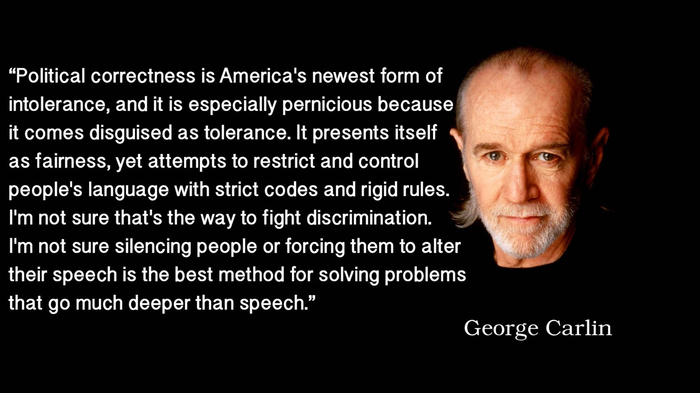
“Political correctness is fascism pretending to be manners.”—George Carlin

Cancel culture—political correctness amped up on steroids, the self-righteousness of a narcissistic age, and a mass-marketed pseudo-morality that is little more than fascism disguised as tolerance—has shifted us into an Age of Intolerance, policed by techno-censors, social media bullies, and government watchdogs.

Everything is now fair game for censorship if it can be construed as hateful, hurtful, bigoted or offensive provided that it runs counter to the established viewpoint.

In this way, the most controversial issues of our day—race, religion, sex, sexuality, politics, science, health, government corruption, police brutality, etc.—have become battlegrounds for those who claim to believe in freedom of speech but only when it favors the views and positions they support.

Free speech for me but not for thee” is how my good friend and free speech purist Nat Hentoff used to sum up this double standard.

Keep reading

Defund The Speech Police

San Francisco has had enough. The city’s mayor recently declared that “the reign of criminals who are destroying our city, it is time for it to come to an end,” and she promised to “take the steps to be more aggressive with law enforcement.”

Her get-tough pledge is, of course, shameless — if only there had been a municipal leader who could have done something before now! — but when wokeness has lost the mayor of San Francisco, it has a public-relations problem.

Following electoral defeats in Virginia, and facing a likely wipeout in next year’s midterm elections, many Democrats are scrambling away from identity politics. From crime to education to the workplace, it poisons everything, and Americans are sick of it.

Thus, we may hope that Scott McConnell is correct in predicting that wokeness “will be rolled back, its practitioners and cultural preferences first widely mocked and then ignored, its victims rehabilitated and in some cases honored.” But we should not be too sure; even if wokeness is politically toxic now, it might nonetheless win in the long run.

Identity politics’ likely resilience was highlighted in a response by Ed West as well as in a Reason article by Greg Lukianoff chronicling how the first wave of political correctness in the 1990s persisted despite its unpopularity. Put simply, identity politics holds power in key institutions, especially in tech, academia, education, the media, and Big Business. While voter anger might spook politicians on issues such as crime, wokeness in all its forms will be hard to root out of its institutional fortresses.

Thus, identity politics will remain as a powerful force in American life even if Democratic politicians avoid and downplay its more unpopular ideas (and they aren’t all giving up yet). Like a weed, snicking the head off wokeness will not kill it. Unless it is actively uprooted, wokeness will continue to embed itself within powerful institutions, just as it was doing before it broke into public view over the last few years.

Keep reading

Man running for Texas Lt. Governor drops out of race to make room for non-white candidates

Matthew Dowd has ended his campaign to become Lieutenant Governor of Texas in order to “step back” and make room for non-white candidates. Dowd, who is a white man, appears to believe that his presence in the race would make it harder for candidates of color to win the race.

In a December 7 statement, Dowd referenced a 2018 column of his entitled “Us white male Christians need to step back and give others room to lead.”

In a justification for his dropping out of the race, he quoted the column, saying “We as white male Christians should do what real leadership demands and practice a level of humility which demonstrates strength by stepping back from the center of the room and begin to give up our seats at the table. We should make this move not because we feel threatened, but because we know it is morally right and it is what would help America in this troubling time.”

Keep reading

Britain may outlaw catcalling

Pestering women on the street and in bars could soon become an offense as part of an overhaul of laws to protect women against violence.

Loopholes in current laws mean there is no specific offense for sexually harassing women verbally in the street.

Now a Government-commissioned review will next week call for public sexual harassment and inciting hatred against women to be made criminal offences, reports The Telegraph.

The proposed change is part of a push to outlaw “public sexual harassment”.

However, calls for misogyny to be made a hate crime will be rejected — as it’s thought it be ineffective, according to sources.

A Whitehall source told the paper: “The Law Commission is not going to class misogyny as a hate crime because it would be ineffective and in some cases counterproductive.

“But it will call for a public sexual harassment offence which doesn’t currently exist.

Keep reading