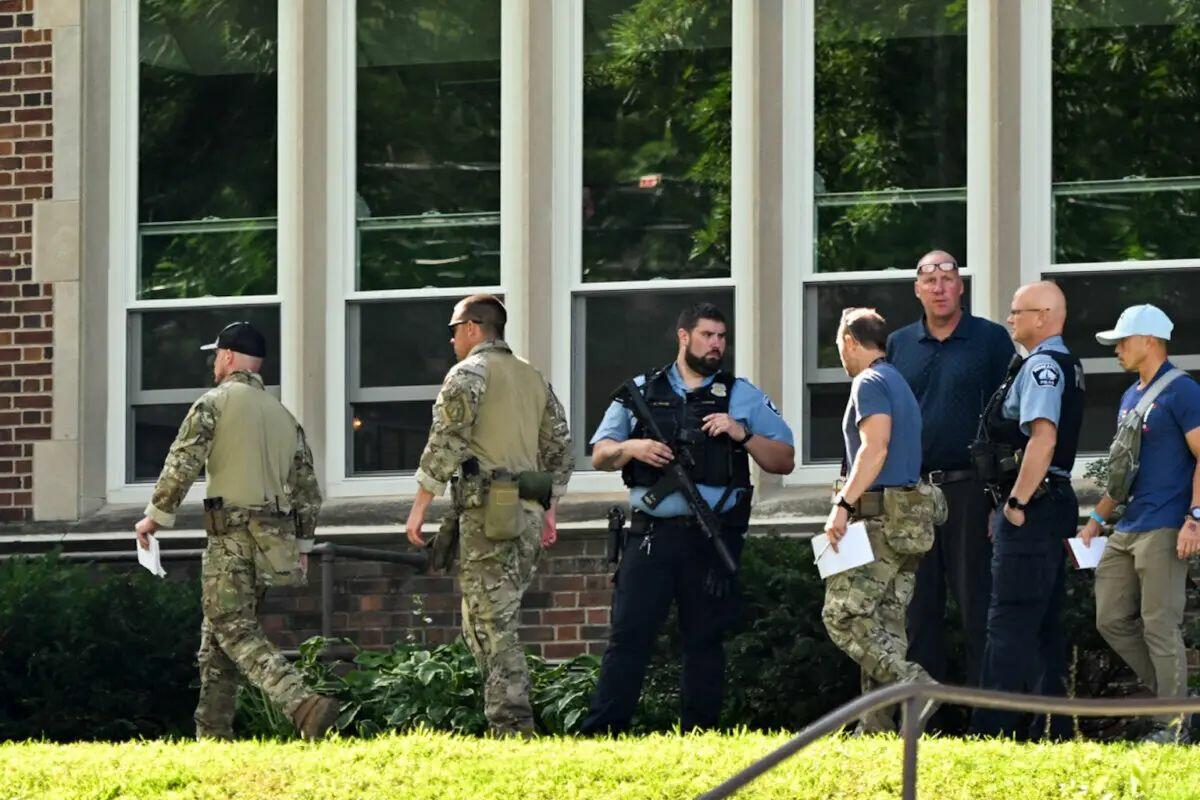
Wilkes-Barre, PA man arrested on terrorism-related charges after bomb-making materials found at his home

Pennsylvania man was arrested in Wilkes-Barre after a counterterrorism investigation determined him to be attempting to possess or manufacture weapons of mass destruction.

24-year-old Saleh Edwards was arrested and charged with criminal attempt to possess or manufacture weapons of mass destruction. The investigation was launched by city police and the FBI after a report of suspicious activity.

According to a report by WNEP, investigators executed a court-authorized search of Edwards’ home on Sunday. Court documents related to the case remain sealed, leaving limited public information about what authorities allegedly discovered during the search. A preliminary hearing is scheduled for January 6, when additional details may be released. 

Luzerne County District Attorney Sam Sanguedolce told the outlet that a motive has not been identified and authorities do not yet know what Edwards allegedly planned to do with the explosive device. He said the investigation began after a neighbor raised concerns about suspicious activity at the residence.

During the search, Saint Clair Street was blocked off as police, county detectives, and FBI special agents searched the home. Sanguedolce described the case as a “joint counterterrorism investigation” involving multiple agencies.

Edwards was arraigned on Sunday and denied bail by Judge Donald L. Whittaker, who cited concerns about public safety. Edwards is currently being held at a county jail.

The arrest comes months after a separate, unrelated incident in Pennsylvania, in which a man who brought firearms to a “No Kings” protest in Chester County later pleaded guilty after explosive devices were found at his residence.

Keep reading

Pennsylvania High Court Rules Police Can Access Google Searches Without Warrant

The Pennsylvania Supreme Court has a new definition of “reasonable expectation.” According to the justices, it’s no longer reasonable to assume that what you type into Google is yours to keep.

In a decision that reads like a love letter to the surveillance economy, the court ruled that police were within their rights to access a convicted rapist’s search history without a warrant. The reasoning is that everyone knows they’re being watched anyway.

The opinion, issued Tuesday, leaned on the idea that the public has already surrendered its privacy to Silicon Valley.

We obtained a copy of the ruling for you here.

“It is common knowledge that websites, internet-based applications, and internet service providers collect, and then sell, user data,” the court said, as if mass exploitation of personal information had become a civic tradition.

Because that practice is so widely known, the court concluded, users cannot reasonably expect privacy. In other words, if corporations do it first, the government gets a free pass.

The case traces back to a rape and home invasion investigation that had gone cold. In a final effort, police asked Google to identify anyone who searched for the victim’s address the week before the crime. Google obliged. The search came from an IP address linked to John Edward Kurtz, later convicted in the case.

It’s hard to argue with the result; no one’s defending a rapist, but the method drew a line through an already fading concept: digital privacy.

Investigators didn’t start with a suspect; they started with everyone. That’s the quiet power of a “reverse keyword search,” a dragnet that scoops up the thoughts of every user who happens to type a particular phrase.

The justices pointed to Google’s own privacy policy as a kind of consent form. “In the case before us, Google went beyond subtle indicators,” they wrote. “Google expressly informed its users that one should not expect any privacy when using its services.”

Keep reading

DOJ Wins Motion to Unseal Documents on Investigation into Trump Shooter Thomas Crooks

The Department of Justice announced that it successfully moved to unseal documents related to the investigation into would-be Trump assassin Thomas Crooks. 

“The Department of Justice received court approval to disclose to Congress documents gathered as part of the FBI’s investigation of Thomas Crooks and his attempt to assassinate President Trump,” the Western District of Pennsylvania announced on X.

A copy of the motion and order can be found here.

On July 13, Thomas Matthew Crooks shot President Trump in the ear from a nearby rooftop as he was speaking in Butler, Pennsylvania. One rallygoer was killed in the shooting, and two were injured.

Questions still remain surrounding the failure by law enforcement and Secret Service to secure the area, as well as Crooks’s background.

Crooks used a range finder device and flew a drone at the Butler rally site between approximately 3:50 and 4:05 pm that day, during a period when the Secret Service was allegedly experiencing connectivity issues.

An eyewitness at the scene told the BBC that several people witnessed the shooter crawling on the roof of a local building with a rifle before Trump was shot, but they did not act until Trump was shot. According to later reports, a police officer encountered the shooter on the roof but let him go after he pointed the gun at him and before he shot Trump.

It seems unlikely we will get answers, as the FBI recently concluded that he acted alone.

The records sought by the DOJ, “such as telephone and internet service providers, email services, financial institutions, and others,” relate to the grand jury investigation and were obtained under a grand jury subpoena.

“The United States seeks to disclose pre-existing business records that were created for purposes independent of the Crooks grand jury investigation. Disclosure will reveal only the information contained in the documents, and will not reveal what, if anything, occurred before the grand jury,” the motion reads.

“By moving to unseal these documents, we hope to give the American people more answers about that fateful day in Butler, Pennsylvania,” Attorney General Pam Bondi wrote on X, touting the Trump Administration as “the most transparent administration in American history.”

Keep reading

Pennsylvania Officials Let Unsent Mail Pile Up For A Month, But Promise Mail Voting Is Super Secure

Pennsylvania’s mail scandal — that mail vendor Capitol Presort Services reportedly failed to deliver the state’s mail for a month — is another reason we should not trust the mail with our elections.

Philadelphia Inquirer reporter Gillian McGoldrick reported Saturday that 3.4 million official letters from Pennsylvania state agencies were stuck in limbo from Nov. 3 through Dec. 3. The communications did not get sent until last week, after the state fired the mail vendor and hired another one to send the letters.

It is not clear why state workers can’t handle mailing letters without the complication of a contracted vendor.

Some of the delayed letters contained time-sensitive communications about services with important deadlines, including notices for recipients to interact with agencies or lose benefits, according to McGoldrick’s report. Health coverage, SNAP food benefits, child abuse clearances, decisions about elder abuse and foster homes for kids, along with timely notices of hearings — all from the Pennsylvania Department of Human Services — reportedly piled up at the vendor instead of being given to the U.S. Postal Service for delivery.

Important communications from the Pennsylvania Department of Transportation were also delayed. Halted mail included driver’s license and vehicle registration renewal reminders, vehicle registration cards, driver’s license camera cards, and address card updates.

Just weeks ago, Gov. Josh Shapiro was making the media rounds, attacking President Donald Trump and Vice President J.D. Vance about putting Pennsylvanians in peril because of the government shutdown, when at the same time his own administration was failing to deliver essential communications about these very services through the mail.

Keep reading

Pennsylvania Governor Signs Law Banning “Hair Discrimination”

Democrats continue to double down and pander to the woke demographic whenever they see an opportunity.  These gestures are usually designed to virtue signal and rarely have any significance in terms of political change, however, leftists don’t necessarily pass laws or make declarations because a problem actually exists.  Rather, they do these things in order to encourage false perceptions within the populace.

In other words, equality has been a legal fact within the US for decades, but leftists want people to believe racism is a never-ending battle that requires their perpetual activism and government intervention.  The more they demand “equity”, the more division and conflict they end up inciting. 

Democrat Pennsylvania Governor Josh Shapiro insists that racism is an ongoing problem in his state and he has taken bold action to fight back by passing the “CROWN Act”, a law which prohibits discrimination based on a person’s hairstyle, type or texture.

CROWN, which stands for “Creating a Respectful and Open World for Natural Hair”, is clearly aimed at placating the black voting base for Democrats in PA and is unlikely to be applied to any other group. 

For example, black female managers wearing wigs and weaves and appropriating white women’s hair styles will never be accused of racism, but a white manager at Taco Bell who fires a black worker for not wearing a hair net properly will probably face civil litigation for discrimination.  Woke laws are meant to create privileges and double standards, not equal protections.  As Shapiro notes:

“Real freedom means being respected for who you are – no matter what you look like, where you come from, who you love, or who you pray to…For too long, many Pennsylvanians have faced discrimination simply for hairstyles that reflect their identity and culture – that ends today…”

“This is going to help people by making sure that, wherever you work, or wherever you’re applying for a job, they can’t look at your hair and size you up – not based on your qualifications and all of the professional development you have and all of your education,” said PA House Speaker Joanna McClinton. “They will not look at your hair and decide you can’t work here. They will not look at your hair and decide you don’t belong in this C-suite. They will not look at your hair and say, ‘you can’t be in the boardroom.’” 

U.S. Rep. La’Tasha D. Mayes, a West Philadelphia native who now represents parts of Pittsburgh, was the lead sponsor on the bill and said the fight will help improve lives across Pennsylvania.  “Hair discrimination has taken confidence from our children, but that ends today,” Mayes said. “Hair discrimination has taken dignity from workers, but that ends today. It has taken access to economic opportunities, hopes and dreams, but that begins to end today.”

Keep reading

Kash Patel Talks In Depth About Attempted Trump Assassin And His Motives

FBI Director Kash Patel told investigative journalist Catherine Herridge that hatred for the U.S. government and the two-party system played a role in Thomas Matthew Crooks’ attempt to assassinate President Donald Trump on July 13, 2024 in Butler, Pa.

Herridge asked Patel what motivated Crooks, 20, to try to kill Trump, then the presumptive Republican presidential nominee. Patel’s answer appeared to depart from previous FBI statements when bureau officials said they were unable to find a motive or ideology behind the assassination attempt. The FBI director — appearing on Herridge’s show “Straight to the Point” by the Los Angeles Times Media Group — told her that Trump was “satisfied” with his agency’s investigation into that fateful day. Patel stopped short of saying the case was closed.

“He [Crooks], as has been publicized, had a basically hateful relationship with the United States government, talked disparagingly about both political parties, to include President Trump, and talked about the need to take matters into his own hands. And, unfortunately, that’s what he did,” Patel said when Herridge asked about Crooks’ motive.

Keep reading

FBI Admits Its Custody of Crooks’ Body on AGR Building Roof All Night

Kash Patel and Danny Bongino, the number one and two at the Federal Bureau of Investigation (FBI) have, for the second time, gone public with the agency’s conclusion that the alleged Butler, PA shooter, Thomas Matthew Crooks, was the lone shooter. Okay. But they refuse to release the FBI investigation of the attempted assassination and that’s a problem for a number of reasons.

First, despite numerous investigations, including a Congressional Task Force, a Secret Service investigation, a Senate Investigation, the Pennsylvania State Police and others, none have provided any information about how the alleged shooter, who “acted alone,” was identified on the AGR Building.

Recall that the alleged shooter’s body lay on the AGR Building roof all night until 6:30a.m. the following morning. Then, when the Butler County Coroner, William Young III, finally was allowed to go on the roof and conduct his death investigation and identification of the body, it’s anyone’s guess which law enforcement agency had custody of the body all night…until now.

Coroner Young has never made public his investigative notes about how he identified the body – the method – and why he was turned away at midnight when he first tried to make identification of the body and told to return the following day. Who gave Young those orders?  More importantly it’s odd that the body would lie on the roof all night.

Does the public trust that there wasn’t any funny business going on? Would Patel and Bongino believe that there wasn’t any funny business? It must be said that even Patel and Bongino in their former lives, who questioned every single FBI investigation, would have been having conniptions about this odd turn of events. Afterall, it isn’t every day that the dead body of a would-be presidential assassin is left at the crime scene all night.

Then, of course, there is the fact that Patel and Bongino provided this “exclusive update” to an unknown Fox News podcaster? Yep, Brooke Singman got the scoop, despite many others who could have actually asked legitimate questions about the FBI investigation. People like Miranda Devine of the New York Post who just last week outed the FBI for failing to report on the alleged shooter Crooks’s online presence. Of course, if you don’t want to have any serious questions asked Singman is the way to go.

Keep reading

FBI Concludes Would-Be Trump Assassin Thomas Crooks Acted Alone

The FBI has concluded that would-be Trump assassin Thomas Crooks acted alone.

Thomas Crooks was able to climb on top of a roof next to Trump’s Butler, Pennsylvania rally and put Trump in his scope.

A bullet grazed President Trump’s ear on July 13, 2024 during his Pennsylvania rally. One rallygoer was fatally struck in the head. Two other rally attendees were wounded, one critically.

A Secret Service sniper fatally shot Thomas Matthew Crooks after he took several shots at Trump and rallygoers.

The so-called ‘security lapses’ and circumstances surrounding the assassination attempt against Trump raise questions about how Thomas Matthew Crooks was able to pull everything off by himself.

Thomas Crooks flew a drone over the Butler fairgrounds at least twice on the day of the Trump rally.

He flew his drone at approximately 3:50 – 4:05 pm that day – during the time the Secret Service was having connectivity issues.

According to WaPo, Secret Service agents never directed local police to secure the roof that Thomas Crooks used to take 8 shots at Trump and rallygoers.

It was previously reported that the Secret Service never picked up radios that were set aside for them by local law enforcement in Butler County at Trump’s rally on July 13.

A photo of Thomas Crooks was taken shortly before he somehow managed to get up onto the roof of the building.

At 5:14 pm, just one hour before the assassination attempt of Trump, a member of the Beaver County sniper team took a photo of Crooks checking his cell phone.

Keep reading

Energy Department loans $1B to help finance the restart of nuclear reactor on Three Mile Island

The U.S. Department of Energy said Tuesday that it will loan $1 billion to help finance the restart of the nuclear power plant on Pennsylvania’s Three Mile Island that is under contract to supply power to data centers for tech giant Microsoft.

The loan is in line with the priorities of President Donald Trump’s administration, including bolstering nuclear power and artificial intelligence.

For Constellation Energy, which owns Three Mile Island’s lone functioning nuclear power reactor, the federal loan will lower its financing cost to get the mothballed plant up and running again. The 835-megawatt reactor can power the equivalent of approximately 800,000 homes, the Department of Energy said.

The reactor had been out of operation for five years when Constellation Energy announced last year that it would spend $1.6 billion to restart it under a 20-year agreement with Microsoft to buy the power for its data centers.

Constellation Energy renamed the functioning unit the Crane Clean Energy Center as it works to restore equipment including the turbine, generator, main power transformer and cooling and control systems. It hopes to bring the plant back online in 2027.

The loan is being issued under an existing $250 billion energy infrastructure program initially authorized by Congress in 2022. Neither the department nor Constellation released terms of the loan.

The plant, on an island in the Susquehanna River just outside Harrisburg, was the site of the nation’s worst commercial nuclear power accident, in 1979. The accident destroyed one reactor, Unit 2, and left the plant with one functioning reactor, Unit 1.

In 2019, Constellation Energy’s then-parent company Exelon shut down the functioning reactor, saying it was losing money and Pennsylvania lawmakers had refused to subsidize it to keep it running.

The plan to restart the reactor comes amid something of a renaissance for nuclear power, as policymakers are increasingly looking to it to shore up the nation’s power supply, help avoid the worst effects of climate change and meet rising power demand driven by data centers.

Keep reading

Pennsylvania School District Using AI-Enabled Wi-Fi To Search Students For Firearms

A Pennsylvania school district is using artificial intelligence to keep guns off its campuses. But civil liberties advocates have warned that the technology could lead to mass surveillance and violation of constitutional rights.

The Chartiers Valley School District in Allegheny County has implemented AI that harnesses the district’s Wi-Fi signals to determine whether people are carrying weapons as they enter the schools.

The technology, called Wi-AI, was developed by CurvePoint of Pittsburgh. CurvePoint grew out of AI research at Carnegie Mellon University.

According to the companyWi-AI uses “spatial intelligence” to find weapons such as guns before they enter a school.

The AI system analyzes a space and detects where potential weapons are located by interpreting “how Wi-Fi signals reflect off people and objects.”

Once a possible weapon is found, security personnel, school administrators, or others can go to the location to determine whether there is actually a threat.

It is now in use at Chartiers Valley School District high school, middle school, and primary school campuses. CurvePoint CEO Skip Smith said that in a recent test, the system found a pistol hidden in a backpack. He said the technology has a 95 percent success rate, failing only 4 percent of its searches.

Smith said the Wi-AI does not carry the same privacy concerns of other security systems because it does not rely on facial recognition or biometric data.

“We don’t know it’s you,“ Smith told The Epoch Times. ”We have no biometric information about you. Our system just sees a big bag of salt water.”

Darren Mariano, president of the Chartiers Valley Board of School Directors, said the district is excited to be the first in the country to adopt the technology.

The safety of our students and staff is always our top priority,” he said in a statement. “We’re thrilled to be the first district in the nation to implement this groundbreaking technology.”

Keep reading