
Backpage: The Monumental Free Speech Case the Media Ignored

After a dozen years of legal tussles, seven years in the crosshairs of ambitious prosecutors, and five-and-a-half years fighting a federal case that saw his business forcibly shuttered, his assets seized, and his longtime partner dead by suicide, alt-weekly newspaper impresario Michael Lacey was found guilty Thursday on just one of the 86 criminal charges levied against him in connection with the online advertising platform Backpage. But the government’s fanatical pursuit of Lacey and his four other Backpage co-defendants is far from over. 

Lacey, an award-winning investigative journalist, was found guilty of international concealment money laundering, which could land him in prison for up to 20 years, and not guilty of international promotional money laundering. But after a week of contentious deliberations, the jury could not come to agreement on the other 84 charges, prompting U.S. District Judge Diane Humetewa to declare a second mistrial in this case. That means Lacey could face a third federal trial essentially for the crime of running a classified ads site that knowingly enabled and profited from illegal, if consensual, transactions involving sex.

Thanks to Section 230 of the 1996 Communications Decency Act, the speech and conduct of website consumers is considered to be the legal responsibility of the speakers themselves, not the owners of the platform. This has been a thorn in the side of politicians and other would-be censors ever since. In 2013, Kamala Harris and 46 other state attorneys general sent a joint letter to Congress urging a rollback of Section 230; the letter started like this: “Every day, children in the United States are sold for sex. In instance after instance, state and local authorities discover that the vehicles for advertising the victims of the child sex trade to the world are online classified ad services, such as Backpage.com.”

Seven weeks before her election to the U.S. Senate, Harris, along with her Texas counterpart Ken Paxton, brought the first criminal case against Lacey, his partner Jim Larkin, and other executives at Backpage, who were paraded in a Sacramento courtroom cage wearing orange jumpsuits. That case was tossed out by a judge who pointed out: “Congress did not wish to hold liable online publishers for the action of publishing third party speech….It is for Congress, not this court, to revisit.” 

But just three days before leaving the A.G.’s office for the Senate, Harris filed yet another Backpage case, which was yet again thrown out (partially) because of Section 230. Once in Congress, Harris helped push through the Fight Online Sex Trafficking Act, or FOSTA, which does peel back Section 230 to make websites liable for the “facilitation” or “promotion” of prostitution by their users, even though prostitution itself is not a federal crime. 
Keep reading

Governor Kathy Hochul Says New York Has Started Conducting Special Media “Surveillance Efforts” To Monitor “Hate”

In response to escalating incidents of harassment, particularly against Jewish and Muslim communities, New York’s Governor Kathy Hochul is today intensifying the state’s counterterrorism measures and is boosting the controversial practice of surveilling social media platforms, and therefore the speech of New Yorkers and other American citizens.

This measure follows ongoing tension in Israel and Gaza. Hochul revealed plans for enhancing the FBI Joint Terrorism Task Force personnel and assigning an extra $2.5 million to the State Police.

“…we’re very focused on the data we’re collecting from surveillance efforts, what’s being said on social media platforms, and we have launched an effort to be able to counter some of the negativity and reach out to people,” Hochul said.

“When we see hate speech being spoken about on online platforms, our media analysis, our social media analysis unit has ramped up its monitoring of sites to catch incitement to violence, direct threats to others.

“And all this is in response to our desire, our strong commitment to ensure that not only do New Yorkers be safe, but they also feel safe.”

This isn’t the first time Hochul has stuck her nose into monitoring online speech.

A New York law aimed at regulating “hateful conduct” online was blocked by a judge. This law, signed by Governor Hochul, required social media networks to report and address hateful conduct, broadly defined as actions that vilify or incite violence based on various identity factors.

Judge Andrew L. Carter, Jr. ruled that the law violated the First Amendment, emphasizing the importance of protecting even hateful speech. The court argued that the law not only restricted the speech of social media users but also compelled social media networks to adopt and endorse the state’s definition of hateful conduct.

Keep reading

Disinformation expert laments loss of power over speech on social media leading up to 2024 elections

Adisinformation expert is lamenting that social media platforms have less control over speech as the 2024 elections approach, while conservatives notch wins against the industry and the Department of Homeland Security’s calls for greater censorship.

This comes as the House Select Subcommittee on the Weaponization of the Federal Government released yet more evidence this week on nexus of the federal government, universities, and Big Tech that worked to censor Americans during the 2020 election. The House Judiciary Committee also held a hearing on the Department of Homeland Security’s efforts to increase censorship through the Election Integrity Partnership.

The new report by the Foundation for Freedom Online (FFO) shows how former Big Tech employees and censorship experts are lamenting their shrinking influence as the presidential election approaches next year. Pressure from a Republican House and some journalists discourages the federal government from collaborating with the Big Tech companies as it did during the 2020 election. Some federal courts have weighed in, finding the collaboration unconstitutional.

“Yoel Roth has been on a public speaking tear, sounding alarms to fellow censorship industry insiders that they’ve lost the control over 2024 election speech they once had in 2020,” Mike Benz, executive director of FFO posted to X on Monday.

Keep reading

UN Agency Unveils Action Plan To Regulate Speech on Social Media Platforms

Yet another United Nations agency – this time the Educational, Scientific, and Cultural Organization (UNESCO) – has joined the contentious efforts to use UN resources in the “war on misinformation.”

UNESCO is not lagging behind some of the veterans of this “war” regarding the kind of alarmist language its leadership is choosing to use to justify the policy.

Thus, Director-General Audrey Azoulay presented an action plan, saying that online disinformation is “a major threat to stability and social cohesion.”

A press release announcing the plan referred to the phenomenon of misinformation as “a scourge” and one that is intensifying. Those behind all this must hope that this is enough to explain what UNESCO – formerly known mostly for protection of world heritage sites and raising funds for underprivileged children – is even doing “fighting disinformation.”

But here’s the plan: to somehow not harm freedom of speech, and yet push for social media companies to hire more “moderators” that speak all the major languages and whose job would be “effective control of content.”

A lot of attention seems to be given to strengthening censorship capacities in languages other than English; that could explain why, according to UNESCO’s statement, the plan has received support particularly from some countries in Latin America and Africa.

Keep reading

Yes, Anti-Israel Protests Are Free Speech

Last Friday, a group of college students penned a guest essay in The New York Times arguing that the wave of anti-Israel, pro-Palestine activity on many college campuses isn’tA New legitimate free expression—and that universities have a “moral responsibility” to combat it.

“Free speech, open debate and heterodox views lie at the core of academic life,” wrote Gabriel Diamond, Talia Dror, and Jillian Lederman, students at Yale, Cornell, and Brown respectively. “They are fundamental to educating future leaders to think and act morally. The reality on some college campuses today is the opposite: open intimidation of Jewish students. Mob harassment must not be confused with free speech.”

The authors point out several examples of clearly unprotected speech that have unfolded in recent weeks, such as online posts made by a Cornell student who threatened to “shoot up” a kosher dining hall, as well as several instances of physical violence against Jewish students.

However, many of the other examples the authors single out are blatantly First Amendment–protected expression.

“Masked students have chanted slogans such as ‘From the river to the sea, Palestine will be free,’ which many view as a call for the destruction of Israel. Others have shouted, ‘There is only one solution, intifada revolution,'” they write. Additionally, Diamond, Dror, and Lederman noted several examples of professors who made offensive statements about the terrorist attack, lamenting that “to the best of our knowledge, none of these professors have received meaningful discipline, much less dismissal.”

Despite their claimed commitments, the authors make a plain-faced call for censorship by invoking university speech codes.

Keep reading

House Drops Bombshell Report Revealing Much Deeper Fed Collusion With ‘Free Speech Police’ Than Previously Known

In the runup to the 2020 election, cybersecurity experts at the Department of Homeland Security and Stanford University decided they had discovered a major problem. 

The issue was not compromised voter rolls or corrupted election tallies but a “gap” in the government’s authority to clamp down on what it considered misinformation and disinformation – a gap identified by DHS officials and interns on loan to the agency from the Stanford Internet Observatory. Given what SIO research manager Renee DiResta described as the “unclear legal authorities” and “very real First Amendment questions” regarding this gap, the parties hatched a plan to form a public-private partnership that would provide DHS with an avenue to surreptitiously censor speech. 

The collaboration between DHS’ Cybersecurity and Infrastructure Agency and the Stanford outfit would quickly expand into a robust operation whose full extent is only now becoming clear. RealClearInvestigations has obtained from House investigators records revealing in previously undisclosed detail the nature and mechanics of the operation – the SIO-led Election Integrity Partnership.  

They show at a granular level the thousands of tweets and Facebook posts on topics from mail-in voting to aberrant election results – arguably core protected speech – that the public-private partnership flagged to social media platforms for censorship, much of which the platforms would suppress. 

The evidence shows EIP – sometimes alongside CISA – pressuring platforms to target speech that included statements by then-President Trump; opinions about election integrity rooted in government records and even think-tank white papers; and speculative tweets from statesmen and everyday citizens alike. RCI details notable instances here

Keep reading

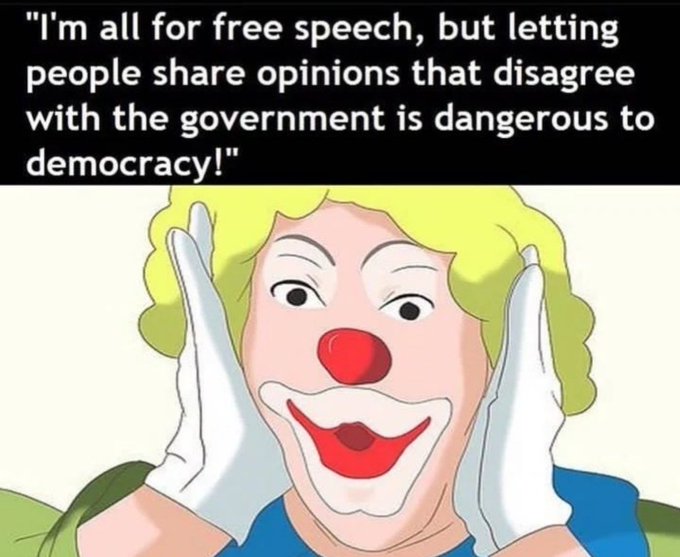
Elon Musk’s Free Speech Stance Is “Dangerous”, Columbia Journalism Fellow Warns

A Columbia University journalism fellow said Elon Musk’s support for free speech on X, formerly known as Twitter, is both “immoral” and “dangerous.”

Anika Navaroli used to work on Twitter’s “Trust and Safety Team,” the unit within the company that censored information, oftentimes true. Musk eliminated the team. She now is a senior fellow at Columbia’s Tow Center for Digital Journalism.

“What has now become clear is that Musk’s vision of speech on X is one of the greatest dangers to democracy, especially leading into the 2024 elections,” Navaroli (pictured) wrote on Thursday in The Hill.

She praised workers like herself for “thanklessly” working behind the scenes to defend “institutions.”

Navoli and her co-workers, in her telling, “were one of the last defenses to American democracy leading up to the Jan. 6, 2021 mob attack on Congress” which “led ultimately to our deplatforming former President Donald Trump.”

She wrote:

Much like poll workers, social media trust and safety workers toil thanklessly and behind the scenes for years to protect the safety and integrity of our most vital democratic institutions. Rather than invest in that crucial work, Musk took a page out of Trump’s playbook, repeatedly and publicly attacking trust and safety workers. He unleashed the Twitter Files, which revealed the names, images, and contact information of former Twitter trust and safety employees.

The journalism fellow said speech is “evolving,” “complicated,” and “sticky.”

“It requires tradeoffs, flexibility, and tough decisions. It shouldn’t be dictated by an autocratic CEO with absolutist ideologies,” Navoli wrote, repeating prior statements she has made on the subject.

“Instead of asking just free speech versus safety to say free speech for whom and public safety for whom,” she previously said during a Congressional hearing.

“So whose free expression are we protecting at the expense of whose safety and whose safety are we willing to allow to go the winds so that people can speak freely.”

She is correct in that our conceptions of speech are complicated – I do not think there is some broad First Amendment right for the authors of pornographic books targeting kids to have their works in libraries.

Keep reading

‘It Feels Like the New McCarthyism’: How the Israel-Hamas War Is Redefining the Limits of Free Speech

War between Israel and Hamas has sparked extensive (mostly) online activism about the conflict — and led to a rash of firings or other workplace discipline from employers concerned about their employees’ views of the conflict.

Artforum’s top editor David Velasco was fired by his publisher, Penske Media, after posting an open letter on the site calling for a cease-fire and suggesting Israel is responsible for the beginning of a genocide; Michael Eisen was removed as editor-in-chief of the science journal eLife after retweeting a satirical article critical of Israel; and Maha Dakhil, a top executive at the Hollywood talent firm Creative Artists Agency, stepped back from leadership roles after reposting an Instagram story that implied Israel was committing genocide. That’s in addition to multiple law students who had job offers revoked after publicly criticizing Israeli actions. The statements range from expressions of sympathy for Palestinians to strident anti-Israel criticisms that seem to minimize Israeli loss of life.

The situation is making Genevieve Lakier, a professor of law at the University of Chicago whose work is focused on the changing meaning of freedom of speech in the United States, very nervous.

“It feels like the new McCarthyism,” said Lakier, who’s one of the leading legal scholars on matters of free speech.

So far, most of the firings appear to have been for expressing pro-Palestinian views — the U.S.-based advocacy organization Palestine Legal reports that they’ve responded to over 260 cases of people’s “livelihoods or careers” being targeted. But the fact that these firings have been due in large part to social media posts and the widespread broadcasting of personal political beliefs means that the trend may not stay on one issue or one side of a dispute for long; Lakier says that we are watching the relationship between free expression and employment shift in real time.

Currently, regulations concerning speech and private employment oscillate wildly from state to state — about half of states have no protections for private employees who express political beliefs, while others have laws that vary in terms of scope. Many of the employment laws that do exist find their roots in the 19th century and are little use in navigating the 21st century workplace. Meanwhile, ideas about protected speech are constantly shifting in the culture: After 9/11, for example, the war on terror brought with it new examinations into what kind of speech promulgates terrorism. More recently, debates over “cancel culture” on campuses and in the workplace have brought up similar questions of what speech is permissible — and when consequences are justified.

Keep reading

UK Police Arrest Women Who Attended Gaza Protest Wearing Paraglider-Print Shirts

London police have made the latest in a series of arrests related to the repeated Gaza and Hamas protests in recent weeks, now arresting two women on suspicion of terrorism offences for wearing prints of paragliders stuck to their clothing at a rally.

Two women, aged 29 and 44 years old surrendered themselves to police and were arrested “on suspicion of inviting support for a proscribed organisation” under the Terrorism Act after the Metropolitan Police published their images in an appeal for information. The pair are being held at a police station, the force said.

Images of four people had been published by police on the 27th relating to “Pro-Palestine” protests on October 14th and 21st, with three of those being women wearing print-outs of paragliders taped to their clothes. The fourth was a man carrying a “I fully support Hamas” placard.

Keep reading