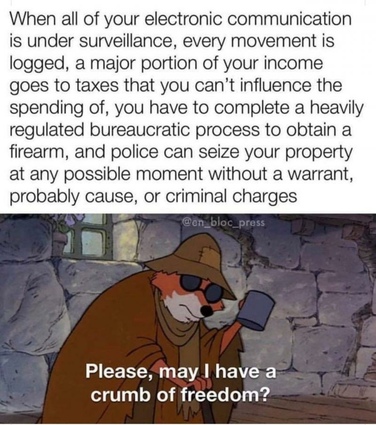
Land of the free…

Snitches have a new way to make money in Charlotte, North Carolina. By texting the FBI and tattling on people that have illegal cash, informants can make up to 25 percent of the money seized, according to an FBI news release. Jilted lovers, jealous friends, and nosy neighbors can now score big. The good news for anyone tempted by the offer is that federal law makes asset confiscation far too easy.
By using civil forfeiture, law enforcement agencies can take cash, cars, and other assets without convicting anyone of wrongdoing. The government doesn’t have to make an arrest, develop a theory about a specific crime, or even witness illegal behavior. Agents can bypass the criminal courtroom altogether.
According to the release, the tip line is designed to help agents intercept drug trafficking shipments through Charlotte. An example campaign graphic shows two agents gazing at a large pile of cash in the trunk of a car. A glowing neon headline reads: “Shine a light on drug trafficking.” The fine print focuses on the kickback, stating that if the tip “on where drug cash is being stored or transported” pans out, “you could receive up to 25% of the seized money.” The message is clear: snitching can be rewarding. But the ad fails to mention four important details.
Carl Nelson and Amy Sterner Nelson’s pre-pandemic lives look a lot different than the ones they live now. There are the obvious ways, and then there are the not so obvious ways, like the fact that they sold their house and their car, liquidated their retirement funds, and moved their family of six from a comfortable West Seattle home to Amy’s sister’s basement after the FBI seized almost $1 million from them in May 2020.
“We went from living a life where we were both working full-time to provide for our four daughters to really figuring out how we were going to make it month to month,” Amy tells me. “It’s completely changed my belief in fairness.”
The bureau took funds from nearly every corner of the Nelsons’ world, including, for instance, the savings Amy racked up from her decade as a practicing attorney and her later efforts as head of The Riveter, the co-working start-up she founded. But the FBI never even suspected Amy of committing any crime. It was Carl they were investigating—a probe that has not resulted in a single charge against him almost two years later.
In April 2020, agents showed up at the Nelsons’ home and informed them that Carl—a former real estate transaction manager for Amazon—was under investigation for allegedly depriving the tech behemoth of his “honest services.” In plainer terms, they accused him of showing favor to certain developers and securing them deals in exchange for illegal kickbacks. “That never happened and is exactly why I’ve fought as long and hard as I have,” he says. “It’s that simple.”
Whether or not the FBI has come to that conclusion is still a mystery; its years-long investigation into Carl’s alleged fraud has not yielded an indictment. Yet no such thing was necessary for the federal government to wreck the Nelsons’ lives, costing them their home, their community, their jobs, their girls’ place in their Seattle school, and their security for the future.
Perhaps more vexing: The FBI has, in some sense, subtly conceded that it didn’t need to do any of the above to complete their investigation or to hamstring any supposed criminal operation run by Carl. Last week, the government agreed to a settlement: Of the original approximately $892,000 it seized, it will return $525,000, while Amy and Carl forfeit about $109,000. (The remaining sum has been depleted by court fees.)
Ottawa Mayor Jim Watson told the CBC that the regime has the power to do this now that the Emergency Act was invoked by Prime Minister Trudeau.
The state-controlled CBC reported:
Ottawa’s mayor says any vehicles seized during the police crackdown on the occupation of the downtown should be sold to cover costs incurred by the city.
“We actually have the ability to confiscate those vehicles and sell them,” Mayor Jim Watson said Saturday.
“And I want to see them sold. I don’t want the return to these people who’ve been causing such frustration and angst in our community.”
The Boston Police department has been robbing citizens of their cash — many of whom were never accused of a crime — to buy surveillance technology off the books, to spy on citizens.
As their report points out, an August investigation by WBUR and ProPublica found that even if no criminal charges are brought, law enforcement almost always keeps the money and has few limitations on how it’s spent. Some departments benefit from both state and federal civil asset forfeiture. The police chiefs in Massachusetts have discretion over the money, and the public has virtually no way of knowing how the funds are used.
Boston cops have stolen so much money that they are secretly buying more expensive gear to seemingly get better at stealing money. According to the report:
[I]n 2019 the Boston Police Department bought the device known as a cell site simulator — and tapped a hidden pot of money that kept the purchase out of the public eye.
A WBUR investigation with ProPublica found elected officials and the public were largely kept in the dark when Boston police spent $627,000 on this equipment by dipping into money seized in connection with alleged crimes.
Because this spy equipment was bought with funds stolen from citizens, not even the Boston city council knew police had it.
Boston city councilors interviewed by WBUR said they weren’t aware that the police had bought a cell site simulator. Councilor Ricardo Arroyo, who represents Mattapan, Hyde Park and Roslindale, said, “I couldn’t even tell you, and I don’t think anybody on the council can necessarily tell you … how these individual purchases are made.”
Only because ProPublica obtained the documents, does anyone know the department is using stingray devices to spy on citizens. So much for transparency.
On a May day in 2015, a task force of Drug Enforcement Administration (DEA) agents and Miami-Dade Police Department officers raided Miladis Salgado’s suburban Miami home and seized $15,000 in cash that they found in her closet.
The DEA agents were acting on a tip from a confidential informant that Salgado’s estranged husband was laundering drug money.
The cash in Salgado’s closet was not drug proceeds, however. It was money that Salgado, who worked at a duty-free store in the Miami airport, had been saving up for her daughter’s quinceañera, an important coming-of-age 15th birthday party. Salgado had been planning to book a banquet hall, D.J., and -photographer. Suddenly bereft of her savings, she had to cancel the party.
It took two years for Salgado to get her money back, even after a DEA agent admitted in a deposition that there was no connection between her cash and the alleged criminal activity. In the meantime, Florida passed a law reforming the state’s civil asset forfeiture process, which allows law enforcement to seize property—cash, cars, houses—even when the owner isn’t convicted of a crime. The 2016 law raised the burden of proof for forfeiting property and now requires at least an arrest before most property can be forfeited.
But despite tightening the rules for when police can keep seized property, Florida remains one of the most prolific practitioners of civil forfeiture. The Sunshine State took in more revenue through forfeitures than any other state in 2018, according to a survey by the Institute for Justice, a libertarian-leaning public interest law firm. Local and state police can evade the new restrictions by working with the federal government, just like the Miami-Dade police did in Salgado’s case. In return for calling in the feds, they get a cut of the proceeds.
Civil forfeiture is not a popular government activity. For those of you who don’t know, civil asset forfeiture according to the ACLU “allows police to seize — and then keep or sell — any property they allege is involved in a crime. Owners need not ever be arrested or convicted of a crime for their cash, cars, or even real estate to be taken away permanently by the government.”
If that sounds crazy to you, I assure you, it’s real. I don’t know how it’s real, because it’s certainly not constitutional—who needs the Fourth Amendment, am I right?— but it is real.
The Dallas Police Department stepped in a hornet’s nest on social media when they posted a braggadocious photo of a seizure of $100,000 in cash. Police confiscated the haul at Dallas Love Field Airport and then posted the photo on social media. The local CBS station picked it up and wrote a glowing article about it. I guess they thought the photo of an adorable German Shepherd (good boi!) standing over piles of cash he found with his incredibly smart and furry nose would make everyone forget that the police just robbed someone…legally. It didn’t work.
As if the dystopian hell Australians are dealing with wasn’t bad enough already, residents of the country’s 2nd largest state are now at risk of losing the money in their bank accounts, their homes or other property, and even their driving privileges, if they do not pay their fines from breaking any of the tyrannical government’s draconian Covid rules in a timely manner.
Since at least September, Queensland Health has employed the services of the State’s Penalties Enforcement Register (SPER) to collect a total of 3046 unpaid fines totaling around $5.2 million, which includes 2755 separate individuals and businesses who were issued citations for not following the public health dictatorship’s unjustifiable orders during Covid lockdowns.
The extreme measures are expected to be implemented in other areas of the country, which could bring in close to $100 million in total. In just New South Wales alone, there are over 56 million in unpaid Covid fines that would be subject to collection, according to 9News Australia.
Keep in mind, throughout the lengthy lockdowns, a huge number of citizens were not permitted to work or make a living in any way. Residents of Queensland could not even leave the house without being harassed by police or military officials, and if they dared stray too far from their house they were issued a ticket and a fine.
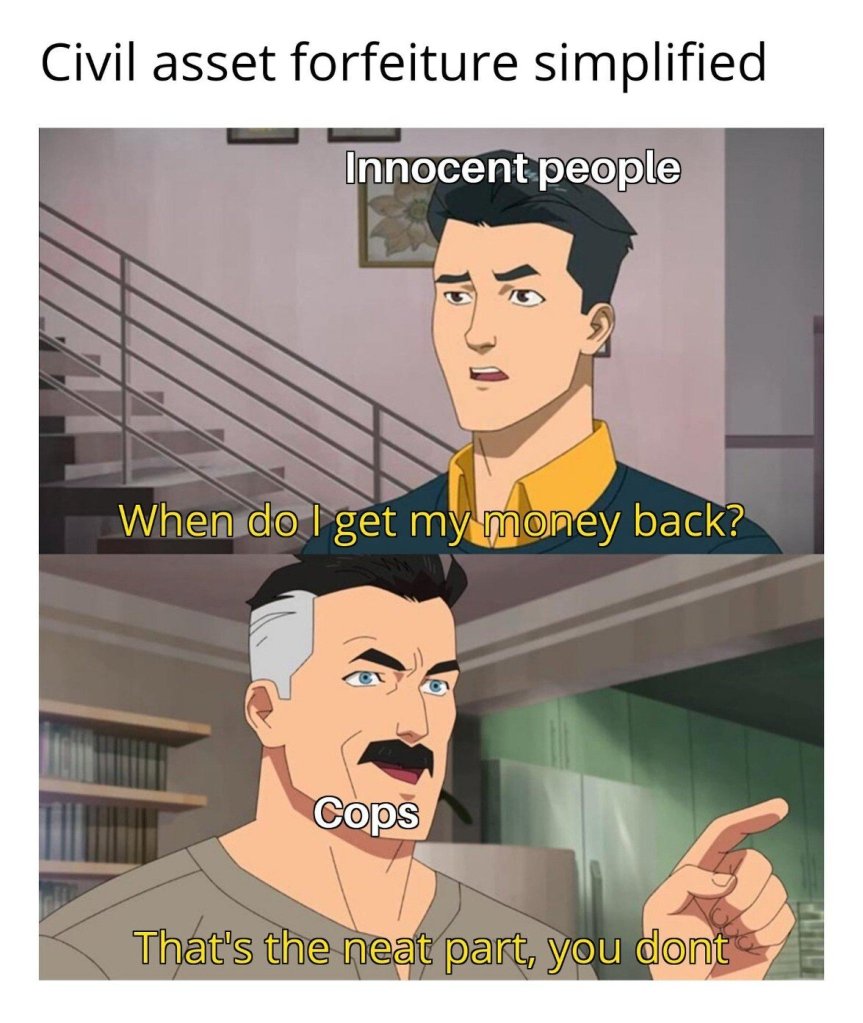
Maine became the fourth state to abolish civil forfeiture, a practice that enables law enforcement to confiscate millions of dollars worth of property without ever filing criminal charges. Taking effect on Tuesday without the governor’s signature, LD 1521 fully repeals Maine’s civil forfeiture laws, while simultaneously bolstering its criminal forfeiture process, which only authorizes forfeiture after a criminal conviction (apart from a few narrow circumstances, like the owner’s death or deportation).
Although civil forfeiture is typically defended as a way to fight back against drug kingpins, in reality, many forfeiture cases have been remarkably petty. In Maine, half of all cash forfeitures were under $1,670.
“It’s a very simple concept; you don’t lose your property unless you used it in the commission of a crime, or knowingly allowed someone else to use it in the commission of a crime,” bill sponsor Rep. Billy Bob Faulkingham wrote in May testimony supporting his bill. “It is time to end this work around that makes people prove innocence, rather than prosecutors proving guilt. This is one of the founding principles of our country.”
 Hellbound and Down
You must be logged in to post a comment.