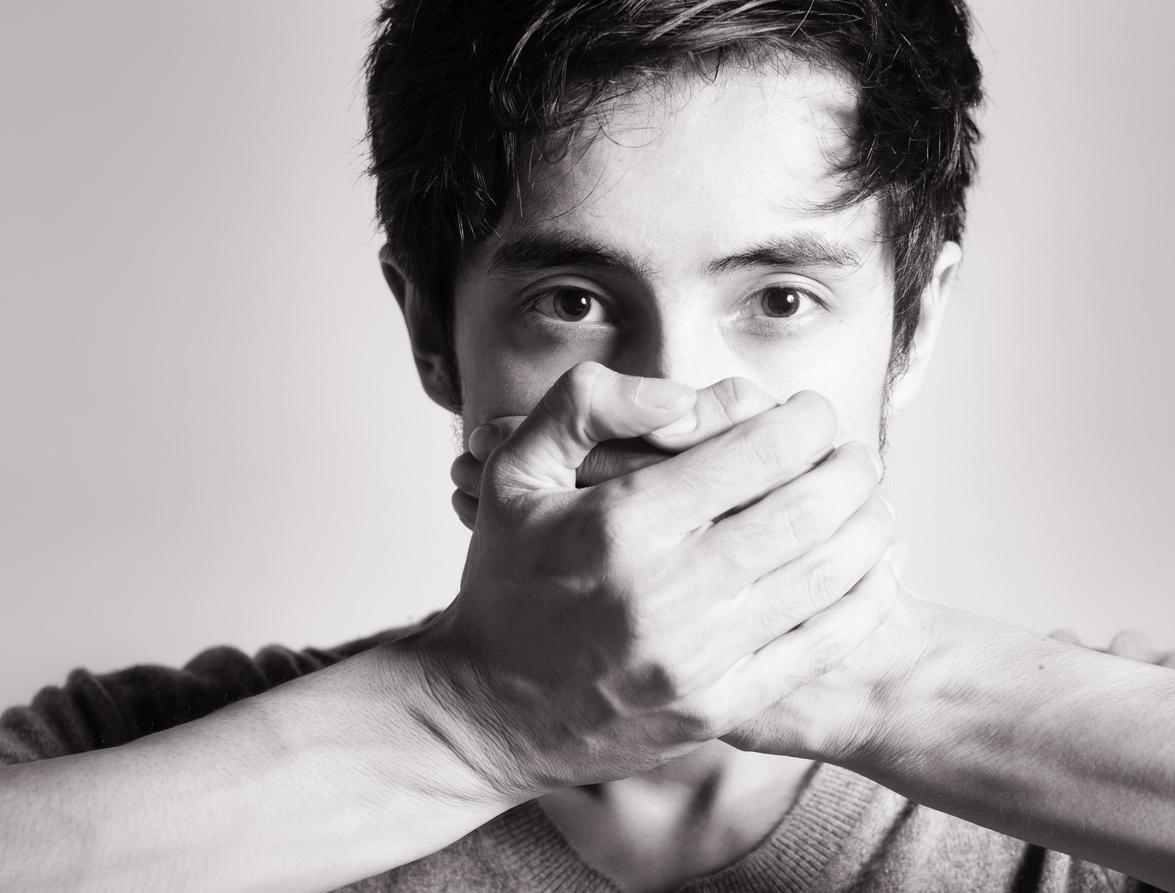
Been there…


Anew Cato national survey finds that self‐censorship is on the rise in the United States. Nearly two-thirds—62%—of Americans say the political climate these days prevents them from saying things they believe because others might find them offensive. The share of Americans who self‐censor has risen several points since 2017 when 58% of Americans agreed with this statement.
These fears cross partisan lines. Majorities of Democrats (52%), independents (59%) and Republicans (77%) all agree they have political opinions they are afraid to share.
Strong liberals stand out, however, as the only political group who feel they can express themselves. Nearly 6 in 10 (58%) of staunch liberals feel they can say what they believe. However, centrist liberals feel differently. A slim majority (52%) of liberals feel they have to self‐censor, as do 64% of moderates, and 77% of conservatives. This demonstrates that political expression is an issue that divides the Democratic coalition between centrist Democrats and their left flank.
QAnon is one of the most annoying things on Twitter and its followers are morons. And, also, it is dangerous and unacceptable that monopolistic Silicon Valley tech plutocrats are exerting more and more control over human communication.
I criticize QAnon constantly and find its acolytes intensely irritating. And, also, I don’t want monopolistic tech billionaires paternalistically protecting my fragile little mind from them.
Twitter shouldn’t be censoring this.
In a corporatist system of government, where few meaningful distinctions exist between corporate power and state power, corporate censorship is state censorship. Permitting such a thing, to any extent, is extremely hazardous for the future of human development.

Twitter announced on Tuesday it has begun taking sweeping actions to limit the reach of QAnon content and banned many of the conspiracy theory’s followers due to ongoing problems with harassment and the dissemination of misinformation.
Twitter will stop recommending accounts and content related to QAnon, including in email and follow recommendations and will take steps to limit content circulation in places like trends and search. This action will affect approximately 150,000 accounts, according to a spokesperson, who asked to remain unnamed due to concerns about the targeted harassment of social media employees.
The Twitter spokesperson also said the company had taken down more than 7,000 QAnon accounts in the last few weeks for breaking its rules on targeted harassment as part of its new policy.
The sweeping enforcement action will ban QAnon-related terms from appearing in trending topics and the platform’s search feature, ban known QAnon-related URLs, and ban “swarming” of victims who are baselessly targeted by coordinated harassment campaigns pushed by its followers.
Alphabet Inc’s Google said on Friday it would prohibit websites and apps that use its advertising technology from running ads on “dangerous content” that goes against scientific consensus during the coronavirus pandemic.
The world’s largest search engine updated its policy as the health crisis has continued to rage throughout the United States, and digital advertising giants like Google and Facebook Inc have faced calls to do more to clamp down on misinformation.
Content not allowed to make money from ads include debunked conspiracy theories, such as the notion that the novel coronavirus was created in a Chinese lab as a bioweapon, that it was created by Microsoft Corp founder Bill Gates, or that the virus is a hoax, Google said in a statement.
Google already bars ads with harmful content like “miracle” health cures or which promote the anti-vaccination movement. It also prevents ads from running on publisher content that encourages those topics.
Google’s new policy will also bar advertisers from creating their own ads that promote coronavirus conspiracy theories.
Google is about to take one giant step into directly shaping the prevailing media narrative.
One month after Google made news by banning ads on websites – such as this one – for violating its terms of service when it comes to “derogatory” material (a purposefully amorphous concept), the world’s leading search engine and internet advertising monopoly which controls 70% of online ad spending, will take an even more aggressive step. According to CNBC, starting on August 18, Google will “ban publishers from using its ad platform next to content that promotes conspiracy theories about Covid-19.” Additionally, “in cases where a particular site publishes a certain threshold of material that violates these policies, it will ban the entire site from using its ad platforms.”
In short, anyone who deviates from the conventionally accepted narrative, or as CNBC puts it challenges the “authoritative scientific consensus” on the coronavirus pandemic will be promptly demonetized.
As the Trump Administration weighs a travel ban on CCP officials, AG Bill Barr delivered a speech warning about the complicity of Silicon Valley and Hollywood in helping to perpetuate the CCP’s growing influence over American culture.
Criticizing China for resisting political liberalization that Americans once believed would eventually follow along with the economic liberalization agenda, Beijing is now embarking on a mission to elevate itself as a locus of geopolitical power to rival the US.
Barr complained that Hollywood has become too willing to kowtow to Beijing, censoring not just versions of movies that are shown in China, but also those that are released in the US.
Many Hollywood films have been “altered one way or another to please the CCP” and many other scripts never see the light of day due to self-censorship. Barr added that it’s tantamount to a “massive propaganda coup”.
He also invoked the memory of Walt Disney, saying the found would be “ashamed” of what happened to his company.
I suspect Walt Disney would be disheartened to see how the company he founded deals with the foreign dictatorships of our day,” Barr said in a speech at the Gerald R. Ford Presidential Museum.
As an example, Barr cited “World War Z”, which reportedly contained a scene where the protagonists speculated that the virus originated in China. Examples of this type of censorship have grown increasingly common Barr said.
He also accused the American tech behemoths from Google to Facebook and Twitter of doing the CCP’s bidding.
An online battle has erupted over the Wikipedia page for Sen. Kamala Harris, D-Calif., with a significant uptick in edits that reflects a pattern that’s been seen ahead of past vice-presidential announcements and led Wikipedia to put the page under “discretionary sanctions.”
The trend was first reported last week by The Intercept. According to the revision history of the Harris article on Wikipedia, there have been 500 revisions to the page since May 9, most of which have been made by one highly prolific editor.
On July 7th, 153 mostly left-leaning intellectuals wrote a letter to Harper’s Magazine, expressing their opposition to “a new set of moral attitudes and political commitments that tend to weaken our norms of open debate.” The Harper’s letter prompted a discussion about the scale, and indeed the existence, of what has become known as “cancel culture” (though the signatories did not explicitly use that term).
While almost everyone on the Right is concerned about cancel culture, many left-wing commentators took issue with the letter, despite the palpable efforts the signatories made to show that they are really, really not right-wing. For example, they were at pains to remind readers that Donald Trump “represents a real threat to Democracy,” and—as both Tyler Cowen and Douglas Murray pointed out—their number were apparently hand-picked to ensure sufficient demographic diversity without including anyone too ideologically unpalatable.
On July 10th, a counter-letter, signed by 164 journalists, writers, and academics, was published in the Objective. (Although it should be noted that 25 of the “signatories” did not actually disclose their names, apparently due to fear of professional retaliation.) According to the counter-petitioners, the Harper’s letter was deficient on a number of counts.
You must be logged in to post a comment.