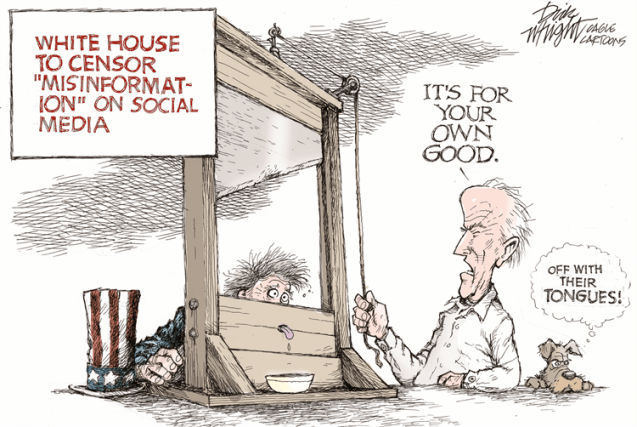
For your own good…

Axios’ Bethany Allen-Ebrahimian shared this email she received from the U.S.-based LinkedIn informing her that the company will be censoring her profile to readers in China due to “the presence of prohibited content” located in her profile.
“I used to have to wait for Chinese govt censors, or censors employed by Chinese companies in China, to do this kind of thing,” she tweeted. “Now a US company is paying its own employees to censor Americans”.
Following a recent Australian court ruling making new organizations legally liable for comments on their Facebook posts, CNN has restricted all Australians from accessing its Facebook page, in effect censoring not only a country but an entire continent.
The Wall Street Journal reports that CNN has restricted access to its Facebook pages in Australia following a recent Australian high court ruling that makes news organizations liable for comments made on their Facebook posts. Users in Australia can no longer access CNN’s primary Facebook page, International page, and pages for its shows.
Following a ruling from the High Court of Australia making news organizations liable for comments on their Facebook pages, CNN appears to be one of the first major U.S. media companies to restrict access to its Facebook pages in the country. According to the High Court of Australia, media companies encourage and facilitate comments from users by creating public Facebook pages and posting news content that encourages debate.
As a result, the court ruled that media companies are then responsible for defamatory content that appears on posts on their Facebook pages as it considers the organization’s publishers of the comments. CNN reportedly asked Facebook whether it could help news organizations to disable comments on all of their pages in Australia following the ruling.
“All censorships exist to prevent anyone from challenging current conceptions and existing institutions. All progress is initiated by challenging current conceptions, and executed by supplanting existing institutions.”
George Bernard Shaw
YouTube is now blocking several video channels associated with high-profile anti-vaccine activists like Joseph Mercola and Robert F. Kennedy, and banning any videos that claim “commonly used vaccines approved by health authorities are ineffective or dangerous,” The Washington Post reported Wednesday.
The video platform had previously blocked misinformation about the COVID-19 vaccines, but not videos that made erroneous or misleading claims about vaccines like those for measles or chickenpox, per the Post.
YouTube Vice President of Global Trust and Safety Matt Halprin said the company did not act sooner because of its myopic focus on COVID-19 vaccines. Its ban was expanded when YouTube realized misinformation regarding other vaccines was contributing to that regarding the COVID vaccine. “Developing robust policies takes time,” said Halprin.
The internet is an increasingly unwelcome place for many. A new study suggests that online “freedom” is in decline — for two very different reasons, depending on who you ask.
The annual report by Freedom House, a Washington, D.C.-based research and advocacy group, said this year is the 11th consecutive to see a global internet freedom decline.
The “Freedom on the Net” report rates countries on a 100-point scale, with the bottom considered least free. This year, scores internationally range from as low as 10 points in China to 96 points in Iceland. Scores 71 and above are designated “free,” while scores below 40 are “not free”; everything in the middle is considered “partly free.”
Considerations made in scoring include the extent to which free speech is legally protected, the proliferation of misinformation and hate speech and whether government authorities were known to target individual users, such as in India or Hungary where journalists and activists have been hit with state-supported spyware.
Facebook and its subsidiary Instagram have removed a new video from the undercover reporting operatives Project Veritas under its “misinformation” policy.
“We encourage free expression, but we don’t allow false information about COVID-19 that could contribute to physical harm,” the Facebook message shared with Project Veritas read.
Facebook didn’t specifically state which part of the video caused them to decide to delete it.
The video in question featured a whistleblower from the Health and Human Services Department (HHS), registered nurse Jodi O’Malley, making allegations that the federal government were underreporting the side effects of the COVID-19 vaccines.
In the video, O’Malley was discussing with Dr. Maria Gonzales, an ER doctor, who alleges that not all patients suffering from heart inflammation after taking the vaccine are being reported. “But now, they [the government] are not going to blame the vaccine,” Dr. Gonzales said of a patient who had suspected myocarditis.
“The Facebook Files” is an in-depth series based on leaked internal documents that expose the way social media giant Facebook views its platform and its social impact. It was released earlier this week.
Several factors are raised in The Journal’s reporting, including Instagram’s negative impact on minors, the implications of algorithmic changes on political discourse, and Facebook’s protection of influential users. Facebook’s internal research opposes its public assertions, and the company has internalized its societal ills while publicizing its positives in the report.
The Journal also highlighted that their decisions may not be as impartial as they appear on the surface and that “Facebook has asked fact-checking partners to retroactively change their findings on posts from high-profile accounts.”
The outlet also accused Facebook of having “waived standard punishments for propagating what it classifies as misinformation and even altered planned changes to its algorithms to avoid political fallout.”
From streaming services removing older episodes of “The Office” to scholars and teachers losing their jobs and suffering serious professional consequences, cancel culture is running rampant in America today. However, new data from the canonical American National Election Studies (ANES) reveals that significant numbers of Americans believe that cancel culture has gone too far. Self-censoring and easy offense are on the rise. And contrary to popular belief, younger Americans are just as likely as their older counterparts to view cancel culture as a net negative. Americans’ opinions of cancel culture and hypersensitivity fall along traditional ideological, educational, and racial lines, suggesting that this movement is anything but something exclusively spawned by younger Americans.
Specifically, the latest round of ANES data shows that non-trivially large numbers of Americans across all generational cohorts report censoring their speech at similar frequencies. Forty-five percent of Gen Zers (Americans ages 18 to 24) as well as 45 percent of Millennials (ages 25 to 40) say that they self-censor themselves at least occasionally. Forty-one percent of their Gen X parents (ages 41 to 57) report doing this, and 40 percent of their Boomer grandparents (ages 57 to 75) say the same. Ironically, those in the Silent Generation – Americans between ages 76 and 93 – are far less likely to report silencing themselves, with only 29 percent reporting doing so. Even if the eldest cohort is more open, the fact remains that almost 4 in 10 Americans readily concede that they limit and watch what they say on a fairly regular basis and think this is not healthy behavior in a democratic polity.
 Hellbound and Down
You must be logged in to post a comment.