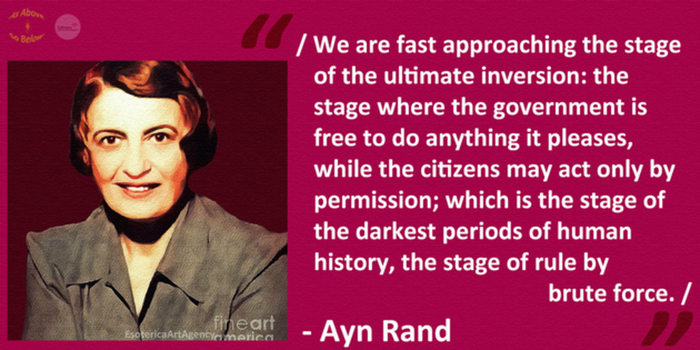
Ayn Rand on the police state…


President Joe Biden’s new disinformation chief Nina Jankowicz argued online mockery of Vice President Kamala Harris and other women in public life was a threat to national security.
“Platforms and governments aren’t doing enough,” she wrote on social media. “It’s time to act. Our national security and democracy are at stake.”
The Department of Homeland Security announced the creation of the new Disinformation Governance Board led by Jankowicz on Wednesday.
Jankowicz argued that Congress should create new laws to block mockery of women online, citing the volume of “gender disinformation” used to criticize Harris.
“Congress should reauthorize the Violence Against Women Act (VAWA) and include provisions against online gender-based harassment,” Jankowicz wrote in a WIRED article highlighting the “abusive content” sent on social media to women in public life.


The US House of Representatives has approved a bill that would remove several constraints on sending weapons to Ukraine amid the ongoing Russian offensive. Adopted by the Senate earlier this month, the “Ukraine Democracy Defense Lend-Lease Act” revives the program Washington used to send military equipment to belligerents in WWII while officially staying neutral.
The final vote on Thursday afternoon was 417-10, with three members not voting. All of the Democrats voted in favor, while all of the ten members opposed were Republicans.
Introduced by Senator John Cornyn (R-Texas), the bill was passed by the Senate on April 6, but the Democrat-dominated House adjourned for a two-week Easter recess before taking it up.
It authorizes the White House to “lend or lease defense articles” to Ukraine or any “Eastern European countries impacted by the Russian Federation’s invasion of Ukraine to help bolster those countries’ defense capabilities and protect their civilian populations from potential invasion or ongoing aggression.”
Cornyn’s bill does not create a new program, but rather makes it easier for President Joe Biden to send weapons to Kiev by suspending limitations imposed by two existing laws, one of which caps the length of the aid at five years.
Traffic halts at the sight of a Ukrainian soldier holding a wooden cross. Drivers and passengers step out of their cars to pay their respects. Following behind the soldier is a contingent of armed servicemen carrying a coffin.
A pedestrian kneels on the sidewalk as the column of troops turns to enter a graveyard where four more soldiers stand guard at an open grave. More than 200 civilians follow behind. Among them, dressed all in black, is the mother of 19-year-old Mykola Kuryk, whose body lies in the coffin, killed in battle at the end of March near Kyiv.
“He was ready to go places where no one else dared to go,” said the leader of Kuryk’s unit, the volunteer battalion of the Sonechko UPA Special Forces. “Even people with more experience. He did not know fear.”
Kuryk died on a special mission near the frontlines. Noting this, the Orthodox priest giving the final blessing observed, “There is no bigger love than to give your soul to your friends.”
His commander hands two medals to Kuryk’s father, honors for his son’s service. The coffin is lowered into the dark grave as the four soldiers standing guard fire a final salute. The smoke from the rifles vanishes into the blue sky as the coffin disappears below the earth.
Kuryk’s grave is next to several other newly filled ones. Much older graves, belonging to locals killed during World War II — the Great Patriotic War for Soviet veterans — are nearby. But there is room for many more.
Kuryk’s life and his service were both short; but since his death, he has become a flash cult hero in Ternopil. His picture hangs on billboards around the city, offering a promise that martyrs like him — who volunteered to defend his country after the Russian invasion in February — will never be forgotten. He may not be, but he will be part of a growing crowd.
This experience — the cycle of volunteering, fighting, dying, and honoring — is a demonstration of Ukraine’s new heavily militarized culture and martial social norms, a development that experts say will be hard to reverse even after the fighting stops and one that threatens to subsume all aspects of Ukrainian life.

Vasily Prozorov, a former officer with the Security Services of Ukraine (SBU) stated soon after his defection to Russia in 2018 that the SBU had been advised by the CIA since 2014.
“CIA employees [who have been present in Kyiv since 2014] are residing in clandestine apartments and suburban houses,” he said. “However, they frequently come to the SBU’s central office for holding, for example, specific meetings or plotting secret operations.”
Prozorov’s revelations take on extremely ominous implications in light of a new report by The Grayzone Project detailing the SBU’s participation in a campaign of assassination, kidnapping and torture overseen by Ukrainian President and Western media darling Volodymyr Zelensky.
The Food and Drug Administration on Thursday issued a long-awaited proposal to ban menthol cigarettes and flavored cigars, a major victory for anti-smoking advocates but one that could dent sales at tobacco companies.
The proposal, which comes a year after the agency announced the plan, still needs to be finalized and can take years to implement as it is likely to face stiff opposition from the tobacco industry.
“The proposed rules would help prevent children from becoming the next generation of smokers and help adult smokers quit,” said Health and Human Services Secretary Xavier Becerra
For decades, menthol cigarettes have been in the crosshairs of anti-smoking groups who have argued that they contribute to disproportionate health burdens on Black communities and play a role in luring young people into smoking.
Menthol cigarettes, banned in many states including California and Massachusetts, account for more than a third of the industry’s overall market share in the United States, even as overall smoking rates have been declining in the country.


You must be logged in to post a comment.