
Visit our brand new LinkTree today: HERE for links to Youtube (music playlists), Social Media, the Merch Store and more!
Tag: youtube
Popular YouTube personality ‘Mr. Crafty Pants’ busted for child porn
A popular influencer and YouTube creator known as “Mr. Crafty Pants” was busted for allegedly possessing and trading disturbing sexual images of children on social media, according to reports.
Michael David Booth — who has nearly 600,000 subscribers on his YouTube channel featuring arts and crafts tutorials with smart cutting machines — was arrested Wednesday in Kentucky after repeatedly sharing the sickening images on the social media messaging app Kik, Wave News reported.
The twisted online personality allegedly possessed six explicit photos — three showing children under the age of 12 and the others depicting teens — which he shared more than 15 times with other users between Aug. 4 and Aug. 7, according to an arrest report obtained by the outlet.
Police said they launched their probe into the depraved 39-year-old in August after the social app flagged his account, which was traced to an IP address linked to Booth’s Norton Commons home.
“It’s scary to think what he could have had access to,” his neighbor, Laura Nash, told the outlet, adding that she immediately asked her children if they had ever interacted with the creep after he was arrested.
Researchers expose large-scale YouTube malware distribution network
Check Point researchers have uncovered, mapped and helped set back a stealthy, large-scale malware distribution operation on YouTube they dubbed the “YouTube Ghost Network.”
The network published more than 3,000 videos across compromised or fake channels, luring viewers with game cheats, cracked software, or pirated tools, but instead delivering malware or phishing pages. 
The YouTube Ghost Network
The YouTube Ghost Network is strikingly similar to the Stargazers Ghost Network, a previously uncovered network of fake or hijacked GitHub accounts that served as a malware and phishing link Distribution-as-a-Service.
In the Stargazers Ghost Network, different accounts filled different roles. Some accounts directed targets to malicious downloads, others served malware, and others still starred, forked, and subscribed to malicious repositories, in an obvious attempt to make the other accounts appear legitimate to potential victims.
Similarly, the YouTube Ghost Network consists of video accounts, post accounts, and interact accounts.
Video accounts, which are either hijacked or created by the malware peddlers, upload videos that promise something appealing, e.g., a free/cracked version of Adobe Photoshop, or game hacks for popular games like Roblox. The descriptions contain download links or direct viewers to password-protected archives on services like Dropbox, Google Drive or MediaFire, and they often tell users to temporarily disable Windows Defender before installing the downloaded cracked software.
Post accounts publish community posts with the same links and passwords, and interact accounts flood comment sections with fake endorsements, creating a false sense of trust.
‘Massive legal siege’ against social media companies looms
Thousands of plaintiffs’ complaints, millions of pages of internal documents and transcripts of countless hours of depositions are about to land in U.S. courtrooms, threatening the future of the biggest social media companies.
The blizzard of paperwork is a byproduct of two consolidated lawsuits accusing Snap Inc.’s Snapchat; Meta Platforms Inc.’s Facebook and Instagram; ByteDance Ltd.’s TikTok; and Alphabet Inc.’s YouTube of knowingly designing their platforms to addict users — allegedly resulting in youth depression, anxiety, insomnia, eating disorders, self-harm and even suicide.
The litigation, brewing for more than three years, has had to overcome numerous hurdles, including the liability shield that has protected social media platforms from facing user-harm lawsuits. The social media companies have filed multiple motions to dismiss the cases on the grounds that Section 230 of the Communications Decency Act prevents them from being held accountable for content posted on their sites.
Those motions have been largely unsuccessful, and courtrooms across the country are poised to open their doors for the first time to the alleged victims of social media. The vast majority of cases have been folded into two multijurisdictional proceedings, one in state and the other in federal court, to streamline the pretrial discovery process.
The first bellwether trial is scheduled to begin in Los Angeles Superior Court in late January. It involves a 19-year-old woman from Chico, California, who says she’s been addicted to social media for more than a decade and that her nonstop use of the platforms has caused anxiety, depression and body dysmorphia. Two other trials will follow soon after, with thousands more waiting in the wings. If successful, these cases could result in multibillion-dollar settlements — akin to tobacco and opioid litigation — and change the way minors interact with social media.
“This is going to be one of the most impactful litigations of our lifetime,” said Joseph VanZandt, an attorney at Beasley Allen Law Firm in Montgomery, Alabama, and co-lead plaintiffs’ attorney for the coordinated state cases. “This is about large corporations targeting vulnerable populations — children — for profit. That’s what we saw with the tobacco companies; they were also targeting adolescents and trying to get them addicted while they were young.”
Matthew Bergman, founder of the Social Media Victims Law Center in Seattle, makes a similar comparison to tobacco litigation in the Bloomberg documentary Can’t Look Away: The Case Against Social Media. “In the case of Facebook, you have internal documents saying ‘tweens are herd animals,’ ‘kids have an addict’s narrative’ and ‘our products make girls feel worse about themselves.’ You have the same kind of corporate misconduct,” Bergman says in the film, which will be available to view on Bloomberg’s platforms on October 30.
Bergman’s firm was the first to file user-harm cases against social media companies, in 2022, after Frances Haugen, a former Meta product manager-turned-whistleblower, released a trove of internal documents showing the company knew social media was negatively impacting youth mental health. The first case, which is part of the consolidated federal litigation, alleged that an 11-year-old Connecticut girl killed herself after suffering from extreme social media addiction and sexual exploitation by online predators.
What set that case apart was how it got around Section 230’s immunity blanket. Bergman argued that his case wasn’t about third-party content, which the federal law protects. Instead, he said it hinged on the way social media companies were intentionally designing their products to prioritize engagement and profit over safety.
YouTube Bows to Trump in Censorship Lawsuit, Will Pay Millions to Avoid Court
And then there were none.
YouTube, a Google subsidiary, became the last of three tech titans to settle a lawsuit brought forth by President Donald Trump, according to a blistering report from The Wall Street Journal.
The video sharing platform agreed to pay a hefty $24.5 million to settle lawsuits brought forth by Trump in 2021.
At the time, the president’s YouTube account had been banned following the Jan. 6 incursion at the U.S. Capitol.
YouTube claimed that they had gone to those extraordinary lengths to remove Trump’s channel to nix potential videos that may incite violence.
(The channel was reinstated in March 2023.)
The YouTube settlement is the second-biggest of the lawsuits brought against various tech titans by Trump — and that appears to be intentional.
The biggest settlement Trump had was with Facebook parent company Meta Platforms, which was for $25 million.
“Google executives were eager to keep their settlement smaller than the one paid by rival Meta, according to people familiar with the matter,” The Wall Street Journal reported.
While $24.5 million does come in lower than the $25 million Meta paid, it’s more than double what X, formerly Twitter, paid Trump for a similar lawsuit, as the now-Elon Musk owned platform paid $10 million.
Interestingly, while Trump will “keep” most of this settlement money — $22 million — none of it will actually be going to him.
The Wall Street Journal noted that the money will be immediately rerouted to the nonprofit Trust for the National Mall, tasked with building a grand ballroom near the White House.
The other $2.5 million will be dispersed among various other plaintiffs. There is no mention of attorney fees.
This decision comes months after YouTube was apparently having “productive conversations” with the Trump administration in June, per The Hill.
Critics Accuse YouTube of Dragging Out Return Process for Banned Channels
YouTube is being criticized for what many see as backpedaling on its commitment to free speech, after pledging to restore banned accounts, only to continue removing new channels created by previously banned figures.
The initial assurance came in a letter dated September 23, 2025, addressed to House Judiciary Committee Chairman Jim Jordan.
In that communication, YouTube acknowledged its past enforcement actions, which included terminating channels over election-related and COVID-19 content under policies that have since changed. The company claimed that its current guidelines permit more room for such topics and asserted:
“Reflecting the Company’s commitment to free expression, YouTube will provide an opportunity for all creators to rejoin the platform if the Company terminated their channels for repeated violations of COVID-19 and elections integrity policies that are no longer in effect.”
The same day, YouTube posted a message on X describing a “limited pilot project” that would provide “a pathway back to YouTube for some terminated creators to set up a new channel.”
However, the platform immediately added that this option would only apply to a “subset” of creators.
The vagueness of the commitment raised suspicion, which intensified when two prominent figures, Infowars founder Alex Jones and “America First” host Nick Fuentes, launched new channels that were almost immediately taken down.
YouTube Expands AI Age Checks, Users Face ID Verification
Google’s video platform is tightening its controls, and a growing number of YouTube users are suddenly finding themselves locked out of content unless they hand over proof of age through ID verification.
The new direction stems from YouTube’s decision to push its AI-driven age estimation system much more broadly than before.
The technology, which YouTube began experimenting with in Europe before confirming its US debut in July, surveils people’s accounts and examines everything from account details and viewing habits to search activity.
Those surveillance signals are then used to guess whether someone is under 18.
The pace of enforcement has accelerated sharply. Within the 24 hours leading up to September 24, Reddit’s r/youtube subreddit saw a flood of posts from users saying their accounts were suddenly flagged for verification, suggesting a big uptick in restrictions.
Accounts flagged as too young are immediately restricted: targeted advertising is reduced, recommendations deemed unsafe are cut back, and access to adult material is blocked outright.
When YouTube’s system determines that an account likely belongs to someone under 18, the platform automatically enforces a set of limits designed to control how the service is used.
Google Says Users Removed Over COVID-19 Views Can Rejoin YouTube
YouTube creators who were removed over their views concerning COVID-19 or the 2020 election can rejoin the service, Google and its parent company, Alphabet, said in a Sept. 23 letter.
Rules in place prohibiting some discussion of COVID-19 and the election were lifted in 2023 or 2024, Google said through its lawyers.
“Today, YouTube’s Community Guidelines allow for a wider range of content regarding COVID-19 and elections integrity,” it stated. “Reflecting the Company’s commitment to free expression, YouTube will provide an opportunity for all creators to rejoin the platform if the Company terminated their channels for repeated violations of COVID-19 and elections integrity policies that are no longer in effect.”
People whose channels were suspended or taken down included Dan Bongino, the current deputy director of the FBI.
The company said it values conservative content creators and recognizes they regularly land compelling interviewers with politicians, business leaders, and others.
Google described the COVID-19 pandemic as an unprecedented time that forced online platforms to “balance freedom of expression” with moderation of content “that could result in real-world harm.” The situation was complicated by top officials in the Biden administration pressuring the company to take action against certain COVID-19 content “that did not violate its policies,” it said.
“It is unacceptable and wrong when any government, including the Biden Administration, attempts to dictate how the Company moderates content, and the Company has consistently fought against those efforts on First Amendment grounds,” the company stated.
YouTube’s medical content policies evolved throughout the pandemic, as health authorities changed their guidance, the company said. The company is now allowing a wide range of content on COVID-19 and elections.
“In contrast to other large platforms, YouTube has not operated a fact-checking program that identifies and compensates fact-checking partners to produce content to support moderation,” the letter states. “YouTube has not and will not empower fact-checkers to take action on or label content across the Company’s services.”
The letter was sent to Rep. Jim Jordan (R-Ohio), chairman of House of Representatives Judiciary Committee.
“Whether you were an established YouTube presence with a massive following like Dan Bongino or just were starting out to express political views there, YOU will have an opportunity to come back onto the platform if you were censored for engaging in political speech,” Jordan wrote on X. “This is another victory in the fight against censorship.”
Google did not respond to a request for comment.
Google Admits Biden White House Pressured Content Removal, Promises to Restore Banned YouTube Accounts
After years of denying bias, Google now concedes that it gave in to pressure from the Biden White House to remove content that did not breach its own rules.
The admission comes alongside a promise to restore access to YouTube accounts permanently removed for political speech related to COVID-19 and elections, topics where government officials had applied behind-the-scenes pressure to control the narrative.
This move follows sustained scrutiny from the House Judiciary Committee, which Reclaim The Net covered extensively, led by Chairman Jim Jordan (R-OH), who issued a subpoena and spearheaded an investigation that revealed the extent of government influence on content moderation decisions at Google.
In a letter from its legal representative, Google confirmed that it faced pressure from the federal government to suppress lawful speech.
We obtained a copy of the letter for you here.
Google revealed that it had been contacted multiple times by top federal officials regarding content on its platforms, even when that content did not break any rules.
The company stated that “Senior Biden Administration officials, including White House officials, conducted repeated and sustained outreach to Alphabet and pressed the Company regarding certain user-generated content related to the COVID-19 pandemic that did not violate its policies.”
FDA Official Pressures YouTube Into Removing a Channel For Posting His Own Vaccine Comments
Last week, a top official with the Food and Drug Administration (FDA) apparently filed a bogus copyright claim to get a critic’s YouTube account taken down. This is an inappropriate act of censorship that, not long ago, conservatives would rightly have stood against.
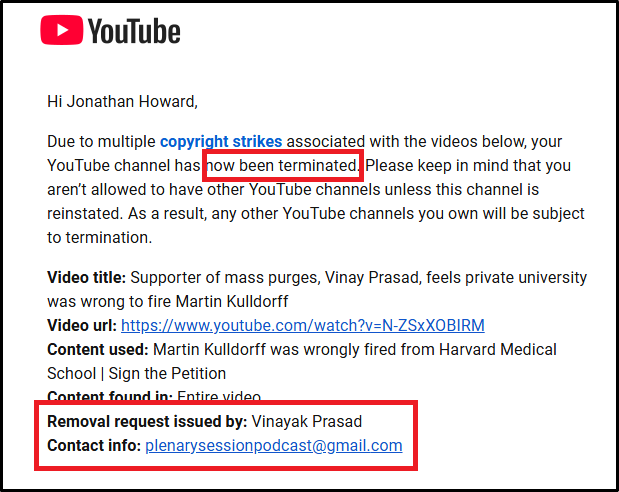
“Jonathan Howard, a neurologist and psychiatrist in New York City, received an email from YouTube on Friday night, which stated that Vinay Prasad, who is the FDA’s top vaccine regulator, had demanded the removal of six videos of himself from Howard’s YouTube channel,” The Guardian reported this week. “Howard’s entire channel has now been deleted by YouTube, which cited copyright infringement.”
On his channel, Howard hosted videos of public health officials—including Prasad, Department of Health and Human Services Secretary Robert F. Kennedy Jr., and National Institutes of Health Director Jay Bhattacharya—making statements during the COVID-19 pandemic that turned out to be untrue or overly myopic. “I had accumulated about 350 videos, almost all of which were short clips of famous doctors saying absurd things,” Howard wrote in a blog post, “that herd immunity had arrived in the spring of 2021 and that RFK Jr. was an honest broker about vaccines, for example.” Howard is also critical of Prasad’s stance on vaccines, which Prasad now has the authority to regulate.
According to an email Howard posted, YouTube “terminated” his channel after “multiple copyright strikes” against his videos, and the “removal request” came from Prasad.
“Publishing someone else’s videos without modification or commentary is a clear copyright violation,” an FDA spokesperson told The Guardian. “The mission of Johnathan Howard was not medical transparency, but personal profit by grifting and stealing someone else’s intellectual property.”
“My YouTube channel had 256 subscribers and its videos were typically seen by dozens of people,” Howard wrote. “I never promoted the channel and made no money from it.” Besides, U.S. law allows for fair use of copyrighted material, which means someone can use protected content for purposes such as “criticism, comment, news reporting,” or “research” without the creator’s permission.
Howard is the author of the book We Want Them Infected, which criticized doctors and public health officials who advocated a herd immunity strategy for dealing with COVID-19. Howard says such warnings fed into anti-vaccine conspiracy theories. His YouTube channel collected videos of people who are now in charge of public health institutions, making what he feels were irresponsible claims during the pandemic.
But whether you agree with Howard or not, it is wrong and hypocritical for Prasad to silence his critics in this way.
 Hellbound and Down
You must be logged in to post a comment.