
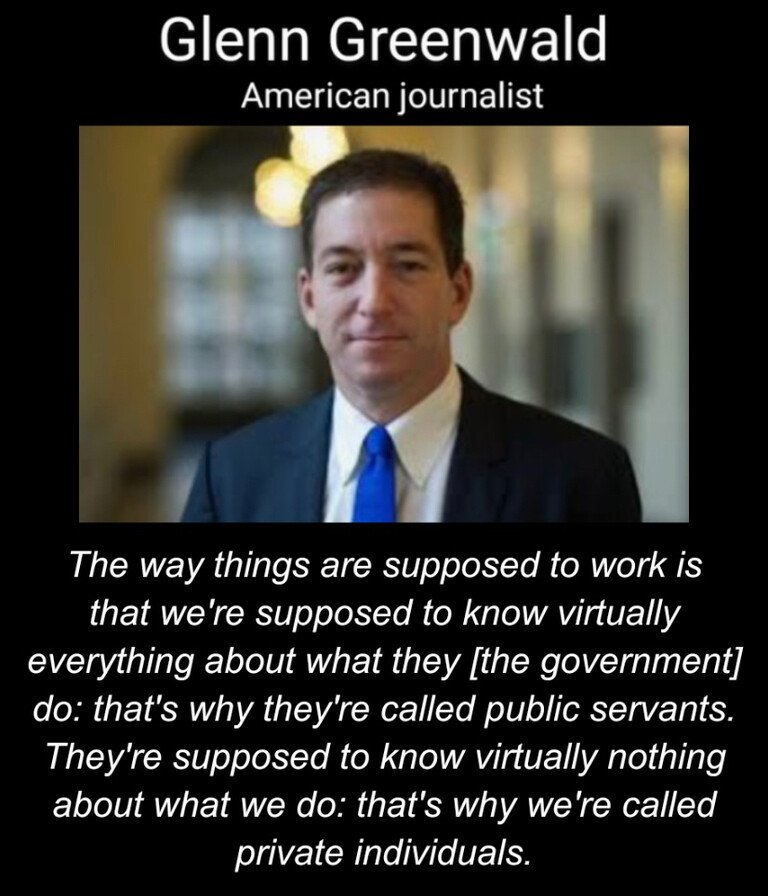
Julian Assange on privacy and transparency…

The U.S. Centers for Disease Control and Prevention (CDC) and three other top federal health agencies are refusing to provide employee COVID-19 vaccination data for 2022.
The CDC and the other agencies, including the one that is forcing virtually all health care workers to get a vaccine, say their most current employee vaccination data is from Dec. 3, 2021.
The Epoch Times asked the CDC, the Food and Drug Administration (FDA), the Centers for Medicare & Medicaid Services (CMS), and the National Institutes of Health (NIH), through media requests and Freedom of Information Act (FOIA) requests, to provide vaccination data current through March 2022, including the number of unvaccinated workers and the number of workers who received an exemption to President Joe Biden’s federal worker mandate, which is blocked by courts as of January.
The CDC recommends COVID-19 vaccination for virtually all Americans 5 and older. Its guidance has been used to justify mandates across the country, including on the federal level.
An official at the agency, which has 12,045 employees, pointed to the December 2021 figures. At that time, 96.4 percent of the CDC’s employees had gotten vaccinated and another 3.2 percent were in compliance with the mandate, or had pending or approved exemption requests.
“The Pelosi Congress (and its police department) is telling a federal court it is immune from all transparency under law and is trying to hide every second of its January 6 videos and countless emails,” stated Judicial Watch President Tom Fitton. “The hypocrisy is rich, as this is the same Congress that is trying to jail witnesses who, citing privileges, object to providing documents to the Pelosi rump January 6 committee.”
In November 2021, Judicial Watch revealed multiple audio, visual and photo records from the DC Metropolitan Police Department about the shooting death of Ashli Babbitt on January 6, 2021, in the U.S. Capitol Building. The records include a cell phone video of the shooting and an audio of a brief police interview of the shooter, Lt. Michael Byrd. In October, Judicial Watch released records, showing that multiple officers claimed they didn’t see a weapon in Babbitt’s hand before Byrd shot her, and that Byrd was visibly distraught afterward. One officer attested that he didn’t hear any verbal commands before Byrd shot Babbitt.
Also in November, Judicial Watch filed a response in opposition to the Department of Justice’s effort to block Judicial Watch’s Freedom of Information Act (FOIA) lawsuit asking for records of communication between the Federal Bureau of Investigation (FBI) and several financial institutions about the reported transfer of financial transaction records of people in DC, Maryland and Virginia on January 5 and January 6, 2021. Judicial Watch argues that Justice Department should not be allowed to shield “improper activity.”
Each year during Sunshine Week (March 13-19), The Foilies serve up tongue-in-cheek “awards” for government agencies and assorted institutions that stand in the way of access to information. The Electronic Frontier Foundation and MuckRock combine forces to collect horror stories about Freedom of Information Act (FOIA) and state-level public records requests from journalists and transparency advocates across the United States and beyond. Our goal is to identify the most surreal document redactions, the most aggravating copy fees, the most outrageous retaliation attempts, and all the other ridicule-worthy attacks on the public’s right to know.
And every year since 2015, as we’re about to crown these dubious winners, something new comes to light that makes us consider stopping the presses.
As we were writing up this year’s faux awards, news broke that officials from the National Archives and Records Administration had to lug away boxes upon boxes of Trump administration records from Mar-a-Lago, President Trump’s private resort. At best, it was an inappropriate move; at worst, a potential violation of laws governing the retention of presidential records and the handling of classified materials. And while Politico had reported that when Trump was still in the White House, he liked to tear up documents, we also just learned from journalist Maggie Haberman’s new book that staff claimed to find toilets clogged up with paper scraps, which were potentially torn-up government records. Trump has dismissed the allegations, of course.
This was all too deliciously ironic considering how much Trump had raged about his opponent (and 2016 Foilies winner) Hillary Clinton’s practice of storing State Department communications on a private server. Is storing potentially classified correspondence on a personal email system any worse than hoarding top secret documents at a golf club? Is “acid washing” records, as Trump accused Clinton, any less farcical than flushing them down the john?
Ultimately, we decided not to give Trump his seventh Foilie. Technically, he isn’t eligible: his presidential records won’t be subject to FOIA until he’s been out of office for five years (releasing classified records could take years, or decades, if ever).
Instead, we’re sticking with our original 16 winners, from federal agencies to small-town police departments to a couple of corporations, who are all shameworthy in their own rights and, at least metaphorically, have no problem tossing government transparency in the crapper.
Remember those videos taken by U.S. military pilots showing unidentified objects flying at incredible speeds and executing impossible maneuvers? They’ve appeared widely in various media since 2017, but soon — if DOD gets its way — you may not be able to watch them, thanks to a move to classify all such videos and other materials relating to UFOs, officially known as unidentified aerial phenomena (UAPs).
Director of National Intelligence (DNI) Avril Haines recently acknowledged that excessive government classification undermines U.S. national security. As she wrote in January in a letter to U.S. senators, “It is my view that deficiencies in the current classification system undermine our national security, as well as critical democratic objectives, by impeding our ability to share information in a timely manner.”
She also acknowledged that excessive classification damages the public’s faith in government and “reduces the Intelligence Community’s capacity to effectively support senior policymaker decision-making.”
The DNI’s testimony followed that of senior military officers who have complained to Congress regarding excessive classification.
This is, in fact, a problem familiar to anyone who has worked extensively with classified U.S. government information.
The DNI’s concerns are particularly timely and important. As I used to remind my security and counterintelligence colleagues in the Office of the Secretary of Defense, we did not win the Cold War because we were better at protecting information; we won the Cold War because we were much better at moving and sharing information, especially in the private marketplace, where the resulting efficiencies and innovation enabled us to consistently outpace and outperform the Soviet Union.
The British Medical Journal (BMJ) has demanded the full and immediate release of all data related to COVID-19 vaccines and treatments, saying it is in the public’s interest to do so.
BMJ, a weekly peer-reviewed medical trade journal published by the trade union the British Medical Association, called for the release of the data in an editorial published on Wednesday.
“Today, despite the global rollout of COVID-19 vaccines and treatments, the anonymized participant-level data underlying the trials for these new products remain inaccessible to doctors, researchers, and the public—and are likely to remain that way for years to come,” BMJ said.
“This is morally indefensible for all trials, but especially for those involving major public health interventions.”
BMJ also accused pharmaceutical companies of “reaping vast profits without adequate independent scrutiny of their scientific claims,” pointing to Pfizer, whose COVID vaccine trial was “funded by the company and designed, run, analyzed, and authored by Pfizer employees.”
New York-headquartered Pfizer still holds that trial data and has indicated that it won’t begin considering requests for such data until May 2025—24 months after the primary study completion date of May 15, 2023, which is listed on ClinicalTrials.gov.
Meanwhile, The Food and Drug Administration (FDA) had asked a judge to give it 75 years to produce all the data concerning the Pfizer and BioNTech vaccine.
The US National Archives and Records Administration (NARA) said on Wednesday it released an additional 1,491 declassified records related to the assassination of former US President John F. Kennedy.
The US government over the next year will continue to review 14,000 previously withheld records to determine if any additional records should be made available to the public, however, certain records will be withheld if there is a strong reason to do so, according to the release.
The media continues to treat former President Barack Obama as a champion of transparency, but his presidential library is looking like a huge bait-and-switch. Obama raised hundreds of millions for a grandiose library in south Chicago – except that it was revealed two years ago that it wouldn’t actually be a library. At the end of the Obama administration, 30 million pages of documents from his presidency were shipped to a former retail store near Chicago. Come to find out, the Obama Foundation, a private nonprofit organization, will control the official records of his time in office, rather than the National Archives and Records Administration, which administers all other presidential libraries. Rather than opening the files to the public and researchers, the Obama Foundation will eventually digitize the records. This could result in even worse delays than George W. Bush sought to finagle. Pulitzer Prize-winning historian David Garrow warned, “The absence of a true Obama presidential library will have the effect of discouraging serious and potentially critical research into the Obama presidency.”
There are plenty of reasons to expect excessive secrecy from both Trump and from Biden, who kept his Senate records locked up during his presidential run. In 2011, Biden was treated like a civic saint when he donated 1,875 boxes of documents from his U.S. Senate career to the University of Delaware. The National Endowment for Humanities gave a grant to help curate the collection, and the deal between Biden and the library was that the documents would remain sealed until “two years after Biden retires from public office.” Biden retired as Vice President in January 2017. Instead of releasing the information to the public, the library announced just before Biden launched his presidential campaign that secrecy would continue until two years after Biden “retires from public life.” Biden in 2019 justified keeping all his Senate records locked up during the campaign because “the idea that they would all be made public in the fact while I was running for public office, they could be really taken out of context.” It is unknown whether Biden’s Senate records contained any bombshells as explosive as his son Hunter’s laptop (which the media raced to defuse before Election Day).
Prerogatives for perpetual presidential secrecy are more akin to royalty than to a republic. Presidential libraries, which cost taxpayers $100 million a year, become lavish taxpayer-funded mausoleums where public records are mostly buried in perpetuity. As New York University history professor Jonathan Zimmerman wrote in 2015, “Why should each president get his own library? Multiple libraries are wasteful… And they’re undemocratic, because they allow our presidents – not the people who elected them – to define their legacies.” Zimmerman recommended putting all presidential records in a single library.
The War in Afghanistan has always been a black box, but the Biden administration just made matters worse.
According to an admission obtained from the State Department, Biden officials recently directed federal agencies to scrub their websites of official reports detailing the $82.9 billion in military equipment and training provided to the Afghan security forces since 2001.
The scrubbed audits and reports included detailed accounting of what the U.S. had provided to Afghan forces, down to the number of night vision devices, hand grenades, Black Hawk helicopters, and armored vehicles.
Reports further quantified 208 aircraft and helicopters; 75,000 war vehicles – including 22 Humvees, 50,000 tactical vehicles and nearly 1,000 mine resistant vehicles; and 600,000 weapons – including 350,000 M4 and M16 rifles, 60,000 machine guns, and 25,000 grenade launchers.
The State Department admitted to removing the reports but justified the move as a way to protect Afghan allies. According to a spokesperson:
“The safety of our Afghan contacts is of utmost importance to us. The State Department advised other federal agencies of to [sic] review their web properties for content that highlights cooperation/participation between an Afghan citizen and the USG or a USG partner and remove from public view if it poses a security risk.”
 Hellbound and Down
You must be logged in to post a comment.