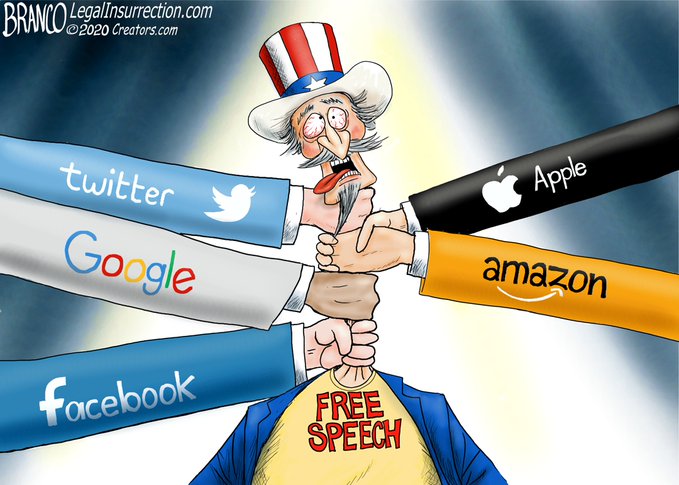
Freedom of speech…just watch what you say…

On Friday, Twitter joined a slew of other social media companies in permanently suspending Donald Trump’s accounts. Subsequently, many other conservative users found themselves deplatformed by the tech giant. The tech oligarchs’ argument is that Trump’s social media presence incites violence, as evidenced by the riot in the U.S. Capitol on Wednesday.
Twitter argued that several of Trump’s tweets violated its Glorification of Violence policy, which states, “You may not threaten violence against an individual or a group of people. We also prohibit the glorification of violence.”
Unsurprisingly, there are countless Twitter accounts that regularly call for harm or violence, in violation of this policy, yet have been allowed to persist. While the president’s posts and remarks have included some awful things, they have been in no way worse than much of what transpires on the platform.
Ayatollah Khamenei, the supreme leader of Iran, has an intact Twitter account that consistently glorifies acts of violence, yet the brutal dictator has not faced any censorship or suspension. After the heartbreaking beheading of a French teacher because he showed a political cartoon depicting Mohammad, and a mass stabbing in a church in Nice, Khamenei focused vitriol on those murdered, claiming the “rage” of Muslim extremists had demonstrated its “vitality.”
While many who opposed the president celebrated, whistleblower and internet freedom advocate Edward Snowden warned that allowing social media companies to set a precedent where they could effectively ban whoever they want from their services set a chilling precedent. “I know a lot of folks in the comments [who] read this are like ‘YAAAAS,’ which, like — I get it. But imagine for a moment a world that exists for more than the next 13 days, and this becomes a milestone that will endure,” he wrote on Twitter.
Almost immediately, a number of non-Trump accounts began to face problems, with pro-Assange journalist Suzie Dawson locked out of her account, educational file sharing website Sci Hub’s account suspended, and the Red Scare podcast’s profile deleted. Other figures began to demand that the accounts associated with the Venezuelan and Chinese government be removed from social media platforms as well.

Alegislative counsel member of the American Civil Liberties Union (ACLU) warned Friday that the suspension of President Donald Trump‘s social media accounts wielded “unchecked power,” by Twitter and Facebook.
Kate Ruane, a senior legislative counsel at the ACLU said in a statement that the decision to suspend Trump from social media could set a precedent for big tech companies to silence less privileged voices.
On Oct. 18, 2020, Twitter banned the account of Dr. Scott Atlas for defending President Donald Trump’s position on mask mandates. In his tweet, he cited scientific studies, and the tweet contained absolutely no false information.
Also in October, Twitter banned the account of The New York Post for accurately reporting on a story about Hunter Biden’s laptop. Today we know these were just the first salvos in this evil company’s assault on American liberty.
For all its talk about safety, community, and the health of discourse, we see today that Twitter acts in favor of one interest and one interest alone: its own, even when it means destabilizing the American people. On Friday, the company permanently banned Trump from its platform and began a purge of conservative voices.
They claim this is needed to protect America from a coup. That is a farcical lie. They did it because their political enemies such as Trump and Sen. Josh Hawley are now out of power, and they mean to keep it way.
As a private company, Twitter is free to do as it pleases. And I am free to call them what they are: a shill for communist China that seeks the destruction of America.
Do you doubt that? Then explain why Iran can call for Jews to be killed on Twitter’s platform and China can spread propaganda about how rounding up Uyghur men and forced sterilization of Uyghur women is actually good, but Donald Trump can’t tweet. It is evil. And anyone defending Jack Dorsey’s death machine is complicit.
If Twitter is really going to ban Trump for the reasons it stated, then Colin Kaepernick should have already been banned for 100 lifetimes.
Instead, Twitter CEO Jack Dorsey gave him millions — in honor of exactly what should have gotten him banned!
We’re in the midst of what is likely the most extreme corporate censorship crusade in modern history — whereby oligarchic tech officials have moved to simultaneously purge the sitting, democratically-elected President from all the internet’s most-used public communications platforms — and the reaction among media activists (a more apt term than “journalists”) is 100% predictable: complete jubilation.
They absolutely love corporate censorship, and their ecstasy at its implementation grows in direct proportion to how ruthless and politically vengeful that censorship is. These people have the foresight of a gnat: they are so consumed by an ideology of petty, vindictive victimhood that they have no capacity to see how such democracy-overruling censorship power poses an unprecedented threat to political speech and civil liberties.
This threat — the coming purge which will be effectuated by those in positions of authority who crave nothing more than to punish their allegedly fascist/white supremacist/MAGA enemies and thereby impose a left/liberal corporate authoritarian monoculture — in the long-run vastly outweighs whatever “threat” was posed by the farcical MAGA goofball intrusion at the Capitol on Wednesday. Which, again, was obviously not a “coup attempt” in any recognizable sense of that term. “MAGA Terrorist Insurrection,” the insane characterization put forth with a straight face on nationally-televised CNN broadcasts by Jake Tapper (to take just one of countless examples) is sheer propaganda — intentionally designed to foment fear and hysteria for profit. CNN enjoyed its highest ratings ever on Wednesday, and of course you can’t just let that go to waste.
The emails, originally reported by Loomered.com, outline an intimate relationship dating back over a decade.
Emails from October 2010 show Facebook’s Public Policy Manager Adam Conner talking directly with Hunter Biden about the removal of a profile on the social media platform.
 Hellbound and Down
You must be logged in to post a comment.