DHS to scan social media posts looking for “domestic terrorists” after Capitol breach

The Department of Homeland Security (DHS) plans to launch a warning system to detect “domestic terrorism” threats by gathering and analyzing intelligence on public social media posts and making predictions on future actions.

The purpose of the system is to detect the sort of posts that allegedly proceeded the breach of the US Capitol on January 6. Law enforcement agencies were criticized for ignoring or missing the posts.

According to a DHS official involved in the efforts, the focus is supposedly not on the posters, but to identify the targets of domestic terrorism. The official also said that, for now, the DHS is using human data analysts, not computer algorithms, to analyze public social media posts.

Keep reading

At Vatican conference, Chelsea Clinton calls for global crackdown on anti-vaccine social media posts

Chelsea Clinton has spoken out against freedom of vaccine-critical speech at a Vatican conference dedicated to dialogue.

Speaking during a pre-recorded online meeting, Clinton, 41, responded to a question about so-called “vaccine hesitancy” regarding COVID-19 vaccines by saying that there must be a global effort to crack down on vaccine-critical social media posts.

“I personally very strongly believe there has to be more intensive and intentional and coordinated global regulation of the content on social media platforms,” she said.

“We know that the most popular video across all of Latin America for the last few weeks that now has tens of millions of views is just an anti-vax, anti-science screed that YouTube has just refused to take down.”

Clinton added that anti-vaccine content created in the United States “flourishes” across the world by way of social media platforms. Her attempts to convince the managers of these sites to remove the material has not worked, she said.

“We know that — because I have tried — that appealing to the leadership of these companies to do the right thing has just not worked, and so we need regulation.”

Keep reading

An army of Big Biotech companies is using psych tactics to ‘create vaccine demand’

“[P]ublic health experts know that the last inch – getting the vaccine from vial to arm – can be the hardest,” according to the Vaccination Demand Observatory

Launched last week, the Observatory runs a “beta dashboard” of data and resources “intended for select global public health professionals.”

The Observatory was established by a group called the Public Good Projects (PGP) which “designs and implements large-scale behavior change programs for the public good,” UNICEF – which has received $86.6 million from the Bill and Melinda Gates Foundation since 2020 – and the Gates-subsidized Yale Institute for Global Health. .

PGP was founded by Joe Smyser, a public health academic who trained at the CDC and has partnered with Google and Facebook. Its board members include executives from Merck pharmaceuticals, Pepsi, Levi-Strauss, the Advertising Council, Sesame Street, Campbell’s, and TikTok.

PGP’s website says that through “media monitoring and bots, grassroots social media organizing, or thought leadership, we deploy our considerable resources and connections to communication for change.”

Bots – or internet robots, also known as crawlers – can scan content on webpages all over the internet and create automated conversations and comments.

“PGP is monitoring coronavirus-related media conversations 24/7 to provide organizations with real-time public health expertise and messaging guidance.”

The group has promoted vaccines before. It developed the #StopFlu campaign, recruiting 120 “‘micro’ social media influencers” in the “African American and Latinx communities across eight states” and giving them prompts to sell their audiences the ideas that flu is a serious problem and that healthy people need flu shots.

Keep reading

Twitter Will Now Call Out ‘Mean Tweets’ – Before They Are Even Sent

To combat toxicity on the platform, social media website Twitter is reportedly developing a feature to makes users reconsider sending messages that its system detects as “mean” or offensive. Initial tests show that 34 percent of users who received the warning chose to revise their message or not send it at all.

NPR reports that Twitter is attempting to make its users more conscientious about the language they use on the platform and is encouraging positivity by implementing a new feature that will detect “mean” replies on its service before a user presses send.

When Twitter detects that a user is about to post something that could be seen as offensive, an automatic prompt will be displayed that states: “Want to review this before tweeting?” The user is then offered three choices: tweet, edit, or delete.

Keep reading

Donald Trump’s New Blog Is Riddled With Facebook and Google Trackers, Share Buttons For Big Tech

As Donald Trump’s new blog launched this week, Facebook’s ADL-supported “Oversight Board” upheld the corporate monopoly’s decision to permanently ban Trump from the platform. Despite this, the President’s new blog is loaded with trackers from Facebook and Google, and features prominent share buttons for Facebook and Twitter while ignoring the free speech platforms used by the majority of Trump supporters, such as Gab, Telegram, and Parler.

Gab CEO Andrew Torba was among the first to uncover the tracking pixels embedded in the new blog that Trump launched on Tuesday called “From The Desk Of Donald J. Trump.”

Despite the fact that the new blog has zero user-oriented features aside from allowing Trump to post his email messages from the Save America 45 PAC directly to the site, the blog features many prominent donation buttons that encourage supporters to donate up to $5,000, including a $250 button that is prominently animated and jumps around the screen.

No indication is given as to where the donations will go, other than a vague message that states “President Trump is calling on you to step up and become a founding member of his Save America team.” Donators are apparently supposed to become ecstatic at the thought of President Trump potentially seeing their name on a “Founding Member Donor List.”

Keep reading

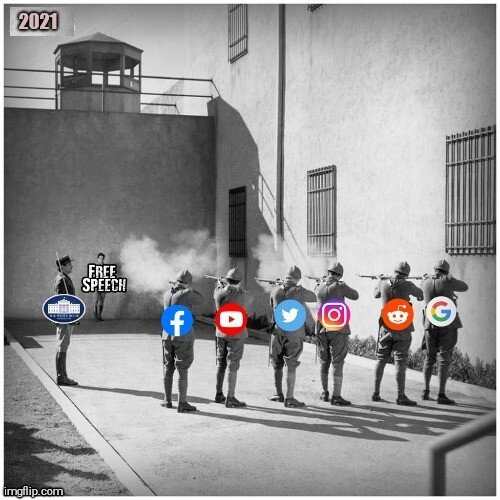
Psaki Says Biden Administration Wants MORE Social Media Censorship – While Also Claiming They Value First Amendment

White House Press Secretary Jen Psaki told reporters on Wednesday that the Biden administration wants more social media censorship — while also claiming to value the First Amendment.

Psaki’s comments came after Facebook announced their decision not to reinstate former President Donald Trump’s accounts.

The Press Secretary Jen Psaki said that Biden believes that “major platforms have a responsibility related to the health and safety of all Americans to stop amplifying untrustworthy content, disinformation and misinformation, especially related to COVID-19, vaccinations and elections.”

Psaki went on to indicate that Biden believes Big Tech must do more to silence “life threatening” speech on social media.

Keep reading

Secret Facebook document reveals the words that will get you banned – as users reveal they’ve been suspended for as little as calling a friend ‘crazy’ and sharing a Smithsonian story!

Facebook users have shared stories of receiving bans after jokingly calling their friend ‘crazy’, sharing a Smithsonian magazine story on tribal New Guinea and labelling someone ‘sad’. 

The social media platform is understood to have internal guidelines which are not made public on moderation. In documents seen by The Wall Street Journal moderators are told the sentences that are and aren’t allowed.  

An example given for a sentence not allowed is: ‘It’s disgusting and repulsive how fat and ugly John Smith is.’ 

But the document adds: ‘We do not remove content like “frizzy hair,” “lanky arms,” “broad shoulders,” etc. since “frizzy,” “lanky,” and “broad,” are not deficient or inferior, and therefore not degrading.”’    

Recent graduate Colton Oakley says he was banned from posting for three days after calling those who are angry about loan cancellation ‘sad and selfish.’ 

Writer Alex Gendler claims he was stopped from posting after sharing a Smithsonian magazine story on tribal New Guinea. 

And history teacher Nick Barksdale told The Wall Street Journal he received a 30 day ban after writing to a friend ‘man, you’re spewing crazy now!’ 

Facebook said this removal was a mistake but Barksdale asked: ‘If you use the term ‘crazy,’ does that automatically get you banned?’

Artist Sunny Chapman, who has received bans, said: ‘What I’m learning about Facebook is not to talk on Facebook.’   

Keep reading