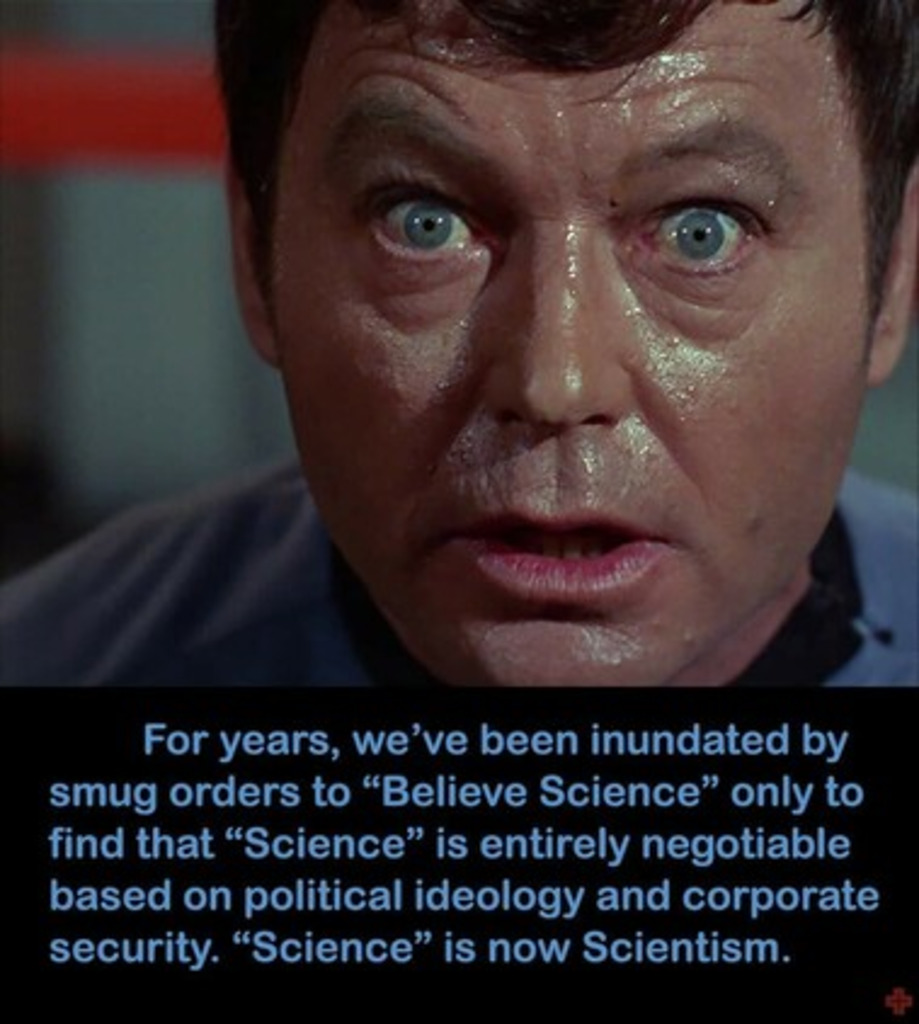
Follow the Scientism

Because we would all prefer to forget the Covid crisis and move on, the following may have already faded from our collective memory. Only a few years ago, Australia rounded up citizens exposed to Covid, including asymptomatic people, and shipped them involuntarily to detention facilities against their will. Videos of Australian quarantine centers made their way onto social media before tech censors, at the behest of governments, dutifully scrubbed them from the internet. Many provincial governors in Australia abused their emergency powers: while not every Australian state chose full-throated authoritarianism, several of them did. Canada likewise built detention facilities for infected persons, and the state of New York fought an ongoing legal battle to do so.

Authoritarian measures during the Covid crisis went beyond forced detainment of suspected or actual cases. The Medical Indemnity Protection Society (MIPS) in Australia, which provides medical malpractice insurance to all the country’s physicians, published twelve commandments for physicians on their website to avoid disciplinary “notifications”—an Orwellian euphemism for investigations overseen by the Australian Health Practitioner Regulatory Agency, the governing entity overseeing all physicians. The MIPS Commandment #9 instructed Australian doctors as follows:

Be very careful when using social media (even on your personal pages), when authoring papers or when appearing in interviews. Health practitioners are obliged to ensure their views are consistent with public health messaging. This is particularly relevant in current times. Views expressed which may be consistent with evidence-based material may not necessarily be consistent with public health messaging.

Read that last sentence one more time: “evidence-based material” refers to peer-reviewed scientific papers or other sources of credible medical information. So, if Australian doctors mention findings of a published study which are not consistent with “public health messaging”—i.e., the approved views of the public health bureaucrats in power—these physicians could potentially lose their ability to practice medicine. Notice that this applies also to physicians “authoring papers,” meaning that if a doctor conducts research and his findings contradict “public health messaging,” he’d better think twice before publishing the results.

Likewise, in the US, the Federation of State Medical Boards (FSMB), an authority on medical licensure and physician discipline, passed a policy in May 2022 on medical misinformation and disinformation that guides all state medical boards and the nation’s physicians they license. My home state of California took up the FSMB’s suggestion to codify these recommendations in law with Assembly Bill 2098. I traveled to Sacramento to testify against this legislation when it was debated in the State Senate.

Keep reading

How Scientific American’s Departing Editor Helped Degrade Science

Earlier this week, Laura Helmuth resigned as editor in chief of Scientific American, the oldest continuously published magazine in the United States. “I’ve decided to leave Scientific American after an exciting 4.5 years as editor in chief,” she wrote on Bluesky. “I’m going to take some time to think about what comes next (and go birdwatching), but for now I’d like to share a very small sample of the work I’ve been so proud to support (thread).”

Helmuth may in fact have been itching to spend more time bird watching—who wouldn’t be?—but it seems likely that her departure was precipitated by a bilious Bluesky rant she posted after Donald Trump was reelected.

In it, she accused her generation, Generation X, of being “full of fucking fascists,” complained about how sexist and racist her home state of Indiana was, and so on.

“Fuck them to the moon and back,” she said of the dumb high school bullies supposedly celebrating Trump’s victory.

Whether or not Helmuth’s resignation was voluntary, it should go without saying that a few bad social media posts should not end someone’s job. If that were the whole story here—an otherwise well-performing editor was ousted over a few bad posts—this would arguably be a case of “cancel culture,” or whatever we’re calling it these days.

But Helmuth’s posts were symptoms of a much larger problem with her reign as editor. They accurately reflected the political agenda she brought with her when she came on as EiC at SciAm—a political agenda that has turned the once-respected magazine into a frequent laughingstock.

Sometimes, yes, SciAm still acts like the leading popular science magazine it used to be—a magazine, I should add, that I received in print form every month during my childhood. 

But increasingly, during Helmuth’s tenure, SciAm seemed a bit more like a marketing firm dedicated to churning out borderline-unreadable press releases for the day’s social justice cause du jour. In the process, SciAm played a small but important role in the self-immolation of scientific authority—a terrible event whose fallout we’ll be living with for a long time.

When Scientific American was bad under Helmuth, it was really bad. For example, did you know that “Denial of Evolution Is a Form of White Supremacy“? Or that the normal distribution—a vital and basic statistical concept—is inherently suspect? No, really: Three days after the legendary biologist and author E.O. Wilson died, SciAm published a surreal hit piece about him in which the author lamented “his dangerous ideas on what factors influence human behavior.” That author also explained that “the so-called normal distribution of statistics assumes that there are default humans who serve as the standard that the rest of us can be accurately measured against.” But the normal distribution doesn’t make any such value judgments, and only someone lacking in basic education about stats—someone who definitely shouldn’t be writing about the subject for a top magazine—could make such a claim.

Keep reading

Transhumanism, Digital Twins And Technocratic Takeover Of Bodies

In the Covidian Era, science has moved on to a digital upgrade of itself called Scientism, the religion of science, where science is god, and part of a new global Technocracy.

“Technocracy is the science of social engineering,” says Patrick Wood, author of Technocracy Rising.

Social engineering used to mean molding the minds of people to conform to new norms. This goes back to 1928, Ed Bernays, and his book Propaganda.  However, in a Technocracy, not only minds, but bodies, too, can be molded. If you did not get the memo, Technocracy has brought humanity from Human to Posthuman and Transhuman.

In the 2022 Journal Global Trends, Russian scientists describe the difference between Posthuman and Transhuman:

The fundamental idea of posthumanism is the rejection of biological, ethical, and ontological anthropocentrism. Transhumanism focuses on changing and improving natural human characteristics through biological, technological, and cognitive modifications…Transhumanism has the potential to preserve man as an effective economic and cognizing agent.

In other words, man as an “economic agent” refers to the cybernetic human as a commodity in a modern world. This means the laws of the nations need to change to catch up.

The U.S. FDA is meeting that goal for change with its FDA Modernization Act 2.0.  What is the FDA Modernization Act 2.0?

The new law amends the Federal Food, Drug, and Cosmetic Act by authorizing sponsors of novel drugs to make use of “certain alternatives to animal testing, including cell-based assays and computer models, to obtain an exemption from the Food and Drug Administration to investigate the safety and effectiveness of a drug.

It is the FDA giving itself permission to transition from testing animal models to directly testing humans.

In the 2023 Journal of Clinical Investigation, authors cite a long list of excuses to change research models:

  1. cost
  2. low approval rates in clinical trials
  3. lack of efficacy in trail outcomes
  4. high rate of failure in therapeutics
  5. species differences between animals and humans

After decades of extrapolating animal studies to humans, suddenly animals are no longer scientifically valid. Does this transition make obsolete more than a century of animal-based research? In one sense, such a transition is long-awaited and frees innocent animals from needless torture. In another sense, it moves the mark to a new target.

Keep reading

The Real Peter Hotez: $cientism, snake oil, & a lifelong campaign to sell vaccines for parasites

It’s time to get to know the nefarious actor that is Peter Hotez, the Anthony Fauci of Houston, a “vaccinologist” mRNA evangelist who has never developed a successful vaccine.

Dr. Hotez has been in the headlines this weekend after he refused an offer from Joe Rogan to debate presidential candidate RFK Jr on Rogan’s program. Now that he’s in the news, it’s worth discussing the extremely unethical behavior and activities of one of America’s most prominent pseudoscientists.

The Baylor Medicine professor is best known for his unapologetic religious promotion of unlimited doses of covid vaccines, for both adults and young children. The dishonest, ruthlessly corrupt (read Simon Goddek’s Twitter thread on Hotez) Big Pharma snake oil salesman has labeled any and all of his detractors as anti-science agents of disinformation.

Keep reading

California presses ahead with restricting doctors’ speech from going against “contemporary scientific consensus”

The California Senate Business, Professions, and Economic Development Committee approved bill AB 2098, which would punish doctors for disagreeing with the state’s chosen authority and spreading COVID “misinformation.”

According to the author of the bill, Democrat Assemblyman Evan Low, the controversial bill “helps ensure we tackle misinformation and disinformation” spread by doctors about COVID.

We obtained a copy of the bill for you here.

The bill was drafted after doctors sharing their opinions about Covid on social media was seen to be undermining public messaging.

The bill argues that misinformation by medical practitioners is negligent:

“‘Misinformation’ means false information that is contradicted by contemporary scientific consensus to an extent where its dissemination constitutes gross negligence by the licensee.”

An analysis of the bill by the committee concluded that it:

“Makes disseminating misinformation, as defined, or disinformation related to COVID-19, including false or misleading information regarding the nature and risks of the virus, its prevention and treatment; and the development, safety, and effectiveness of COVID-19 vaccines, by a physician and surgeon unprofessional conduct.”

During the hearing of the bill by the committee earlier this week, it was heavily opposed, particularly on First Amendment grounds and the idea that doctors should be allowed to go against “scientific consensus,” as that’s how major discoveries of the past have come to be.

Keep reading

Scientism, Not Science, Drives Technocracy And Transhumanism

Science has long been regarded as a stronghold of logic and reason. Scientists don’t draw conclusions based on emotions, feelings or sheer faith. It’s all about building a body of reproducible evidence. Well, that’s what it used to be, but as technocracy and transhumanism have risen to the fore, it has brought with it its own form of science — “scientism” — which is basically the religion of science. Sheldon Richman with The Libertarian Institute writes:1

“The popular slogan today is ‘Believe in science.’ It’s often used as a weapon against people who reject not science in principle but rather one or another prominent scientific proposition, whether it be about the COVID-19 vaccine, climate change … to mention a few …

The clearest problem with the admonition to ‘believe in science’ is that … well-credentialed scientists — that is, bona fide experts — are found on both (or all) sides of a given empirical question … Moreover, no one, not even scientists, are immune from group-think and confirmation bias …

Apparently, under the believers’ model of science, truth comes down from a secular Mount Sinai (Mount Science?) thanks to a set of anointed scientists, and those declarations are not to be questioned. The dissenters can be ignored because they are outside the elect. How did the elect achieve its exalted station? Often, but not always, it was through the political process …

But that’s not science; it’s religion, or at least it’s the stereotype of religion that the ‘science believers’ oppose in the name of enlightenment. What it yields is dogma and, in effect, accusations of heresy. In real science, no elect and no Mount Science exists.

Real science is a rough-and-tumble process of hypothesizing, public testing, attempted replication, theory formation, dissent and rebuttal, refutation (perhaps), revision (perhaps), and confirmation (perhaps). It’s an unending process, as it obviously must be …

The institutional power to declare matters settled by consensus opens the door to all kinds of mischief that violate the spirit of science and potentially harm the public financially and otherwise.”

Technocracy News also added a comment2 to Richman’s article, noting that “Scientism is at the root of both technocracy and transhumanism, indicating that the revolution waged against the world is religious in nature.”

Whether the war against humanity is truly underpinned by religion or not is open for debate and interpretation. But what is clear is that something has shifted science away from its conventional foundation into something that very much resembles religious faith. In other words, it’s a belief even in the absence of evidence, or in the face of contrary evidence, and this is a very serious problem.

Keep reading