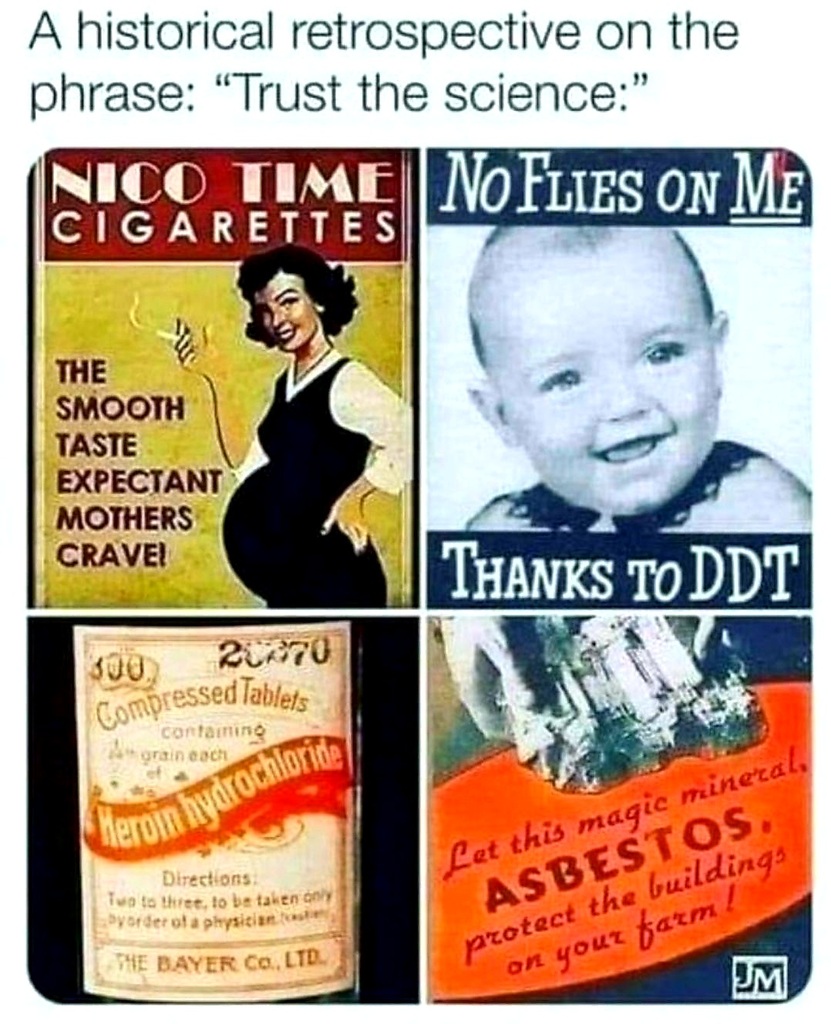
Trust the experts…


It is virtually a religious belief in the dominant liberal culture that people who do not want the COVID vaccine are stupid, ignorant, immoral and dangerous. As large sectors of the population continue to question or disobey their COVID decrees, they have begun to make more explicit this condescending view.
Liberals feel free to disparage them as “stupid” notwithstanding long-standing (though diminishing) racial disparities among this group. A CNN headline from last month told part of the story: “Black New Yorkers may have the lowest vaccination rates, but community groups refuse to give up.” Citing data from the city’s health agency, the network reported that “citywide, just 28% of Black New Yorkers between the ages of 18 and 44 are fully vaccinated. The Hispanic community is the second-least fully vaccinated population in that age group, with 49% being fully vaccinated.”
Two weeks ago, Bloomberg reported that while some of the unvaccinated are unable to get the vaccine (due to work pressures or health conditions), most of them are vaccine-hesitant by choice and continue to reflect racial disparities. Under the headline “U.S. Racial Vaccine Gaps Are Bigger Than We Thought: Covid-19 Tracker,” the news outlet reported: “the White vaccination rate is not as bad as it had seemed and Hispanic communities are lagging more than previously thought.”
Yet liberal elites continue to call anyone who is unvaccinated “stupid,” ignorant and immoral. On Sunday, New York’s Democratic Governor Kathy Hochul, when announcing her intent to use National Guard soldiers to replace health care workers fired for refusing the vaccine, told her audience: “yes, I know you’re vaccinated, you’re the smart ones.” She then said those who refuse to get the vaccine are not just stupid but have turned their back on God: “there’s people out there who aren’t listening to God and what God wants.” Gov. Hochul added that the vaccine “is from God to us and we must say, thank you, God,” and said to her “smart” vaccinated supporters: “I need you to be my apostles.”
Scientists at the Wuhan Institute of Virology (WIV), including British zoologist Peter Daszak of EcoHealth Alliance, were reportedly planning to release “enhanced airborne coronaviruses into Chinese bat populations” to inoculate them in the months before the pandemic. The scientists also sought funding from the U.S. to “create chimeric viruses,” which are “genetically enhanced to infect humans more easily.”
The Telegraph reported that the plans from the Chinese scientists were revealed in leaked grant proposals dating back to 2018, which a former U.S. official confirmed as being authentic, the outlet claimed.
“New documents show that just 18 months before the first Covid-19 cases appeared, researchers had submitted plans to release skin-penetrating nanoparticles containing ‘novel chimeric spike proteins’ of bat coronaviruses into cave bats in Yunnan, China,” The Telegraph reported. “Papers, confirmed as genuine by a former member of the Trump administration, show they were hoping to introduce ‘human-specific cleavage sites’ to bat coronaviruses which would make it easier for the virus to enter human cells.”
Researchers have developed a hologram that allows you to reach out and “feel” it — not unlike the holodecks of “Star Trek.”
University of Glasgow scientists have created hologram system that uses jets of air known as “aerohaptics” to replicate the sensation of touch, according to Ravinder Daahiya, a researcher who worked on the project. He said that the air jets can allow you to feel “people’s fingers, hands and wrists.” The team published a paper of their findings in Advanced Intelligent Systems.
“In time, this could be developed to allow you to meet a virtual avatar of a colleague on the other side of the world and really feel their handshake,” he said in his piece for The Conversation. “It could even be the first steps towards building something like a holodeck.”
Vaccinations can be a controversial subject for many people, especially when it comes to injections. So what if you could replace your next shot with a salad instead? Researchers at the University of California-Riverside are working on a way to grow edible plants that carry the same medication as an mRNA vaccine.
The COVID-19 vaccine is one of the many inoculations which use messenger RNA (mRNA) technology to defeat viruses. They work by teaching cells from the immune system to recognize and attack a certain infectious disease. Unfortunately, mRNA vaccines have to stay in cold storage until use or they lose stability. The UC-Riverside team says if they’re successful, the public could eat plant-based mRNA vaccines — which could also survive at room temperature.
Thanks to a $500,000 grant from the National Science Foundation, researchers are now looking to accomplish three goals. First, the team will try to successfully deliver DNA containing mRNA vaccines into plant cells, where they can replicate. Next, the study authors want to show that plants can actually produce enough mRNA to replace a traditional injection. Finally, the team will need to determine the right dosage people will need to eat to properly replace vaccinations.
Boasting a whopping $15 million in funding, a newly formed bioscience company hopes to bring the woolly mammoth back from extinction. Dubbed ‘Colossal,’ the organization is reportedly spearheaded by technology entrepreneur Ben Lamm and Harvard geneticist George Church. The first stage of the ambitious project will be centered around producing a hybrid creature, of sorts, comprised of Asian elephant DNA that has been infused with woolly mammoth genes that are responsible for the animal’s iconic hairy coat and bodily characteristics that allow it to withstand freezing temperatures. Ultimately, Church explained, “our goal is to make a cold-resistant elephant, but it is going to look and behave like a mammoth.”
The purpose of this endeavor goes beyond merely bringing a mammoth-like creature into our modern world to demonstrate the awesome power of science as the company foresees the hypothetical animal as a way of both helping to stave off the extinction of Asian elephants, which are a threatened species, and also preserve the climate of the Arctic tundra. Their reasoning for the latter goal is that if that region of the world were once again populated by the massive pachyderms, the animals would naturally knock down trees and cause grasslands to emerge while also compacting the permafrost beneath them.


Engineers and contractors are building a massive, multi-room clock inside a mountain in West Texas—a clock that will tell time for the next 10,000 years. And despite an informal website with a whiff of Blogspot template, this is a Jeff Bezos project.
There are a lot of surprises in the story of the Clock of the Long Now. It’s the brainchild of Danny Hillis, a computer scientist and entrepreneur who first imagined the 10,000-year clock in 1986. Now, he’s a visiting professor at MIT Media Lab with a reputation for building supercomputers, autonomous dinosaur robots, and Disney theme park rides. He’s exactly the kind of guy who decides he wants to build a huge eon clock in a mountain.
How does the clock work? Well, the longness of the time involved is the big engineering challenge. The clock is designed to tick just once a year and chime once per millennium. Experts are blasting rooms out of the interior of the mountain in order to install steampunky piles of gears and flywheels. According to Bezos, the Amazon founder and richest man on the planet, the clock will be 500 feet tall, “all mechanical, powered by day/night thermal cycles,” and “synchronized at solar noon.”
You must be logged in to post a comment.