The Army Tried To Turn Nerf Footballs Into Hand Grenades

Few things are as quintessentially American as football and most people in this country have probably played it in some form at least once in their life. This was what the U.S. Army was banking on when it developed an anti-tank grenade using an explosive charge jammed into a hollowed-out Nerf football in the early 1970s.

The Army’s Land Warfare Laboratory (LWL) at Aberdeen Proving Ground in Maryland concocted the “football device,” something I wrote about briefly years ago now, as part of a broader effort to develop a hand-thrown anti-tank weapon of some kind that began in July 1973. The Army had originally established LWL in 1962 to develop, test, and evaluate any and all weapons or other technology that might be applicable to counter-insurgency campaigns, a type of warfare that was emerging around the world at the time. This included in various countries in Southeast Asia, such as South Vietnam and Thailand, where the United States was already becoming increasingly embroiled at that time. 

In 1970, LWL was renamed the Land Warfare Laboratory, a switch that kept its acronym intact, and it began exploring systems that be might useful to a broader set of conflict types. One of these efforts was the anti-tank grenade project, a requirement driven by concerns about the utility of existing infantry anti-armor capabilities, especially in an urban environment, such as the ones the U.S. military expected to be a primary setting for any major conflict against the Soviets in Europe.

“Current standard US Army antitank weapons have been designed to provide maximum practical stand-off range,” a 1974 final test report on the football grenade, as well as the other types LWL evaluated, explained. The primary infantry anti-tank weapons in Army service at the time were the BGM-71 TOW and FGM-77 Dragon anti-tank guided missiles and variants of the M72 Light Anti-Tank Weapon (LAW), a shoulder-fired rocket launcher.

Keep reading

As Millions Face Eviction and Starvation, Pentagon to Spend Nearly $2 Billion a Day on War

According to an analysis from Feeding America, food insecurity will hit 52 million people due to COVID-19 in the United States, which is an increase of 17 million people from pre-pandemic times. Supply line disruptions, lower levels of donations, and millions of unemployed people who’ve lost their jobs due to government-imposed lockdowns have created a massive strain on America’s food supply and more and more family’s are being pushed into a situation of food insecurity.

It’s not just the brink of starvation that millions of Americans face either. Thanks to government-mandated lockdowns, a record number of Americans are unable to find jobs as businesses are forced to close or have gone out of business permanently. This is creating a situation in which families are unable to pay their rent — leading to the potential for mass evictions.

In March the CARES Act imposed a federal moratorium on evictions, which mandated that it was illegal to evict tenants who participate in federal housing assistance programs or who live in properties with a federally backed mortgage loan due to the nonpayment of rent. When the CARES Act moratorium expired on July 24, a host of state and local governments passed their own eviction prevention measures—but these actions varied significantly across the country and left many renters vulnerable to eviction once again.

Then, on September 4, the Centers for Disease Control and Prevention issued another moratorium on evictions through December 31, 2020. While this will certainly help those who rent — temporarily — all the moratorium did was pass the burden onto the landlord who may no longer be able to pay the mortgage on the property without the incoming rent.

And no, contrary to what many believe, most landlords are not mega rich property owners and live modest lifestyles.

Keep reading

Biden’s Pentagon Transition Team Members Funded by the Arms Industry

On Tuesday, Joe Biden released a list of transition teams for the various departments in his future White House. The Pentagon transition team for Biden consists of 23 people, many of whom hail from hawkish think tanks.

The team is led by Kathleen Hicks, who worked in the Pentagon under the Obama administration. Hicks most recent employer is the Cen­ter for Strate­gic and Inter­na­tion­al Stud­ies (CSIS), a think tank that receives contributions from arms makers like Northrop Grumman, Boeing, Lockheed Martin, and Raytheon, to name a few.

CSIS also receives contributions from governments. The think tank’s top government donors are the US, the UAE, Taiwan, and Japan. Two other CSIS employees are on the transition team; Andrew Hunter and Melissa Dalton, who both worked in the Pentagon under the Obama administration.

CSIS employees author policy papers and Op-Eds that generally call for more US involvement around the world. In August, Hicks co-authored an Op-Ed in The Hill titled, “Pentagon Action to Withdraw from Germany Benefits Our Adversaries,” a piece that slammed Trump’s plan to draw down troops from Germany, which Biden could to call off.

Two members of the transition team come from the Center for a New American Security (CNAS), Susanna Blume, a former Pentagon employee, and Ely Ratner, who served as deputy national security advisor to then-vice president Joe Biden from 2015 to 2017.

CNAS is another think tank that enjoys hefty donations from weapons makers, major corporations, and governments. From 2019 to 2020, CNAS received at least $500,000 from the US State Department and at least $500,000 from Northrop Grumman. Other donors include Google, Facebook, Raytheon, and Lockheed Martin.

Three more team members list their latest employer as the RAND Corporation, Stacie Pettyjohn, a wargaming expert, Christine Wormuth, who held a few roles in the Obama administration, and Terri Tanielian, a behavioral scientist.

RAND is another hawkish think tank that receives the bulk of its funding from the US government, including the US Army, Air Force, and Department of Homeland Security. RAND is also funded by the UAE, Qatar, and NATO.

A report from In These Times found at least eight out of the 23 team members come from organizations that receive funding from US weapons makers (not including RAND). Besides the CSIS and CNAS employees listed above, In These Times includes Sharon Burke, who works for New America, Shawn Skel­ly, from CACI International, and Vic­tor Gar­cia, from Rebellion Defense.

Keep reading

The Space Force Has Created an “Orbital Warfare” Unit, and Now Has Its Own Spaceship

It’s not specifically a TIE fighter or X-Wing from the “Star Wars” series, but The Drive reported last week that Trump’s recently created Space Force is now in charge of the experimental X-37B spacecraft. A craft that was prior in the ownership of the Air Force, which should turn many heads.

The unit is also precariously known as Delta 9, according to the service. Military.com reports:

Space Operations Command was activated last month during a ceremony at Peterson Air Force Base, Colorado. Under the field commands are deltas and squadrons, according to the Space Force’s command hierarchy.

Delta 9’s Detachment 1 “oversees operations of the X-37B Orbital Test Vehicle, an experimental program designed to demonstrate technologies for a reliable, reusable, unmanned space test platform for the U.S. Space Force,” according to the unit’s fact sheet.

Delta 9 consists of three active-duty squadrons headquartered at Schriever Air Force Base, Colorado: 1st Space Operations Squadron, 3rd Space Operations Squadron and 750th Operations Support Squadron, along with Detachment 1. The three squadrons conduct “protect-and-defend operations from space and provide response options to deter and defeat adversary threats in space,” according to the chart.

Keep reading

Area 51 Has A Huge New Hangar Facility That Points To A Drone Swarm Future

The Air Force’s clandestine flight test center deep inside the Nevada Test and Training Range, known as Area 51 or Groom Lake, among more colorful nicknames, continues to grow as it approaches its seventh decade of operations. Constant construction has grown the remote facility dramatically since the turn of the millennium, including the addition of a massive and still mysterious hangar built at the base’s remote southern end. Now, an even larger extension to an existing hangar facility that is quite peculiar in nature points to the very real possibility that the age of large swarms of unmanned combat air vehicles (UCAVs) has finally arrived.

Keep reading

With Operation Popeye, the U.S. government made weather an instrument of war

It was a seasonably chilly afternoon in 1974 when Senators Claiborne Pell, a Democrat from Rhode Island, and Clifford Case, a Republican from New Jersey, strode into the chambers of the Senate Committee on Foreign Relations for a classified briefing. While the meeting was labeled “top secret,” the topic at hand was rather mundane: They were there to discuss the weather.

More specifically, Pell, the chairman of the now-defunct subcommittee for Oceans and International Environment, and his colleague were about to learn the true extent of a secret five-year-old cloud seeding operation meant to lengthen the monsoon season in Vietnam, destabilize the enemy, and allow the United States to win the war.

Though it cycled through several names in its history, “Operation Popeye” stuck. Its stated objective—to ensure Americans won the Vietnam War—was never realized, but the revelation that the U.S. government played God with weather-altering warfare changed history. The Nixon administration distracted, denied, and, it seems, outright lied to Congress, but enterprising reporters published damning stories about rain being used as a weapon, and the Pentagon papers dripped classified details like artificial rain. Eventually, the federal government would declassify its Popeye documents and international laws aimed at preventing similar projects would be on the books.

But the public would, more or less, forget it ever happened. Given the rise of geo-engineering projects, both from municipal governments and private companies, some experts believe Popeye is newly relevant.

Keep reading

Raytheon CEO: The Idea That Biden Would Cut Defense Spending is ‘Ridiculous’

Raytheon CEO Gregory Hayes told CNBC on Tuesday that the idea that Joe Biden would cut military spending if he is elected president is “ridiculous.” Hayes was responding to warnings from Republicans about possible cuts to the Pentagon under a Biden administration.

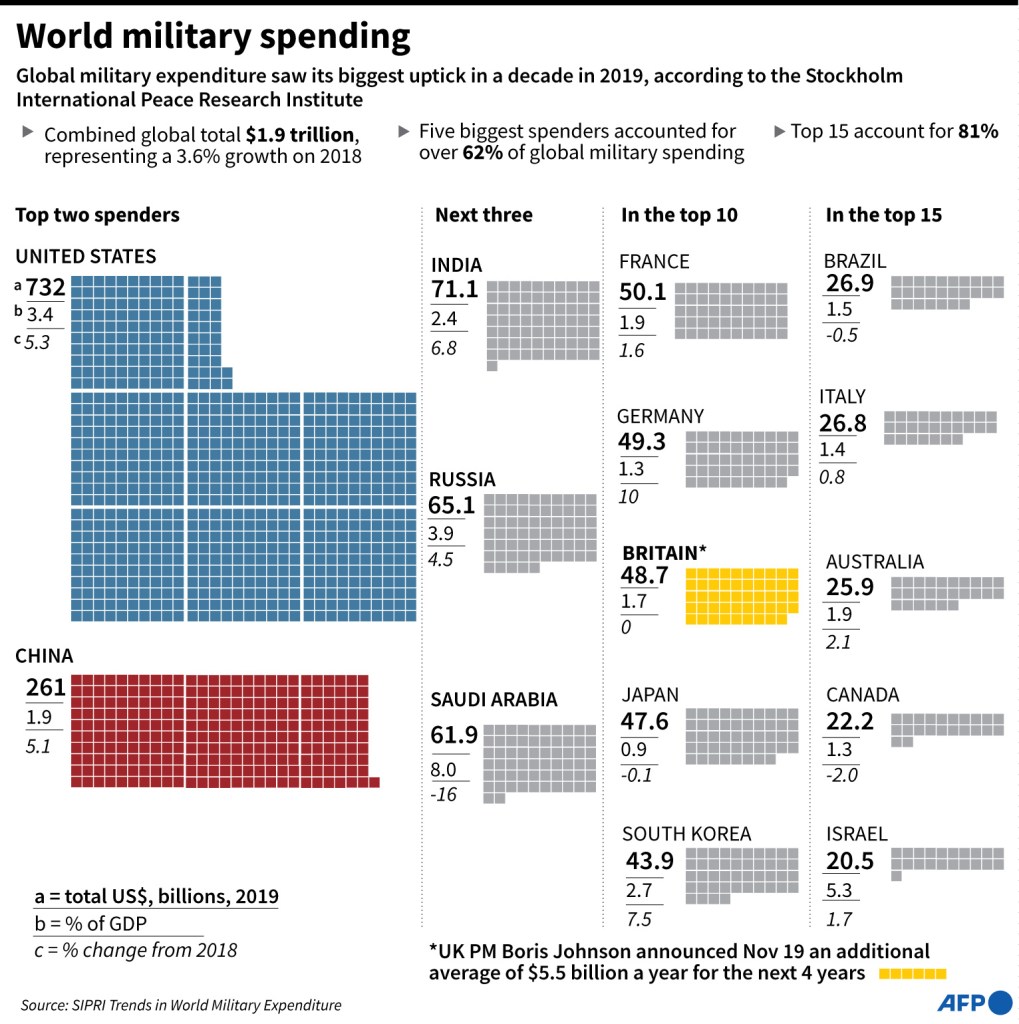
President Trump has presided over a significant increase in the Pentagon budget, bringing it from $700 billion in 2018 to $733 billion in 2020. Despite this record budget, Biden said in an interview with Stars and Stripes that he expects the budget to increase in certain areas.

The Raytheon CEO went on to warn of threats posed to the US by China and Russia that the military needs to compete with. “We have lost our technological edge to the Chinese, and in some cases to the Russians, and we’re going to have to invest more dollars into some of these new technologies if we’re going to be able to compete with these new threats,” Hayes said.

Keep reading