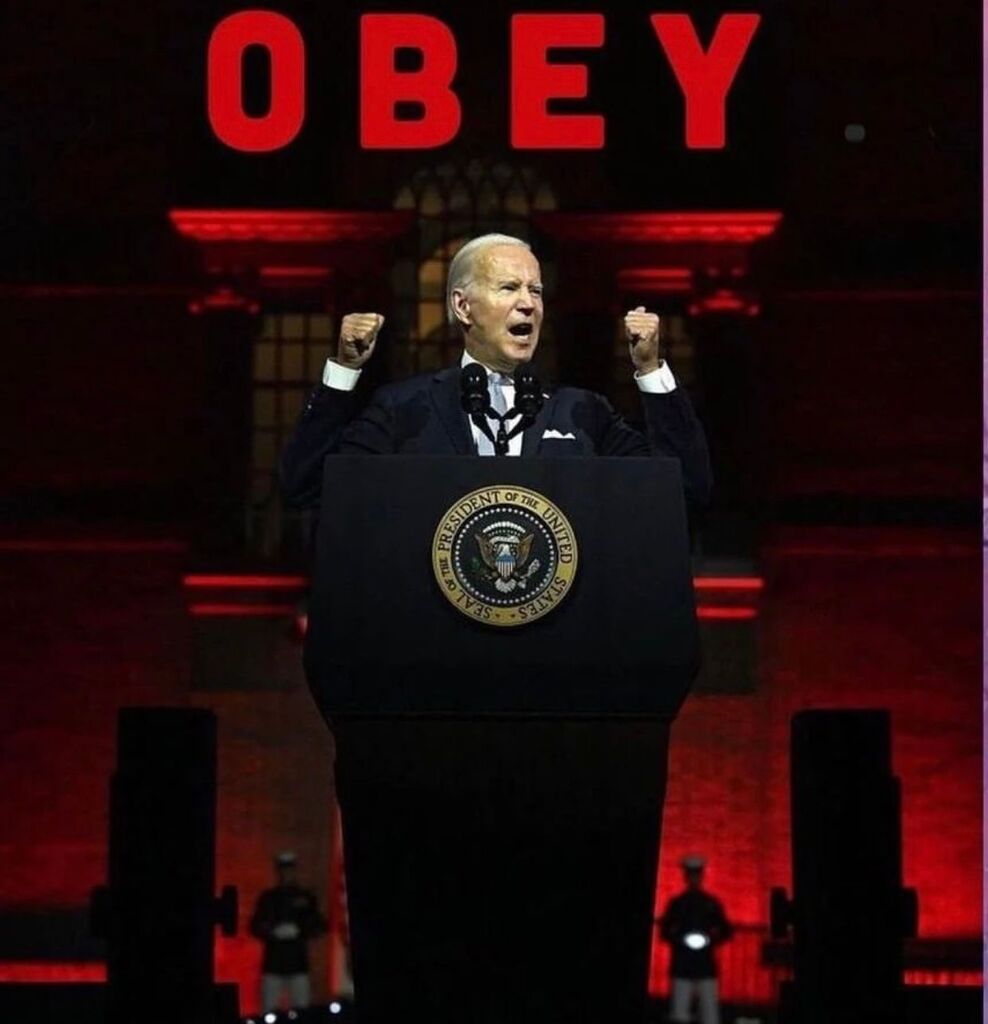
Here’s How Biden’s Radical Rewrite Of Key Civil Rights Law Will Fundamentally Change America

President Joe Biden’s Department of Education (DOE) is expected to roll out new Title IX rules that will expand the definition of sex to include gender identity, which experts say will have legal and cultural implications for all aspects of American education.

The Office of Civil Rights (OCR) is planning to take an unprecedented step to expand the definition of sex to include gender identity under Title IX of the 1972 Education Amendments, a key civil righs law which ensures no person is discriminated against under any federal education program or activity “on the basis of sex.”

The rule change will require every sex-separated space, program, building, bathroom and locker room to accommodate individuals “who may feel as though they are women, even though biologically, they are men,” Sarah Perry, a senior legal fellow for The Heritage Foundation, told The Daily Caller News Foundation.

“What we saw with Lia Thomas at the NCAA Championships will now be happening at schools and colleges across the country if they receive so much as $1 of federal funding from the Department of Education,” Perry said.

Keep reading

Twitter Allows White House to Make ‘Clearly False’ Claim That COVID Vaccine Wasn’t Available Until Biden Era

Twitter’s policy has been banishment of accounts posting COVID-19 misinformation, so will the official White House account suffer that punishment?

“When President Biden took office, millions were unemployed and there was no vaccine available,” says a Thursday afternoon post to the verified White House account. It segued from there to talk about unemployment numbers.

The bold lie that there was no vaccine available is even more astonishing when considering President Joe Biden was fully vaccinated before his Inauguration Day ceremony.

Mainstream media documented the availability of COVID-19 vaccines beginning with Pfizer’s announcement of an effective coronavirus vaccine six days after the election. A December 10, 2020, report by The Washington Post credited former President Donald Trump with proving naysayers wrong by making good on his promise to have a vaccine ready within months.

Keep reading

Biden Wanted $33B More For Ukraine. Congress Quickly Hiked To $40B. Who Benefits?

From the start of the Russian invasion of Ukraine on February 24, the Biden White House has repeatedly announced large and seemingly random amounts of money that it intends to send to fuel the war in Ukraine. The latest such dispatch, pursuant to an initial $3.5 billion fund authorized by Congress early on, was announced on Friday; “Biden says U.S. will send $1.3 billion in additional military and economic support to Ukraine,” read the CNBC headline.

This was preceded by a series of new lavish spending packages for the war, unveiled every two to three weeks, starting on the third day of the war:

  • Feb. 26: “Biden approves $350 million in military aid for Ukraine”: Reuters;
  • Mar. 16: “Biden announces $800 million in military aid for Ukraine”: The New York Times;
  • Mar. 30: “Ukraine to receive additional $500 million in aid from U.S., Biden announces”: NBC News;
  • Apr. 12: “U.S. to announce $750 million more in weapons for Ukraine, officials say”: Reuters;
  • May 6: “Biden announces new $150 million weapons package for Ukraine”: Reuters.

Those amounts by themselves are in excess of $3 billion; by the end of April, the total U.S. expenditure on the war in Ukraine was close to $14 billion, drawn from the additional $13.5 billion Congress authorized in mid-March. While some of that is earmarked for economic and humanitarian assistance for Ukraine, most of it will go into the coffers of the weapons industry — including Raytheon, on whose Board of Directors the current Secretary of Defense, Lloyd Austin, sat immediately before being chosen by Biden to run the Pentagon. As CNN put it: “about $6.5 billion, roughly half of the aid package, will go to the US Department of Defense so it can deploy troops to the region and send defense equipment to Ukraine.”

As enormous as those sums already are, they were dwarfed by the Biden administration’s announcement on April 28 that it “is asking Congress for $33 billion in funding to respond to the Russian invasion of Ukraine, more than double the $14 billion in support authorized so far.” The White House itself acknowledges that the vast majority of that new spending package will go to the purchase of weaponry and other military assets: “$20.4 billion in additional security and military assistance for Ukraine and for U.S. efforts to strengthen European security in cooperation with our NATO allies and other partners in the region.”

It is difficult to put into context how enormous these expenditures are — particularly since the war is only ten weeks old, and U.S. officials predict/hope that this war will last not months but years. That ensures that the ultimate amounts will be significantly higher still.

The amounts allocated thus far — the new Biden request of $33 billion combined with the $14 billion already spent — already exceed the average annual amount the U.S. spent for its own war in Afghanistan ($46 billion). In the twenty-year U.S. war in Afghanistan which ended just eight months ago, there was at least some pretense of a self-defense rationale given the claim that the Taliban had harbored Osama bin Laden and Al Qaeda at the time of the 9/11 attack. Now the U.S. will spend more than that annual average after just ten weeks of a war in Ukraine that nobody claims has any remote connection to American self-defense.

Even more amazingly, the total amount spent by the U.S. on the Russia/Ukraine war in less than three months is close to Russia’s total military budget for the entire year ($65.9 billion). While Washington depicts Russia as some sort of grave and existential menace to the U.S., the reality is that the U.S. spends more than ten times on its military what Russia spends on its military each year; indeed, the U.S. spends three times more than the second-highest military spender, China, and more than the next twelve countries combined.

Keep reading

Biden made it harder for student-loan borrowers to get rid of debt when they go bankrupt

In 1976, Congress amended the Higher Education Act to make federal student loans nondischargeable through bankruptcy unless the borrower meets the undue hardship standard. The standard requires them to prove that they cannot maintain a minimal standard of living, their circumstances will likely not improve, and they have made a good-faith effort in repaying their debt.

Nearly three decades later, Joe Biden — then a senator serving Delaware — had a large role in making it that standard stricter. In 2005, Congress passed the Bankruptcy Abuse Prevention and Consumer Protection Act, and its implications for student-loan borrowers were dire. As signed into law under former President George W. Bush, the bill expanded the undue hardship requirement to borrowers with private student loans, expanding the scope of borrowers who would have to prove their impossible predicament in court. 

During his 2020 presidential campaign, Biden defended his vote for the bill, saying in a Democratic primary debate that he “improved it.”

“I had a choice, it was going to pass — Republican president, Republican Congress, and I offered two amendments to make sure that people under $50,000 would not be affected and women and children would go to the front of the line on alimony and support payments,” Biden said in March 2020. “I did not like the rest of the bill, but I improved it, number one.”

Sen. Bernie Sanders of Vermont, one of Biden’s 2020 rivals who pushed for expansive student debt cancellation, blasted the 2005 bankruptcy law, along with Biden’s support of it.

“That bankruptcy bill made it impossible or very difficult for people to escape from that student debt,” Sanders said during the primary debate. “It was a very, very bad bill.”

Keep reading

Two-Thirds of Americans Now Live Paycheck to Paycheck Due to Inflation

The U.S. economy is strained to the point of breaking Americans’ budgets, and this week’s releases of consumer and producer inflation data showed that the pain being felt by American families and U.S. companies isn’t going to ease up soon. 

As a result of steadily rising inflation that kicked off just after President Biden took office and has so far reached and stayed in 40-year high territory — including repeated all-time records set for fuel prices — Americans’ budgets are being stretched to the breaking point and then some. 

That’s because, even as wage growth is trending higher — around five percent over last year — the eight-plus percent consumer inflation means Americans’ real wages are actually three percent lower than twelve months ago.

Keep reading

Amid Nationwide Shortage, Illegal Immigrants Get Baby Formula First, Lawmaker Claims

Amid a nationwide shortage of baby formula, a Republican lawmaker is claiming that illegal immigrants detained by the border patrol are being given priority over Americans.

Republican Rep. Kat Cammack (FL) posted videos on social media as she claimed the Biden administration is shipping “pallets” of baby formula to border facilities.

“They are sending pallets, pallets of baby formula to the border,” Cammack said in online postings on Wednesday. “Meanwhile, in our own district at home, we cannot find baby formula,” she added, displaying a photo that showed empty store shelves.

Cammack said a border agent has been sending her photos of the deliveries of baby formula. “They’re receiving pallets and more pallets of baby formula at the border,” she said. “This was taken at Ursula processing facility [in McAllen, Texas] where thousands are being housed and processed and then released,” she said.

Keep reading