Democrats’ All-Electric USPS Fleet Sees Each Truck Come With A $6.8 Million Price-Tag

According to a recently published New York Post report, the Biden administration played a major role in the push to massively electrify the United States Postal Service mail truck fleet. From a USPS press release in 2022:

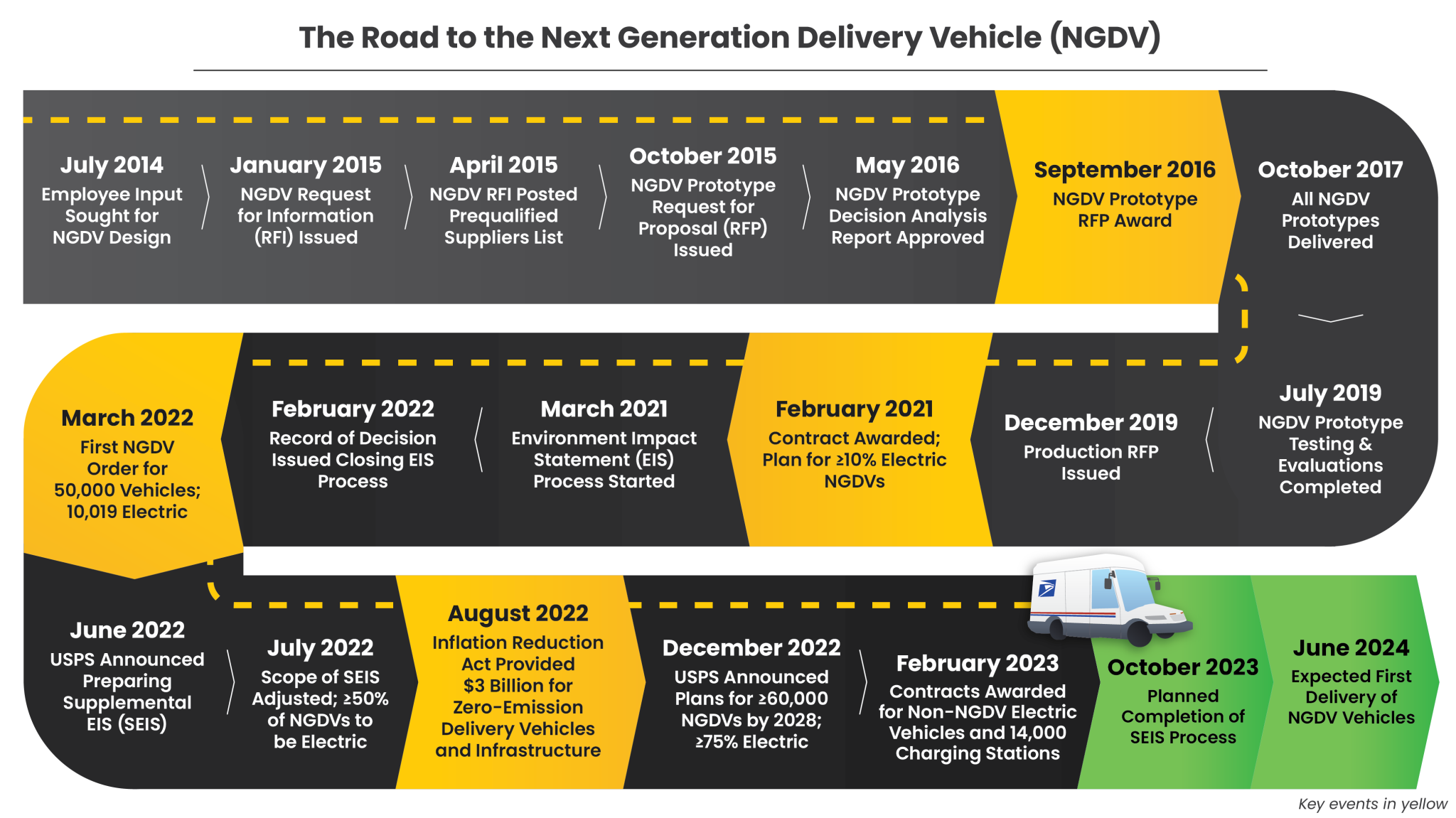
The United States Postal Service today announced that it expects to acquire at least 66,000 battery electric delivery vehicles as part of its 106,000 vehicle acquisition plan for deliveries between now and 2028. The vehicles purchased as part of this anticipated plan will begin to replace the Postal Service’s aging delivery fleet of over 220,000 vehicles.

The Postal Service anticipates at least 60,000 Next Generation Delivery Vehicles (NGDV), of which at least 75% (45,000) will be battery electric.

But, like Buttigieg’s E.V. charging stations, which cost about a billion dollars each, or Kamala Harris’s $42 billion rural internet “flop” that connected a whopping zero rural Americans to the web, or her one-billion-dollar solar panel plan for Puerto Rico which resulted in “only a few” installations), Biden’s “green” USPS plan has been an absolute cluster.

From the Post item:

A Biden administration plan to create a ‘green’ fleet of postal vehicles has churned out a mere 250 electric mail trucks in just over two years — after shelling out taxpayer funds meant to build thousands…

The nearly $10 billion project — which called for more than 35,000 battery-powered US Postal Service (USPS) vehicles to be completed by September 2028 — was funded in part by $3 billion in funding from former President Joe Biden’s 2022 Inflation Reduction Act.

(I suspect the Post item has a typo, because as you see above, the number from the USPS is 45,000, not 35,000.)

So far, the disbursed IRA funds are around $1.7 billion, which means that if Congress is able to claw back the $1.3 billion still allocated for the project, each of these 250 trucks have cost U.S. taxpayers a minimum of $6.8 million a piece—the whole plan was a $10 billion “investment,” so who knows how much else was spent from other sources. Now, “investments” are supposed to give the investors a return on their money, haven’t these financial whizzes heard?

Keep reading

Driving an Electric Car Is like Environmentalism

In Sweden there exists an electrified road for Electric Vehicles (EVs) to charge while driving, see Endnote [i].  The 2 km stretch of road is the world’s first of its kind, and an expansion of a further 3,000 km of electric road by 2045 is planned. It all sounds rather cool and futuristic, and I am reminded of a song lyric from the 1980s, the singer Eddie Grant sang “we’re gonna rock onto Electric Avenue”.

However, let us consider whether these expensive EVs are actually environmentally friendly or are yet mega-corporate marketing scam? This article demonstrates that the latter is the case.

The reality is that the misled environmentalists buying these cars are suckers for mega-corporate advertising, seemingly proud of their so-called low-carbon eco-cars. Apparently, unaware that the manufacture of millions of electric car batteries, requires huge mining operations to acquire and refine large quantities of rare earth metals, such as lithium, rhodium and cobalt; that these metals have to be mined out of the ground using machinery which is powered by carbon-emitting vehicles powered by diesel or petrol; and importantly, that the mining and refining processes can cause significant and extensive pollution to land, air and water systems, for example in rural China and Mongolia, see Endnote [i]. Unlike the fake climate agenda, these are real environmental problems.

Further to my recent article 1900 Scientists Say ‘Climate Change Not Caused By CO2’ – The Real Environment Movement Was Hijacked, and my book Climate CO2 Hoax, a ‘devastator’ can been described as a lie so big it devastates and bewilders. “Buy an electric car to save the planet” is one such devastating lie.

Below is a picture of a lithium leach field. This is what your EV batteries are made of. It is so neuro-toxic that a bird landing on this stuff dies in minutes. Take a guess what it does to your nervous system? Pat yourself on the back for saving the environment.

Keep reading

B.C. government realizes EV mandates not achievable: leaked slideshow

The Energy Futures Institute released a copy of a government slideshow presentation on Tuesday (June 24) that reveals the B.C. government is considering easing electric vehicle mandates due to slumping sales.

“It’s been obvious for a long time that B.C.’s electric vehicle targets were unattainable,” said Barry Penner, Energy Futures Institute chair and former B.C. Liberal environment minister, in a news release. 

B.C. passed the Zero Emission Vehicles Act in 2019, becoming the first jurisdiction in the world to mandate 100 per cent electric vehicle sales by a specific target date. The target is only for vehicles under a certain weight category. By 2026, 26 per cent of vehicle sales must be for electric models. By 2030, this must be 90 per cent and by 2035, 100 per cent.

Automakers selling cars in B.C. are required to demonstrate they are meeting the targets.

The slideshow, dated June 18 and presented by Nat Gosman, an assistant deputy minister from the Energy and Climate Solutions ministry, acknowledges that electric vehicle sales in B.C. have “levelled off” and reaching the mandated targets at this point will be “challenging.”

According to the presentation, sales were at 15.3 per cent in April after averaging 18.5 per cent in the first three months of 2025 and 22.4 per cent in 2024.

Keep reading

Biden Judge Blocks Trump From Withholding EV Charger Funds After Joe Biden Spent $7.5 Billion to Install 8 EV Chargers

A federal judge on Tuesday blocked the Trump Administration from withholding funds for electric vehicle chargers.

In 2021, the Democrat-controlled Congress gave Joe Biden $7.5 billion to install electric vehicle chargers all over the country and only 7 or 8 EV charging stations have been built. It’s a total scam.

According to 2021 analysis from the New York Times, $1.2 trillion of the ‘Infrastructure’ bill would be spent over 8 years and $550 billion will go to roads, bridges, rail lines, electric vehicles, water systems and other programs.

Electric vehicles are unpopular, expensive and bad for the environment but the Biden Regime is going into overdrive to force car companies to produce more EVs while they crack down on gas-powered vehicle tailpipe emissions.

President Trump vowed to immediately dismantle Joe Biden’s insane electric vehicle mandate.

Earlier this year the US Transportation Department suspended Biden’s EV charging station scam.

On Tuesday, Seattle-based US District Judge Tana Lin, a Biden appointee, temporarily blocked Trump from withholding EV charger funds to 14 states.

Keep reading

Race to mine metals for EV batteries threatens marine paradise

Stark images, captured from a drone by environmental campaigners and shared with the BBC, appear to show how nickel mining has stripped forests and polluted waters in one of the most biodiverse marine habitats on Earth.

The Raja Ampat archipelago – a group of small islands in Indonesia’s Southwest Papua Province – has been dubbed the “Amazon of the Seas”.

But mining for nickel – an ingredient in electric vehicle batteries and in stainless steel – has ramped up there in recent years, according to the organisation Global Witness.

In a move that was welcomed by campaigners, the Indonesian government this week revoked permits for four out of five mining companies operating in the region.

In a statement published online, Indonesia’s Ministry for the Environment said: “Raja Ampat’s biodiversity is a world heritage that must be protected.

“We pay great attention to mining activities that occur in the area.”

But photographs – taken by Global Witness as part of an investigation – appear to show environmental damage already done.

Aerial images show forest loss and sediment run-off into waters that are home to biodiverse coral reefs.

Global Witness told the BBC that land use for mining, across multiple small islands in the archipelago, increased by 500 hectares – equivalent to about 700 football pitches – between 2020 and 2024.

Keep reading

Another Nail in the EV Coffin

Matthew Lynn’s latest column in Telegraph has flagged up a WhatCar? survey that reveals EVs are the most likely to leave you stranded by the roadside. He summarises the survey’s main findings:

 Exclusive What Car? research shows that electric vehicles (EVs) suffer more breakdowns than diesel, hybrid or petrol models, and that EVs are the least likely to be fixed at the roadside.

What Car? asked 29,967 car owners about their breakdown experiences over the past two years as part of the most recent What Car? Reliability Survey, conducted in association with MotorEasy.

Overall, 11% of survey participants said their car had broken down in the past two years, but the breakdown rate for EV owners was 16.8%, the highest of all fuel types. In contrast, 10.7% of petrol-powered cars needed to be recovered, 14% of hybrids broke down and 15% of diesel vehicles.

Lynn is excoriating in his judgement of EVs:

They will save the planet, they are quieter, they will rebuild local industries, and they even come with attractive tax breaks. Rewind a couple of years, and there were plenty of reasons for buying a shiny new Tesla or Polestar electric vehicle instead of an old-fashioned, high-pollution, petrol or diesel car.

And yet, one by one, all those arguments have been punctured. They won’t help the environment as much as we think, they are mostly made in China, the tax breaks are gone, and now we learn that they are more likely to break down as well.

Along with higher insurance costs, EVs are rapidly being exposed as the expensive choice:

The faults on EV’s were less likely to be something that could be fixed on the side of the road by an emergency repair service, meaning that motorists were less likely to be able to complete their journey, and might have to pay for an expensive towing service as well.

And of course, if something does go wrong it will probably cost more to fix, with surveys suggesting that EVs cost 30% to 50% more to repair than petrol cars, while replacing the tyres if you get a puncture will be pricey as well, with each one, according to one survey, costing £77 more on average than traditional vehicles.

Keep reading

House version of Trump’s ‘One Big, Beautiful Bill’ creates federal tax on electric, hybrid vehicles

There’s a first-of-its-kind national vehicle registration tax tucked inside the final version of President Trump and the GOP’s “One Big Beautiful Bill Act.” The legislation has created a new federal vehicle tax for energy-efficient vehicles that rises each year based on inflation.

The annual national registration fee would begin at $250 for electric vehicles and $150 for hybrid vehicles. An earlier version of the bill included a $20 fee for all other vehicles, but it was dropped from the final version that passed the House on Thursday. The only Republicans to vote against the bill were Reps. Thomas Massie of Kentucky and Warren Davidson of Ohio. All House Democrats voted against it.

The Senate is now considering the legislation.

Under the House-passed bill, the administrator of the Federal Highway Administration would impose the fees each year. 

According to the text of the bill, a state motor vehicle department must “incorporate the collection of the fees” into the vehicle registration and renewal processes administered by each department “so long as such fees are imposed for each year in which the fees are required.”

Keep reading

The Tesla attacks are proof that the left is turning on itself in orgy of liberal cannibalism

Climate crusaders, those sanctimonious shepherds of the earth, are trading their pious protests for outright carnage as attacks against Tesla vehicles ripple across the country — an orgy of liberal cannibalism that’s as predictable as a vegan toting along his own tofu to a barbecue. 

But setting EVs on fire isn’t the only banner of hypocrisy unfurled lately by eco-warriors — whose extremist ideologies increasingly collide with the real world to reveal their ironic outcomes.

This month, officials in the Brazilian city of Belém paved over tens of thousands of acres of protected Amazon rainforest and wetland to build a four-lane, eight-mile-long highway necessary to accommodate the roughly 50,000 climate activists who will descend on the city in November for the UN’s COP30 climate summit. 

That’s not all the jet-setting eco zealots will require: The local airport is doubling its capacity, to 14 million passengers; the seaport is being redeveloped to accommodate cruise ships; a 5.3 million square foot sports and entertainment complex is under construction; and a row of hotels is going up along the new “sustainable highway,” as local authorities dub the project.

Across the world, the UK government is moving ahead on plans to bulldoze 4,000 acres of pristine countryside in Dereham and Swaffham to install a solar panel farm, one of several new solar farms under consideration in the gray, rainy little island nation.

Keep reading

Alberta to impose EV tax starting next Thursday

Starting February 13, Alberta’s electric car drivers will be subject to an EV tax. A $200 surcharge will be added to their tab when they renew their annual registration.

“Owners of electric vehicles use the same roads as other Albertan drivers,” said Alberta’s Minister of Service and Red Tape Reduction, Dale Nally. “It’s only fair they contribute to public services, including those that ensure the continued safety and upkeep of Alberta’s roads.”

The province says it addresses concerns on tax fairness, according to a prior government news release, with drivers of internal combustion engine vehicles paying similar fuel tax charges each year. 

Keep reading

Trump Suspends $5 Billion Electric Vehicle Charging Station Program

President Donald Trump’s administration halted the $5 billion Biden electric vehicle charging program, which has been criticized for its poor production of charging stations.

Emily Biondi, the associate administrator for the Office of Planning, Environment, and Realty, in a letter to the state Department of Transportation directors on Thursday, said the administration has suspended the National Electric Vehicle Infrastructure (NEVI) program.

“The new leadership of the Department of Transportation (U.S. DOT) has decided to review the policies underlying the implementation of the NEVI Formula Program. Accordingly, the current NEVI Formula Program Guidance dated June 11, 2024, and all prior versions of this guidance are rescinded,” Biondi wrote.

“As result of the rescission of the NEVI Formula Program Guidance, FHWA is also immediately suspending the approval of all State Electric Vehicle Infrastructure Deployment plans for all fiscal years. Therefore, effective immediately, no new obligations may occur under the NEVI Formula Program until the updated final NEVI Formula Program Guidance is issued and new State plans are submitted and approved,” the official continued.

Lawmakers included the $5 billion program in the $1.2 trillion so-called infrastructure bill, more formally known as the Infrastructure Investment and Jobs Act.

The program had aimed to create more than 6,000 charging stations and has served as an embarrassment for then-Transportation Secretary Pete Buttigieg.

In September 2023, Buttigieg admitted he had trouble finding an electric charging station while he was traveling on the road.

Keep reading