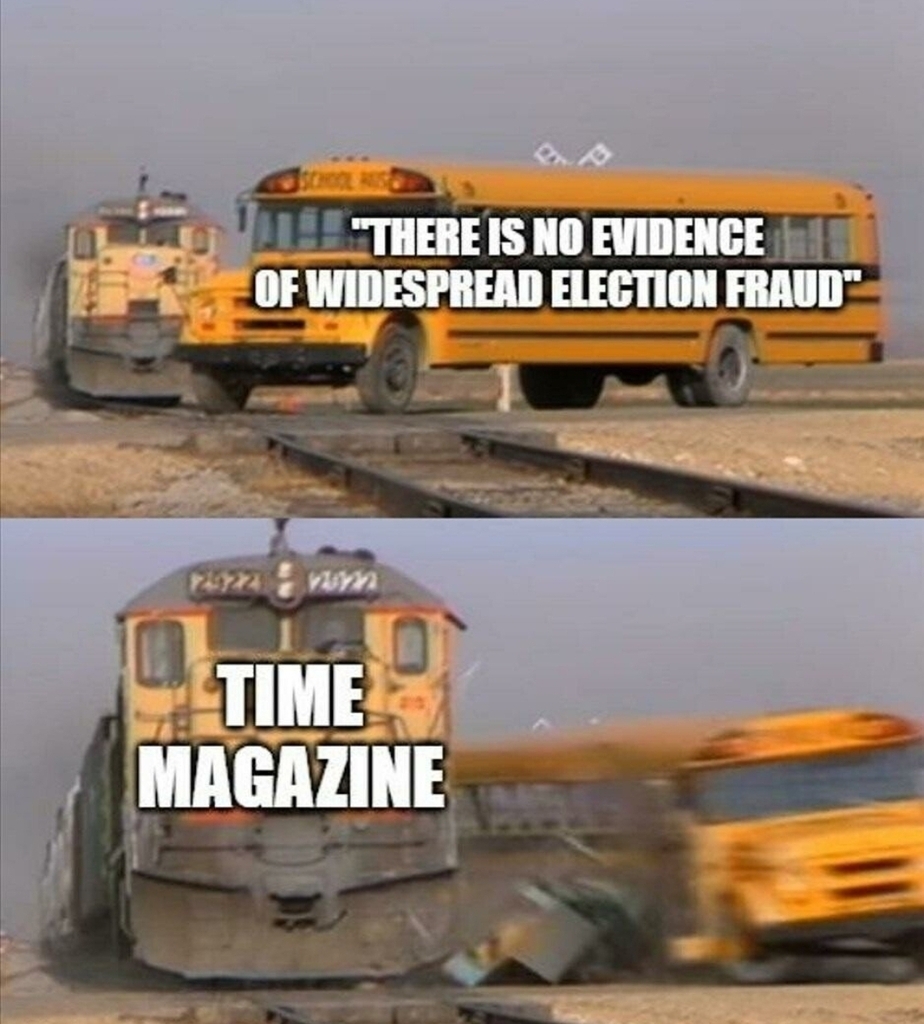
So smug they’re admitting it…

This seems like the sort of thing you don’t say out loud but, like a serial killer, many in politics are just too absorbed in their own egos to not try to take credit for their deeds.
TIME wrote a very interesting piece making some very alarming claims. Namely, that a secret cabal banded together across the country to stop Donald Trump from winning re-election. This included everything from manipulating media coverage to getting election laws changed, at least according to TIME’s account.
This is the inside story of the conspiracy to save the 2020 election, based on access to the group’s inner workings, never-before-seen documents and interviews with dozens of those involved from across the political spectrum. It is the story of an unprecedented, creative and determined campaign whose success also reveals how close the nation came to disaster. “Every attempt to interfere with the proper outcome of the election was defeated,” says Ian Bassin, co-founder of Protect Democracy, a nonpartisan rule-of-law advocacy group. “But it’s massively important for the country to understand that it didn’t happen accidentally. The system didn’t work magically. Democracy is not self-executing.”
That’s why the participants want the secret history of the 2020 election told, even though it sounds like a paranoid fever dream–a well-funded cabal of powerful people, ranging across industries and ideologies, working together behind the scenes to influence perceptions, change rules and laws, steer media coverage and control the flow of information. They were not rigging the election; they were fortifying it. And they believe the public needs to understand the system’s fragility in order to ensure that democracy in America endures.

The election fraud drum needs to be banged until every American is aware of the MASSIVE election fraud during the 2020 elections. The implications are profound for future elections, and indeed, for every future action by federal and state governments, for if elections can be stolen with impunity, then we are no longer living in a constitutional Republic subject to the will of the people. Rather, we are living in a government-corporate oligarchy, as aptly described in a wonderful commentary by Angelo Codevilla. And the only way to resurrect our Republic is to slay the election fraud dragon!
Toward that end, public consciousness about election fraud must be raised. I took a shot at laying it all out in this Redstate article that included links to dozens of sources documenting the fraud. A key contributor to that article was Mensa physicist John Droz, Jr., who led a team that conducted statistical analysis of ballots in several key swing states in order to determine where anomalies existed that warranted further detailed forensic analysis of ballots cast and counted. He has subsequently written his own summary about the legacy media’s disregard for – and mischaracterization of – election lawsuits. His commentary provides the remainder of focus for this article.
Louisiana Attorney General Jeff Landry and Secretary of State Kyle Ardoin Thursday morning announced their offices have arrested an Amite City Councilman on eight counts of election fraud.
Emanuel Zanders, III is accused of submitting voter registration applications that are known by the person to be materially false, fictitious, or fraudulent.
At a news conference in Baton Rouge, both Attorney General Landry and Secretary Ardoin expressed the importance of election integrity through free and fair elections. They stressed that every legal voter gets one legal vote and no more: one man, one vote.
“Anything other than a one-for-one vote distorts our election process,” said Attorney General Landry. “Those who wish to distort an election in this matter are breaking the law and betraying their fellow citizens. It is even more disheartening when the perpetrator is an elected official.”
The Senate is currently controlled by Republicans, 50-48. But if both Democrats win in Georgia, their party would control the chamber because likely incoming Vice President Kamala Harris would be the tiebreaker vote.
In the two races, Democrats Jon Ossoff and Raphael Warnock, a pastor, are facing off against incumbent Republican Sens. David Perdue and Kelly Loeffler.
“If you send Jon and the reverend to Washington, those $2,000 checks will go out the door,” Biden said Monday while campaigning in Atlanta on the eve of the election. “And if you send Senator Perdue and Loeffler back to Washington, those checks will never get there. It’s just that simple. The power is literally in your hands.”
John Lott, who was hired by the Justice Department in October as senior adviser for Research and Statistics at the Office of Justice Programs, has published a study concluding that as many as 368,000 “excess votes” tipped the election outcome to favor Joe Biden in two consequential battleground states.
“Increased fraud can take many forms: higher rates of filling out absentee ballots for people who hadn’t voted, dead people voting, ineligible people voting, or even payments to legally registered people for their votes,” reads the study’s summary. “The estimates here indicate that there were 70,000 to 79,000 ‘excess’ votes in Georgia and Pennsylvania.”
The best estimate shows an unusual 7.81% drop in Trump’s percentage of the absentee ballots for Fulton County alone of 11,350 votes, or over 80% of Biden’s vote lead in Georgia. The same approach is applied to Allegheny County in Pennsylvania for both absentee and provisional ballots. The estimated number of fraudulent votes from those two sources is about 55,270 votes.
The study aimed to quantify how large of a problem voter fraud and other election irregularities were in the 2020 election. “The process is applicable to other states where precinct-level data is available on voting by absentee and in-person voting,” explains the study’s introduction.
Lott concludes that the discrepancies in absentee voting are not likely to have been caused by a shift by Democrats to vote absentee because of the pandemic, as the study controlled for in-person voting.
“In layman’s terms, in precincts with alleged fraud, Trump’s proportion of absentee votes was depressed – even when such precincts had similar in-person Trump vote shares to their surrounding countries,” Lott explains. “The fact that the shift happens only in absentee ballots, and when a country line is crossed, is suspicious.”
“The precinct level estimates for Georgia and Pennsylvania indicate that vote fraud may account for Biden’s win in both states,” Lott concludes.
 Hellbound and Down
You must be logged in to post a comment.